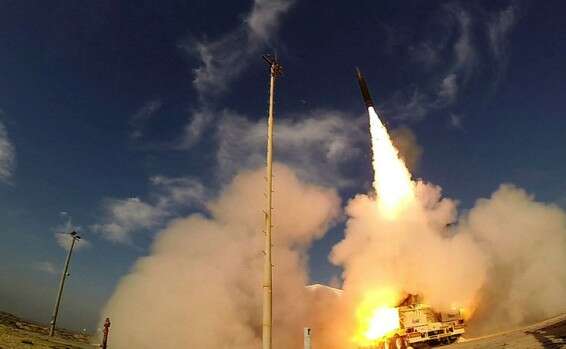
The Defense Ministry successfully tested the Arrow 3 long-range missile interceptor system on Monday.
The launch followed two shelved tests, one in December, canceled due to security concerns, and one in January, scrapped over a problem with the interceptor's ground control data systems.
Arrow 3 is designed to intercept ballistic missiles outside the atmosphere. It is part of Israel's multitiered air defense, which includes Iron Dome, designed to intercept and destroy short-range rockets and artillery shells; David's Sling, which counters medium- to long-range rockets and missiles; and the Arrow 2 short- and medium-range ballistic missile interceptor.
The test was carried out at 2:30 a.m. and included representatives from the Defense Ministry's Homa Directorate, which oversees the development of Israel's missile defenses, Israel Aerospace Industries, the Israeli Air Force and the U.S. Missile Defense Agency.
A Defense Ministry statement said that the interceptor was fired from an airbase in central Israel and "performed its mission successfully."
The launch "constitutes an important milestone in Israel's operational ability to defend itself against existing and future threats in the regional theater," the statement said.
"The test we conducted was very complex. We launched an interceptor that crossed the atmosphere and went deep into space. An analysis of its performance shows that the missile did what we wanted it to do," said Boaz Levy, executive vice president of Israel Aerospace Industries' Missiles and Space Group.
"Arrow 3 is designed to intercept [targets] outside the atmosphere. It was launched against a target simulating a future threat against Israel. The missile performed every task expected of it. We're very pleased with the results. If it was a real target it would have been intercepted," he said.
Homa Director Moshe Patel said the test will "allows us to hold interception tests in Alaska this year, which we cannot carry out here due to safety considerations. We have all the signs that the interceptor hit the target simulating a future missile and neutralized it. "
Levy noted that during the test, "the interceptor carried out a full operational scenario as if it was going after a real target. This allowed us to complete the goals set before we embark on a series of tests in Alaska, where we can hold a full interception test without the safety limitations we face here."
According to Levy, the U.S. Congress has allocated the necessary budget for the Arrow 3 system's tests overseas.