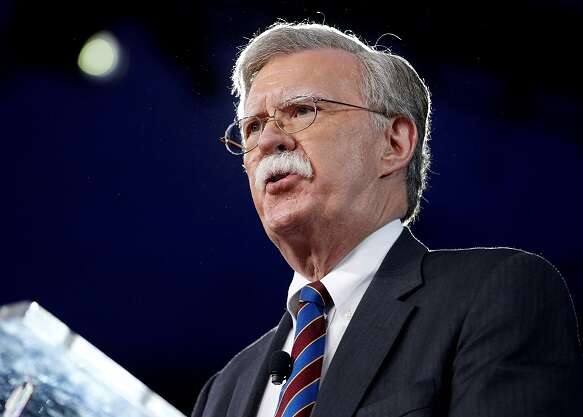
U.S. President Donald Trump's choice of former U.N. Ambassador John Bolton as his new national security adviser provoked strong reactions worldwide on Friday, with particularly strong criticism in the bitterly divided Middle East.
Some commentators saw it as another nail in the coffin of the Obama-era agreement between Iran and world powers to limit Tehran's nuclear ambitions, already cast into grave doubt by Trump himself.
Others expected Bolton to further undermine any remaining slender hopes of a two-state solution to the decades-long Israeli-Palestinian conflict emerging in the foreseeable future.
In recent months, Bolton has applauded Trump's plan to move the U.S. Embassy in Israel from its current location in Tel Aviv to Jerusalem, thereby officially recognizing Jerusalem as Israel's capital. The move, which upended decades of U.S. policy, angered many Palestinians who view parts of Jerusalem as the capital of a future Palestinian state.
Education Minister Naftali Bennett called Bolton "an extraordinary security expert, experienced diplomat and a stalwart friend of Israel."
But other voices in Israel were less enthusiastic. The Haaretz website quoted Bolton as saying in 2016 that the two-state solution had "been dead for a long time" and arguing for the Palestinian territories to be placed under Egyptian and Jordanian sovereignty.
In Lebanon, the Hezbollah-aligned newspaper Al Akhbar reported Bolton's appointment with the headline "Zionist Hawk in the White House," drawing attention to Bolton's historical calls for action against Iran.
"Bolton's appointment, combined with [Mike] Pompeo's nomination [for secretary of state] last week, significantly lowers the odds that Trump will stick to the nuclear deal beyond May," said Ellie Geranmayeh, senior policy fellow at the European Council of Foreign Relations.
"Both men have vocally opposed the nuclear deal, advocated for regime change in Iran and Bolton has repeatedly called for bombing rather than diplomacy as a fix to the nuclear issue."
The nuclear deal is expected to collapse if the U.S. pulls out.
Trump is surrounding himself with "like-minded advisers," Geranmayeh told Reuters, and "purging those who disagree."
But she said Bolton's position on the Iran nuclear agreement would meet strong resistance from U.S. Defense Secretary Jim Mattis and the other European powers party to the deal.
Meanwhile, European officials expressed alarm at the dizzying personnel changes in Washington. "The writing is on the wall unless we Europeans can present a forceful and united front to save the Iran deal," said one EU diplomat.
Another commented: "Any moderating factor in White House foreign policy is being lost. We hoped the 'adults in the room' would win over Trump, but now the adults are leaving."
Some observers of Iran and the region saw storm clouds gathering.
"President Trump has now chosen a war cabinet," said Ali Alfoneh, senior fellow at the American think tank Atlantic Council.
Bolton was a leading advocate of the 2003 invasion of Iraq and has called for a change of government in North Korea.
Any new conflict between the United States and Iran would undermine moderates in Iran and strengthen radical forces, Alfoneh said.
Mohamed ElBaradei, former head of the International Atomic Energy Agency and a Nobel Peace Prize winner, tweeted that "Bolton was a champion of 'us-versus-them' foreign policy."
"We should brace ourselves for a rough and dangerous ride," he said.
Turkey's response to the appointments of Pompeo and Bolton was cautious.
"We hope these changes of duty will be a means to further strengthen the continuing efforts to solve the problems that have existed between our countries for a long time," a Turkish Foreign Ministry spokesman said.
Among the international reactions, Moscow too struck a note of reserve.
"That is not a question for us, it is for the U.S. administration," a Kremlin spokesman said when asked about Bolton's nomination.