The chances of securing a wider agreement with Iran on its nuclear, missile and regional activities appear slim at best after the U.S. withdrawal from the Iran nuclear deal, current and former diplomats say.
U.S. President Donald Trump on Tuesday pulled out of the 2015 pact under which Iran agreed to rein in its nuclear program in return for economic sanctions relief, saying he was "ready, willing and able" to negotiate a new deal even though Tehran has ruled that out and threatened retaliation.
Trump's decision undoes the main foreign policy achievement of his predecessor, Barack Obama, opens the door to greater U.S. confrontation with Iran and strains relations with some of America's closest allies – Britain, France and Germany – which strove to persuade him to stick with the deal.
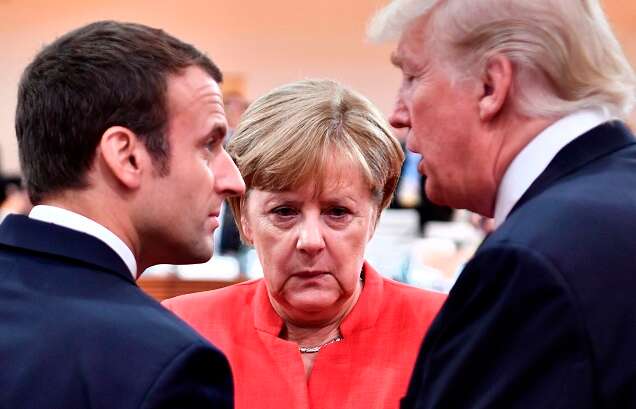
French President Emmanuel Macron, sensing, perhaps, during a visit to Washington that Trump would abandon the deal, on April 24 floated the idea of working with Iran on a "new deal."
Macron said such a deal would have four pillars: limiting Iran's nuclear program in the short and long term, restraining its ballistic missile program and curbing what the West views as its destabilizing behavior in Syria, Yemen, Iraq and Lebanon.
The idea, French officials said, was to keep hope alive for some kind of diplomacy if Trump pulled out of the deal.
Current and former diplomats, however, said it would be extremely difficult to bring Iran back to the negotiating table for such a "grand bargain," particularly after what Tehran can only regard as Washington's reneging on the deal.
"For quite some time, and I am talking about years, Iran will resist any kind of negotiation on a new deal," said Robert Einhorn, a former State Department nonproliferation expert, saying it was "politically untenable" for Iranian President Hassan Rouhani to embark on fresh talks.
Pie in the sky?
The decision sets the stage for a resurgence of political infighting within Iran's complex power structure, Iranian officials said, possibly strengthening hard-liners looking to limit Rouhani's ability to open up to the West.
"If Trump walks out of the deal and imposes sanctions that could paralyze Iran's oil sales, then Iran will have no choice but to show a harsh reaction," said a senior Iranian government official speaking before Trump's announcement.
An Iranian intelligence official hinted that if pressured, Iran might adopt a more aggressive regional policy..
Iran has strategic reasons for undertaking the activities that the West views as destabilizing.
Mindful of Iraq's devastating use of missiles on Iranian cities during the 1980-1988 war between the two countries, Iran's missile program aims to achieve some level of deterrence and ensure it is not left defenseless again.
Its activities in Syria, Iraq, Lebanon and Yemen similarly reflect a desire to project its power and are, to some degree, part of its struggle with Saudi Arabia for regional dominance.
Getting Tehran to meaningfully constrain, let alone give up, such programs will be difficult at best.
"It's not [totally] pie in the sky, but [it] seems unachievable because neither the U.S. or the Iranians are ready at this stage," said a European diplomat.
Why might Iran, eventually, play ball?
"As Bill Clinton said, 'it's the economy, stupid'," said another European diplomat.
This diplomat said Iranians were increasingly divided between those who believe the way to preserve the Islamic Republic was by improving the economy and those who feel it was by internal toughness and overseas aggressiveness.
"The message from us Europeans is that we're not in the regime change [game] ... What we think is that a global agreement helps progressively transform Iran" and may eventually persuade it to abandon regional domination.
"Yes that's ambitious but [reflects] that the people we have dealt with day in, day out since July 2015 on infrastructure, cultural cooperation, business, education, transport are people who see progress ... through economic modernization and not regional domination," the diplomat added.
"The period we are about to enter could lead to real pressure on the Iranian system. So we are already telling them that a comprehensive agreement with these four pillars [that Macron laid out] is something that can benefit you."
Iranian mistrust
A grand bargain would ultimately need a green light from the other parties to the nuclear accord, Russia and China.
Two European diplomats said both initially would be up in arms about the U.S. withdrawal but would have to accept the reality and, like the Europeans, need to decide whether they were ready to expose their companies to American sanctions.
"In their dialogue with Iran, will they tell them to fight to the bitter end with the U.S. or will they say, we don't like it, but let's see what we can do with the Europeans to see what we can [do to] save the furniture?" said a senior French official.
He said he believed China would be more constructive than Russia initially because it had no interest in a regional military confrontation.
"With Russia, there will be more work to do to get them on board because it's implicated in the region in Syria and has a tougher posture towards the West," he added.
Asked if Trump would accept such a deal, the senior French official replied: "He says he wants a deal, a better deal. So let's try and give him that. Will the Iranians trust us? Probably not."