The tense events of the past week on the Israel-Gaza Strip border did not go quite as planned but overall, Israel can look back at them with relative satisfaction.
Hamas failed to meet almost all of the objectives it set for itself for the volatile week that comprised the U.S. Embassy's move to Jerusalem and the Nakba Day march, marking the "catastrophe" of Palestinian displacement during Israel's 1948 War of Independence. The masses did not rush the Israeli border; no Israeli casualties were noted among soldiers or civilians and none fell prey to the terrorist group's abduction plots; Palestinians across the West Bank did not stage mass riots in solidarity with Gaza; the Arab world remained mostly indifferent to the images from the border; Palestinian Authority President Mahmoud Abbas held his ground with respect to the stalled Fatah-Hamas talks; and nothing was accomplished with regard to resolving the dire issues plaguing the coastal enclave.
Hamas's failure ran even deeper, because it repeatedly failed to draw the masses into the fray on the border. On Monday, 40,000 Palestinians arrived at the security fence to protest the relocation of American Embassy to Jerusalem – nothing to sneeze at and certainly a challenge for the military – but still short of the 100,000 goal the terrorist group was boasting it could deliver to the border. Hamas' plan to stage a million-man march the next day – Nakba Day – fizzled quickly as only a few thousand protesters showed up and made sure to keep a reasonable distance from the border.
But the Israeli accomplishment is incomplete, not only because Hamas has been left battered and bruised and therefore dangerous and bloodthirsty. The IDF met its primary objective, namely to prevent a mass breach of the border and terrorist attacks in the Gaza sector but it failed to meet its two secondary objectives: minimizing Palestinian casualties and preventing Gaza from making headlines worldwide.
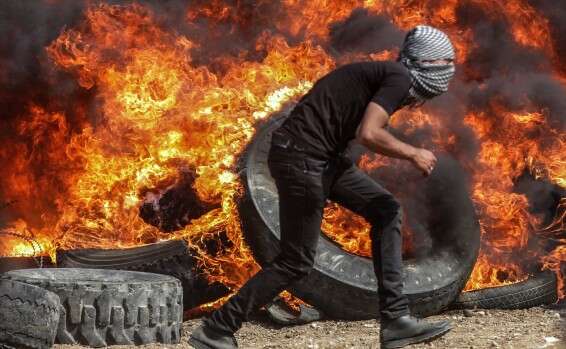
The military says the issue of casualties was unavoidable: The demonstrations were violent and terrorists used them to try to carry out attacks. The fact that, by Hamas' own admission, 50 of the 60 Palestinians who were killed were its operatives, indicates that the Israeli troops used their discretion and operated selectively, using standard crowd control measures such as water cannons, tear gas and rubber bullets before resorting to live fire.
But even defense officials admit that the high number of casualties was hard to swallow and certainly difficult to explain – an area in which Israel repeatedly fails, even when on paper it has a clear-cut case.
It is unclear why Israeli public diplomacy fell asleep at the wheel. Hamas made no secret of the nature and objectives of its "March of Return" campaign and Israel had weeks of weekly riots to prepare an organized campaign that would explain that no other country in the world would tolerate such an attempt to breach its territory.
On the ground, as always, the system was reactive instead of proactive and methodical, and found it difficult to present an alternative to the international community's natural instinct of supporting the weaker party, certainly given the images coming out of Gaza. As usual, only U.S. Ambassador to the U.N. Nikki Haley came to Israel's defense, while our own leaders expressed their frustration in the form of a diplomatic squabble with Turkish President Recep Tayyip Erdogan.
Until the next news cycle
It is doubtful that the global interest in Gaza will last very long. Between Saturday's royal wedding in London and the fast-paced dynamics of the international news cycle, by next week public opinion will be focused elsewhere. But Gaza will remain where it is, stuck in Israel's throat, with no solution in sight.
The concern of a rapid escalation in the south saw senior political and defense officials lock horns over how close Gaza really is to imploding. The defense establishment has been warning about this scenario for a long time, claiming that total chaos is merely "a few months, maybe a year" away. The enclave's dilapidated infrastructure cannot hold out for much longer, its 2 million residents have been pushed to the brink too many times and no one knows what will happen when their rage boils over.
Hamas, which is well aware of the fact that it is running out of time, had hoped the border riots would help it force gestures out of someone – Israel, Abbas, the Arab world or the international community – that could help it save the day, but that did not happen.
This has left Gaza's rulers with five options: The first is that Abbas drops one of his conditions for the Fatah-Hamas reconciliation, preferably the demand that Hamas disarms; the second is that Hamas decides to compromise and disarm, ostensibly or otherwise; the third is that Hamas and Israel reach some sort of long-term agreement that would allow the rehabilitation of Gaza in exchange for a cessation of terrorist activity; the forth is that the weekly border riots continue, and the fifth is that Hamas, despite statements to the contrary, will provoke a war with Israel to take the target off its own back.
As things stand, Hamas is likely to opt for a prolonged riot campaign, but in a more restraint manner. Egypt, and to some extent Qatar, which shuttled between Israel and the terrorist group this week in an effort to defuse tensions, was very clear in its demands of Hamas, especially over concerns that the violence will eventually spread to its shared border with Gaza.
Cairo excoriated Hamas leader Ismail Haniyeh over the senseless deaths on the border, but it was also tough on Israel, demanding that it reopen the Kerem Shalom goods crossing that was shuttered on Sunday after Palestinian rioters again vandalized their side of it, causing over $9 million in damages.
Familiar dynamics, unpredictable results
The real test, as always will be on the ground. Recent machine-gun fire at the southern city of Sderot shows that Hamas may have released some of its restraint. His total control over the manner in which the border riots rage attests to its iron grip on Gaza and with it to the fact that it is responsible for all that transpires there. That is why the IDF carried out an unusually large strike on Hamas posts in the enclave in the early hours of Thursday morning, signaling that Israel will not tolerate sporadic terrorist fire, even if it means a security escalation in the south.
It is likely that Hamas got the message. The simmering domestic unrest in Gaza has Hamas concerned for its political survival and recent Israeli threats are cause for Hamas leaders to fear for their lives.
But deterrence naturally erodes over time and there is no shortage of triggers that could spark a conflagration on the ground at almost any moment.
The holy Muslim month of Ramadan is volatile by nature and the fiery sermons expected in the mosques this Friday over the high number of casualties earlier this week will only fuel the flames.
This all but guarantees security forces will remain on high alert in the Gaza sector and in Judea and Samaria, which may have remained calm this week, but where the constant friction between Israelis and Palestinians, along with the proximity to Israeli cities, creates a constant potential for terrorist attacks.
No Ramadan in the past nine years has been terrorism-free in Judea and Samaria, and it takes a special kind of optimism to believe this year will be any different. Palestinians in the West Bank are not eager to riot – this year's Nakba Day in the West Bank was the calmest in years – but all it would take is a few frustrated youths with a knife, a car or a gun to ignite the area. This will pose a challenge for the IDF, as it will try to provide Israel with full security in a complex reality in all sectors.