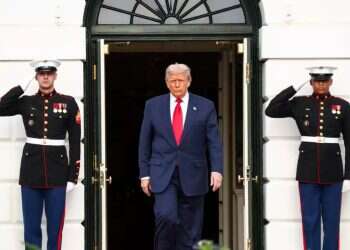
A day before U.S. President Donald Trump withdrew from the Iran nuclear deal, one of his senior officials phoned Saudi Arabia to ask the world's largest oil exporter to help keep prices stable if the decision disrupted supply.
Riyadh, Tehran's archrival, has long been a close Washington ally, but direct pressure on a member of Organization of the Petroleum Exporting Countries over oil policies is rare. Washington last pressed Saudi Arabia to increase output in 2012.
Riyadh has said that even though prices have spiked to over $80 per barrel, the highest since 2014, the market has yet to recover from a long slump. Until the phone call, Saudi officials had been saying it was too early to raise output.
Riyadh took this line partly because higher crude prices could help the stock market float of a stake in state oil giant Saudi Aramco expected to take place in 2019, Saudi industry sources said.
So there was shock among some of Saudi Arabia's fellow OPEC members when it issued a supportive statement hours after Washington imposed new sanctions on Tehran. It said it was ready to raise output to offset any supply shortage.
Three sources familiar with the matter said a senior U.S. administration official had called Saudi Crown Prince Mohammed bin Salman before Trump's announcement to make sure Washington could count on Riyadh, the de facto OPEC leader.
One of the sources said the call took place on May 7. The other two did not specify a date for the call.
Washington was worried that the sanctions would curb deliveries from Iran and push oil prices up, the sources said.
A White House spokesperson declined to comment on whether a call took place.
A senior Saudi official did not confirm the call but said, "We were made aware of the decision on the JCPOA [Joint Comprehensive Plan of Action] before the announcement. … We always have conversations with the U.S. about the stability of the oil market."
OPEC will meet on June 22 and needs a consensus of all members to officially change its output policy. Iran's oil minister, Bijan Zanganeh, said last week he did not agree on the potential need to increase global oil supplies.
An OPEC source familiar with Saudi thinking said that Riyadh and Washington had discussed their oil policies before the U.S. announcement on Iran.
"You need to work with your partners in dealing with any potential effect on supply," that OPEC source said.
Allies 'upset'
The sudden shift in Riyadh's public position came as a surprise to its Gulf allies, who coordinate OPEC policies closely.
Some Gulf countries were "upset that there was no prior consultation with them," a separate source said. They felt Riyadh had come under pressure from Washington and they had not been consulted before public comments by Saudi Energy Minister Khalid al-Falih.
Falih traveled to Russia's economic forum in St. Petersburg last month and said the kingdom was prepared to gradually ease oil output curbs to calm consumers' worries.
The shift has also irked some producers outside the Gulf.
"Some people felt they were not properly consulted before the comments in St. Petersburg," a second OPEC source said.
Since the original international sanctions were lifted in January 2016, Iran has struggled to raise production above 4 million barrels per day. This is due to a lack of new projects.
Iran would benefit less than Saudi Arabia from an increase in supplies if it cannot raise output, as well as receive a lower price for existing production.
A third OPEC source said it would be against the OPEC charter to raise output just because Washington had requested it. "For some OPEC members, this is too much," the source said.
U.S. reliance on Saudi crude imports has decreased in recent years, in part as domestic shale output has risen, but Saudi Arabia remains an important source of U.S. supply.
Sources familiar with the issue said Riyadh's shift in stance was prompted by pressure by Washington and other consuming countries but does not reflect concern in Saudi Arabia that there is a supply deficit.
In late April, Trump in a tweet criticized OPEC for high oil prices. India and China also raised concerns about high oil prices in separate calls with Falih.
"The thinking before was to continue with the OPEC deal until the end of the year," a fourth OPEC source said. "But then Trump and the Iran nuclear deal happened and consuming nations started to complain. Consumers are very important for us."