European countries share concerns over Iran's ballistic missile program and want solutions to its "aggressive tendencies" in the Middle East, German Chancellor Angela Merkel said on Thursday.
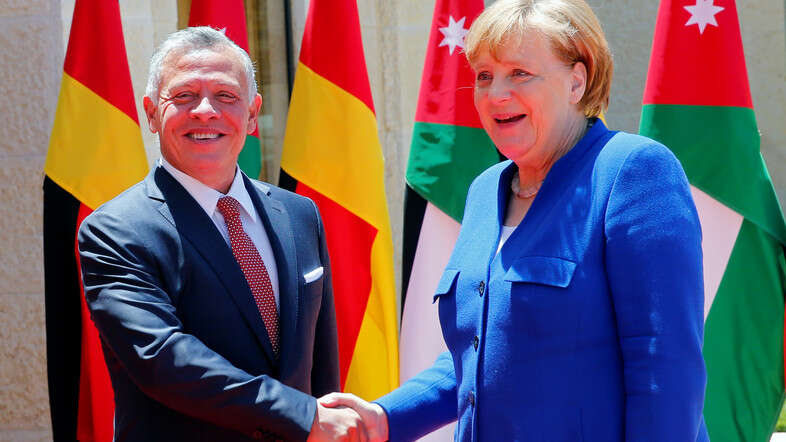
"Iran's aggressive tendencies must not only be discussed, but rather we need solutions urgently," Merkel said after meeting with Jordan's King Abdullah in Amman.
She announced 384 million euros ($445 million) of aid to Jordan this year.
Germany has remained party to the 2015 Iran nuclear deal, which lifted sanctions on Iran in exchange for it curbing its nuclear program, after U.S. President Donald Trump withdrew from it in May.
Merkel said on Thursday that while European countries want to maintain the accord, they share concerns over Iran's ballistic missile program, its presence in Syria, and its role in the war in Yemen.
Iran is a major military supporter of Syrian President Bashar Assad, sending some of its own forces to Syria and backing Shiite militias from Lebanon and Iraq who are fighting there.
Gulf and Western countries accuse Iran of arming the Houthi rebel group in Yemen, an allegation it denies.
Merkel also voiced support for Jordan's concerns about Iranian activity in southwestern Syria near the Jordanian and Israeli borders, where Syria is ramping up military action.
"You live not just with the Syria conflict, but also we see Iran's activities with regard to Israel's security and with regard to Jordan's border," she said.
Earlier this month, after meeting Prime Minister Benjamin Netanyahu, Merkel said Iran's regional influence was "worrying, especially for Israel's security."
King Abdullah, who met Netanyahu on Monday and Trump's son-in-law and regional envoy Jared Kushner on Tuesday, said there could be no peace in the Middle East without a Palestinian state with Jerusalem as its capital.
The United States is preparing a new peace plan, which has not yet been made public, but has already angered Palestinians by recognizing Jerusalem as the capital of Israel.
Abdullah this month appointed a new prime minister after the country's biggest protests in years over taxes and price increases pushed by the International Monetary Fund.
Merkel said reforms should be balanced and "not hit the wrong people."
In addition to the aid for Jordan, Germany is also providing it with a $100 million credit line to help it cope with the requirements of the IMF reforms, Merkel said.