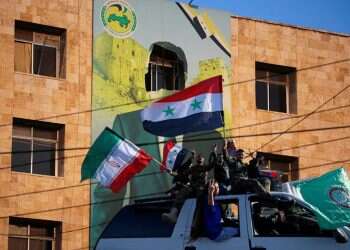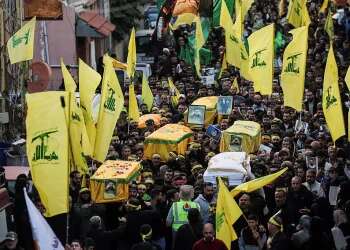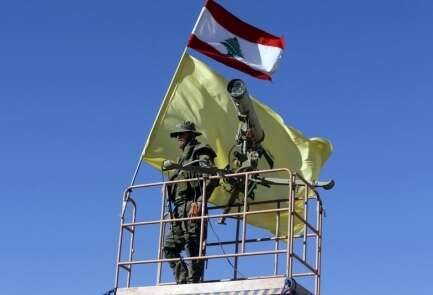
Iranian proxy Hezbollah is helping to lead a Russian-backed offensive in southern Syria, pro-regime sources said, exposing the limits of U.S. policy that hopes Russia can get Iran and its proxies out of Syria.
Hezbollah's role in the offensive also defies Israeli demands that Iranian proxies be kept away from the Syria-Israel border.
"Hezbollah is a fundamental participant in planning and directing this battle," said a commander in the regional alliance that backs President Bashar Assad's regime. "Everyone knows this – the Israeli enemy, friends, and even the Russians."
Hezbollah's role includes directing Syrian forces, the commander said. It has also deployed its own forces on the ground.
But the Iranian-backed Lebanese Shiite terrorist group is keeping a lower profile than in past Syria campaigns, acknowledging the risks of an escalation opposite Israel.
A senior official in the regional alliance that backs Assad said Hezbollah was fighting "under the cover" of the Syrian army in the south. A European diplomat said Iranian-backed forces were not thought to be taking part "in strength."
For Assad, the campaign holds out the prospect of reopening a vital trade artery to neighboring Jordan, re-establishing his control over the Golan Heights, and crushing rebels once deemed a threat because of their proximity to Damascus.
The offensive has yet to face resistance from Assad's Western, Israeli or Arab foes. Washington has told the rebels it once backed not to expect intervention. Some have surrendered.
Politically, the campaign has been one of the most complex yet for Assad.
Echoing the U.S., Israel has been pressing Assad's Russian allies to keep Iranian-backed forces away from its border. It also wants them removed from Syria more widely.
Recent Russian calls for non-Syrian forces to leave the south have been seen as partly directed at Iranian-backed forces.
White House National Security Adviser John Bolton said on Sunday that President Donald Trump would discuss Syria with Russian President Vladimir Putin at a summit in Helsinki on July 16.
"There are possibilities for doing a larger negotiation on helping to get Iranian forces out of Syria and back into Iran, which would be a significant step forward," Bolton told CBS News' "Face the Nation."
Seven years into the war, in which hundreds of thousands of people have been killed and millions displaced, Assad now commands most of Syria with his allies' help.
However, most of the north and a chunk of the east remains out of his hands. The presence of Turkish and U.S. forces in those areas will complicate further gains.
As Assad seeks military victory, there seems little hope of a negotiated peace, with some 6 million Syrians abroad as refugees and 6.5 million more internally displaced. The southwest offensive alone has uprooted 270,000 people.
Support from Iran and Hezbollah helped Assad survive rebel advances and plug manpower gaps early on, and then win back territory once Russia's air force arrived to help in 2015.
Iranian-backed Shiite militias have also been seen as critical in holding territory. On the ground, Russia has deployed some regular forces, military police and private contractors.
While Iran and Russia have worked closely together, differences have surfaced recently.
Tension flared last month when Russian forces arrived unannounced in an area of Hezbollah deployment near the Lebanese border. The Russians withdrew the next day.
The official in the pro-Assad alliance said the United States appears to be hoping to "substitute" Iranian influence with Russian influence, but this would be futile. Russia and Iran have an "understanding" in Syria, the official said.
"The battlefield situation in Syria will not be reversed. The regime and its allies have very wide control," the official said. Assad has said Hezbollah and other allies will stay a long time.
Excluding Iran and Hezbollah from the southwest was one objective of contacts between the United States, Russia, Israel and Jordan that had sought – unsuccessfully – to stave off a government offensive, a European diplomat said.
"I suspect that a few Iranians will not cause the Israelis too much concern, but larger numbers of Iranians or Hezbollah would," the diplomat said.
Israel is "broadly comfortable" with the Syrian army returning to the Golan frontier as long as groups such as Hezbollah stay away, the diplomat said.
"I think the Israelis are reasonably comfortable and confident that they can continue to deter, enforce and agree on an arrangement that keeps Iran away from the Golan at the moment," the diplomat added.
Tensions may rise as the Syrian regime offensive moves from Deraa province towards Quneitra on the Golan Heights, where tensions between Israel and Iran sparked a military confrontation in May. Israel beefed up its tank and artillery deployment on the Golan Heights on Sunday.