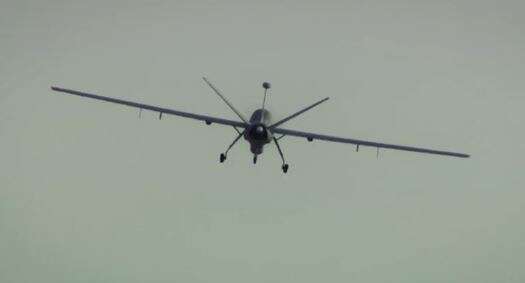
Israeli defense contractor Elbit Systems on Thursday unveiled a 1.6-ton drone designed to fly in civilian airspace and assist in homeland security missions.
The move came hours after U.S. rival General Atomics' MQ-9B SkyGuardian – a version of the widely used Predator family of drones – completed its Atlantic crossing on Wednesday ahead of the Farnborough Airshow, the world's largest military airshow, set to take place in Britain next week.
Changing security concerns following the dismantling of Islamic State and rising geopolitical tensions have caused European and other countries to shift defense efforts from far-away conflicts to homeland security, resulting in demand for drones that can be safely integrated into civilian airspace to, for example, monitor border crossings, Elbit officials said.
A version of Elbit's Hermes 900 StarLiner is being assembled for the Swiss armed forces and is scheduled to be delivered in 2019 in a deal worth $200 million.
The StarLiner, launched ahead of the Farnborough Airshow, is derived from the Hermes 900 drone, which was operated by Brazil for surveillance during the 2014 World Cup. That operation required closing off airspace to civilian aircraft, something the StarLiner, with technology to detect aircraft and avoid collisions, will not require, Elbit said.
The drone is compliant with NATO criteria, qualifying it to be integrated into civilian airspace, Elbit said, but it will still need the approval of various civil aviation authorities.
The StarLiner has been flying in civilian airspace in Israel over the past year. It can reach 30,000 feet – the altitude of some commercial jets – and photograph an 80 square-kilometer (31 square-mile) area. The drone can be equipped with radar, cameras to take video and still pictures, and signals intelligence to analyze electronic signals.
"Some customers would like to use the system to gather intelligence," Elbit CEO Bezhalel Machlis said. "Another example can be for homeland security applications, to fly above an area and make sure it is monitored against terrorist activities."
Elad Aharonson, general manager of Elbit's ISTAR division, said the company is "getting a lot of interest from customers for the same configuration from all over the world. This is a major step toward unmanned civilian planes."
He added that the main barrier to such aircraft would be psychological rather than technical.
Elbit expects to receive approval from the European Aviation Safety Agency for its own product in the coming months.
Israel's drone exports between 2005 and 2012 totaled $4.6 billion, according to consultancy Frost & Sullivan. They reached $525 million in 2016, accounting for 7% percent of Israel's defense exports, Defense Ministry data shows.
Drones are a major source of revenue for Elbit and state-owned Israel Aerospace Industries. The United States and Israel dominate the industry but face growing competition from cheaper Chinese drones.
U.S. military drone makers are vying for a larger share of the global market, which market researcher the Teal Group forecasts will rise from $2.8 billion in 2016 to $9.4 billion in 2025.