
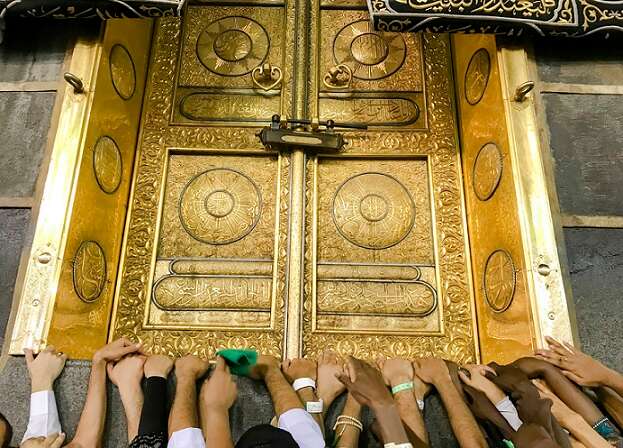
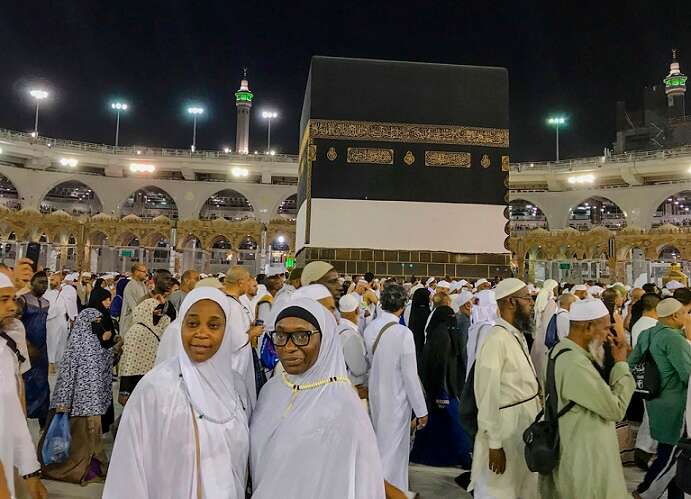
More than 2 million Muslims began the annual hajj pilgrimage Sunday in Saudi Arabia, circling the cube-shaped Kaaba from first light in Mecca that Islam's faithful face five times each day during their prayers.
The five-day hajj pilgrimage represents one of the world's biggest gathering every year, a trip required of all able-bodied Muslims once in their life.
The hajj offers pilgrims an opportunity to feel closer to God amid the Muslim world's many challenges, including the threat of extremists in the Mideast after the Islamic State group was beaten back in Iraq and Syria and the plight of Myanmar's Muslim Rohingya minority.
"We are very blessed by Allah to be in this place, and we pray to Allah to make the Islamic nations from the West to the East in a better situation," said Essam-Eddin Afifi, a pilgrim from Egypt. "We pray for the Islamic nations to overcome their enemies."
The Kaaba represents the metaphorical house of God and the oneness of God.
Muslims circle the Kaaba counterclockwise seven times while reciting supplications to God, then walk between the two hills traveled by Hagar. Mecca's Grand Mosque, the world's largest, encompasses the Kaaba and the two hills.
Before heading to Mecca, many pilgrims visit the city of Medina, where the Prophet Muhammad is buried and where he built his first mosque.
Muslims believe the hajj retraces the footsteps of the Prophet Muhammad, as well as those of the prophets Ibrahim and Ismail – Abraham and Ishmael in the Bible.
After prayers in Mecca, pilgrims will head to an area called Mount Arafat on Monday, where the Prophet Muhammad delivered his final sermon. From there, pilgrims will head to an area called Muzdalifa, picking up pebbles along the way for a symbolic stoning of the devil and a casting away of sins that takes place in the Mina valley for three days.
At the hajj's end, male pilgrims will shave their hair and women will cut a lock of hair in a sign of renewal for completing the pilgrimage. Around the world, Muslims will mark the end of hajj with a celebration called Eid al-Adha. The holiday, remembering Ibrahim's willingness to sacrifice his son, sees Muslims slaughter sheep and cattle, distributing the meat to the poor.
"This is the first time I see the Grand Mosque and the Kaaba. It is the best feeling of my life to be able to perform the hajj," said Mostafa, 50, as he looked at the cube-shaped structure towards which Muslims turn in prayer five times a day.
The accountant traveled to Saudi Arabia from Turkey where he has lived for five years since fleeing Aleppo in Syria. "War destroys everything. … Life in Turkey is hard and I barely earn enough."
Maj. Gen. Mansour al-Turki, the spokesman of the Saudi Interior Ministry, told journalists Saturday that over 2 million Muslims from abroad and inside the kingdom would be taking part in this year's hajj.

For Saudi Arabia, the hajj is the biggest logistical challenge the kingdom faces. Its ruling Al Saud family stakes its legitimacy in part on its management of the holiest sites in Islam. King Salman's official title is "Custodian of the Two Holy Mosques" at Mecca and Medina. Other Saudi kings, and the Ottoman rulers of the Hijaz region before them, all have adopted the honorary title
The kingdom has spent billions of dollars of its vast oil revenues on security and safety measures, particularly in Mina, where some of the hajj's deadliest incidents have occurred.
The worst in recorded history took place only three years ago. On Sept. 24, 2015, a stampede and crush of pilgrims in Mina killed at least 2,426 people, according to an Associated Press count.
The official Saudi toll of 769 people killed and 934 injured has not changed since only two days afterward. The kingdom has never addressed the discrepancy, nor has it released any results of an investigation authorities promised to conduct over the disaster.
Hoping to avoid another such disaster, Saudi Arabia has made use of technology to manage the flow of millions at the same place at the same time.

This includes electronic identification bracelets, connected to GPS.
"There is a comprehensive electronic agenda for every pilgrim and we have provided many apps that offer guidance," Hajj and Umrah Minister Mohammed Bintin told Reuters.
"We have a fleet of more than 18,000 buses, all of them linked to a control system that tracks their path."
Bintin said a high speed railway between Mecca and Medina had been completed and was being now being tested.
Meanwhile, Saudi Arabia also faces threats from al-Qaida terrorists and a local faction of the Islamic State group. Days earlier, the Interior Ministry acknowledged arresting a Saudi wearing an explosive vest in the kingdom's central al-Qassim region who shot at security forces.
Al-Turki acknowledged both the threat posed by a possible missile launch from Yemen's rebels and terrorist attacks during the hajj.

"Our policemen are ready to deal with any such threat and to sacrifice their lives in order to protect the pilgrimage from any threat," he said.
"We will prevent any actions that are not part of the haj ritual and any act that may impact the safety of pilgrims or their ability to perform the rite," al-Turki told Reuters.
Those on the hajj said they hoped for better relations across the Muslim world.
"I hope this year would be a good one for the Islamic nations," said Ahmad Mohammad, an Egyptian pilgrim. "I hope the situation will be better, and I ask Allah to accept my pilgrimage."
That was a feeling shared by Jordanian pilgrim Jehad Hussein.
"I pray to Allah to grant victory to all of them, the people of Palestine, the people of Gaza, Syria and all Arab countries. Allah willing," she said.


