On Monday, Israel and Hamas were on a path to the most dramatic military escalation since Operation Protective Edge in 2014. Even though neither side wants a broad conflagration, in the absence of restraining factors they could quickly find themselves at war.
The escalation began when a covert IDF unit was detected in the Gaza Strip and an Israeli officer identified only as Lt. Col. M. (his name has not been released for publication), was killed in the ensuing firefight. Contrary to various unsubstantiated reports, the purpose of the mission was not to assassinate or abduct anyone, and the operation was supposed to have remained secret. The IDF's most elite units carry out dozens of similar operations every year, and Monday's mission had been approved in advance by the political echelon and was unrelated to the current developments in Gaza.
According to reports from Gaza, the covert Israeli squad was in a van with Gazan license plates when it was stopped at an unexpected checkpoint near Khan Yunis. The Hamas patrolmen at the checkpoint became suspicious of the vehicle's occupants, so the Israelis opened fire, killing several Palestinians. One Palestinian returned fire, which mortally wounded Lt. Col. M. and moderately wounded another officer.
A dramatic rescue operation unfolded after the clash, with IAF aircraft providing cover and carving out an escape route under enemy fire. Simultaneously, an IDF rescue team entered Gaza by land and a Sikorsky helicopter landed. The Israeli soldiers boarded the helicopter, which took off without lights and flew to Soroka Medical Center in Beersheba. Lt. Col. M. was pronounced dead there and the other wounded officer was rushed into surgery.
The IDF is now investigating how the covert team was detected. Hamas on Monday presented some of the equipment it claims was left behind by the Israeli squad – mostly electronic components. It is safe to assume that the terrorist organization is now busy trying to understand their purpose.
Once the rescue operation was completed, Israeli officials braced for Hamas' response. It seemed the terrorist organization was taken off guard, as its initial response was relatively minor. It fired a few rockets and mortar rounds toward Israeli communities directly across the border. Prime Minister Benjamin Netanyahu decided to cut short his trip to France and immediately return to Israel, but Israeli decisionmakers had already decided to try to contain the event. Had Hamas stopped there, Israel would have stopped too.
However, on Monday afternoon, Hamas took things too far. A Kornet anti-tank missile was fired at an Israeli bus near Kibbutz Kfar Aza, and almost caused a disaster: The missile hit the bus and exploded near a group of soldiers standing nearby, seriously wounding one.
Considering the alert levels in the area, coupled with the lessons of the past, it is unclear why a bus was permitted to travel on a route that was clearly visible from Gaza, particularly since the IDF should have learned its lesson from a very similar incident in 2011 when an anti-tank missile was fired at a bus near Nahal Oz. The fact that the missile was fired alongside heavy salvos of rockets targeting Israeli communities indicates that Hamas assumed that a war was inevitable and rushed to land the first blow.
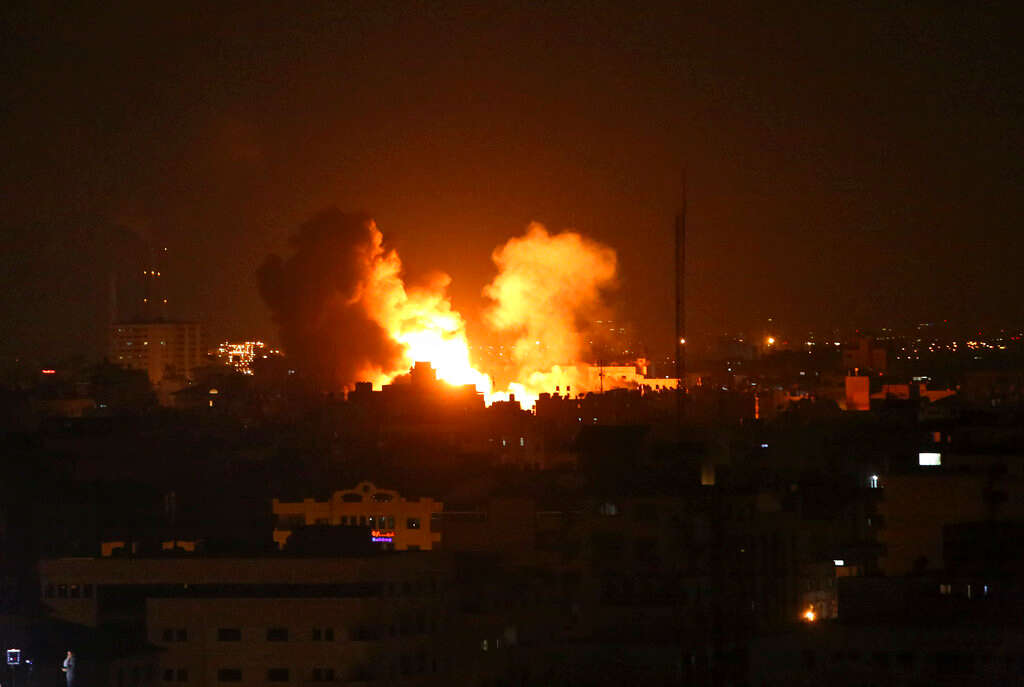
This chain of events left Israel no other option but to respond. The strikes Israel launched were relatively limited in scope, but by late evening, several sectors in Gaza had been heavily bombed. With that, Israeli officials were still taking pains to keep matters under control, just as Hamas appeared to be doing by restricting its rocket fire to Israeli communities near the border, refraining from expanding its attacks deeper into Israel.
Now, however, it seems the sides are struggling to keep the flames in check. Until recently, several restraining factors were in play in Gaza, chief among them the Egyptians and United Nations special envoy Nickolay Mladenov, who also helped negotiate the Qatari money transfer into Gaza that paved the way toward cease-fire understandings last week. However, the mediators have now withdrawn to the background, with some even accusing Israel of violating the understandings.
Hamas is also charging that "Israel started it" and is threatening to ramp up its rocket barrages if Israel expands its strikes in Gaza, indicating that the group is trying to leverage the latest events in order to shift the balance of deterrence in its favor. Israel has made it clear that it will not play along with Hamas' ultimatum and that the strikes in Gaza will continue, but it will be difficult to exact a painful toll from Hamas now that the organization has largely gone underground.
Unlike previous rounds in recent months, it seems that this time the sides will struggle to secure a quick cease-fire, and not just because of the (temporary) absence of restraining elements in Gaza. The Israeli public is fed up with the Gaza situation. While the prime minister is doing all he can to find a diplomatic solution to the problem, as soon as Hamas broke the rules of the game on Monday, Israel had no choice but to respond in a manner that would restore deterrence – even at the potential cost of a large conflict. The preparations for war have already been made and, to some extent, can already be seen on the ground.