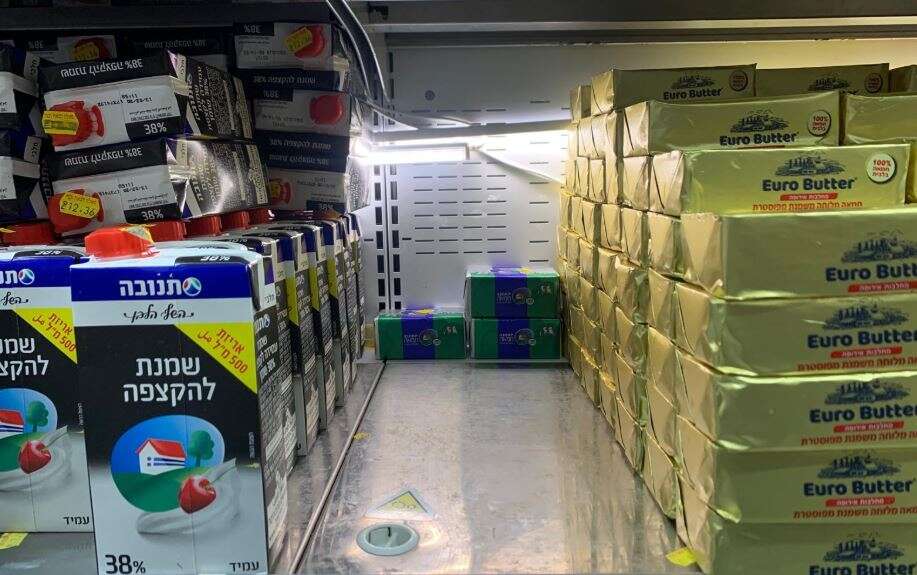
The government recently announced plans to exempt butter from import duties as well as quotas in an attempt to battle the shortage plaguing Israeli supermarkets since early last year.
The measure still requires the formal approval of the Finance Ministry, but it has already been cleared by the Justice Ministry, despite opposition from dairy farmers, who fear that nixing both import duties and quotas will cut into their revenues in the long run.
Follow Israel Hayom on Facebook and Twitter
Butter has become a scarce commodity in Israel since 2019. Dairy farmers claim production costs, especially relating to removing the byproducts of butter production, are astronomical, and seek additional government subsidies to keep up with the demand for butter.
But while the demand may have its merits, consumers have become furious over the fact that they are forced to buy imported butter, whose prices are not regulated. Many claim that the butter shortage is fabricated by the large dairy farms in a bid to prompt consumers to pressure the government to cave into the cartel's demands.
The so-called "butter recession" has become such that Israelis have taken to sharing rare sightings of locally produced butter on social media. Other posts indicate that many consumers have taken to simply making their own butter at home.
Government ministries have been blaming each other for the butter shortage. In late 2019, the Economy and Industry Ministry recommended that the Agriculture Ministry, which is responsible for setting the dairy farms' quotas and subsidies, "eliminates in total all customs duties and the butter quotas system."
The Agriculture Ministry rejected the recommendation and argued that it required legislation. It also blamed the system of quotas distribution, which falls to the Economy Ministry, for the problem.
Under Israeli law, a caretaker government must refrain from passing permanent legislation unless the measure is absolutely vital. Israel has been facing a political crisis since April 2019, when the results of the elections held that month failed to produce a government, as did the subsequent elections called for September. On March 2, Israelis will head to the polls for the third time in one year – a first in Israel's history.
As an interim government is in place, the Attorney General's Office was asked to determine whether an administrative order could be issued on the matter. Deputy Attorney General Meir Levin issued an opinion stating there was nothing preventing the government from eliminating the quotas and customs imposed on butter imports during an election campaign.
According to financial daily Globes, the question remains whether the state will demand that the importers sell the butter at a fixed price, as local dairy farmers do. The Treasury's Prices Committee is expected to rule on the matter in the coming weeks.