

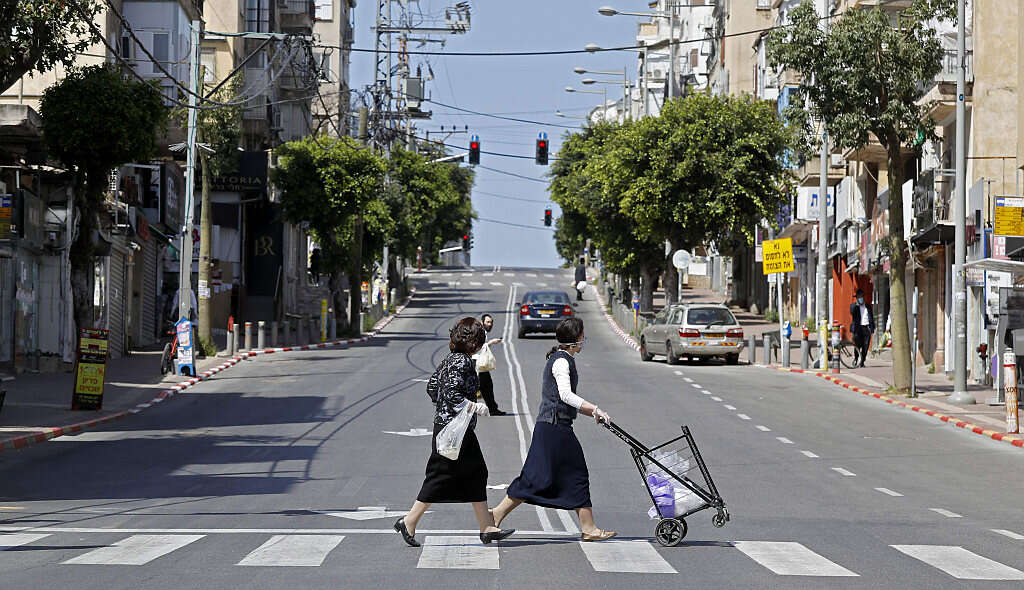
The cabinet late Saturday night decided to impose a partial lockdown of Jerusalem that will primarily focus on the capital's ultra-Orthodox neighborhoods with high morbidity rates of the coronavirus. The order will go into effect on Sunday at noon until April 15.
According to Health Ministry data, about 75% of the infections in Jerusalem have occurred in Haredi neighborhoods, most of which will now be locked down.
Follow Israel Hayom on Facebook and Twitter
As of Saturday afternoon, the number of confirmed coronavirus cases nationwide stood at 10,743, with 102 fatalities as a result of the virus. Over 1,300 have recovered from the disease, according to the latest Health Ministry figures.
The lockdown move comes after days of deliberation and protest against such a decision by Jerusalem Mayor Moshe Lion. Some ministers who had received the proposal and the adjoining map were furious over the idea.
At least two cabinet members, Shar chairman Interior Minister Aryeh Deri and United Torah Judaism head Health Minister Yaakov Litzman, live in areas that will be locked down.
Litzman is currently under home-quarantine after testing positive for the virus last week.

Prime Minister Benjamin Netanyahu and Deri engaged in a heated argument Thursday night during which Deri said he felt that the Health Ministry was "quick on the trigger" when it came to imposing restrictions on Haredi communities.
Still, the government approved the quarantine of four of the capital's seven zones delineated ahead of Passover: Zone 1, which covers northeast Jerusalem; Zone 2, which covers northwest Jerusalem; Zone 3, which covers southwest Jerusalem; and Zone 5, which covers much of the city center.
Among the neighborhoods placed under lockdown are Har Nof, Mea Shearim, Geula, the Bukharim Quarter, Romema, Sanhedria, Neveh Yaakov, Ramat Shlomo and Makor Baruch.
Residents of these areas cannot leave unless they are going to work, getting essential medical treatment, attending the funeral of an immediate family member or transferring their children to a former spouse. In addition, they can attend legal proceedings or access other essential services with approval.
In each zone, several neighborhoods were excluded from the quarantine.
Zone 1 exceptions: The Atarot industrial zone, Kafr Akab, Beit Hanina, Pisgat Ze'ev and the Hashalom neighborhood; Zone 2 exceptions: Har Hotzvim industrial zone, Arazim Valley Park and Motza Valley Park; Zone 3 exceptions: Givat Shaul industrial zone, Beit Hakerem, Her Herzl administrative area, Yuvalim, Ganim, Kiryat Dania and Hadassah Ein Kerem hospital; Zone 5 exceptions: The Government Quarter administrative area and Beit David, which includes the Old City.
According to Health Ministry data released last week, Har Nof had 118 infections out of a population of some 17,000, making it the area with the highest infection rate in the country. Another 416 cases were confirmed in "northern Jerusalem Haredi neighborhoods" out of a population of below 80,000.
There were over 1,800 total cases in the city and at least 21 residents have died of the disease, according to Health Ministry data released Saturday.


