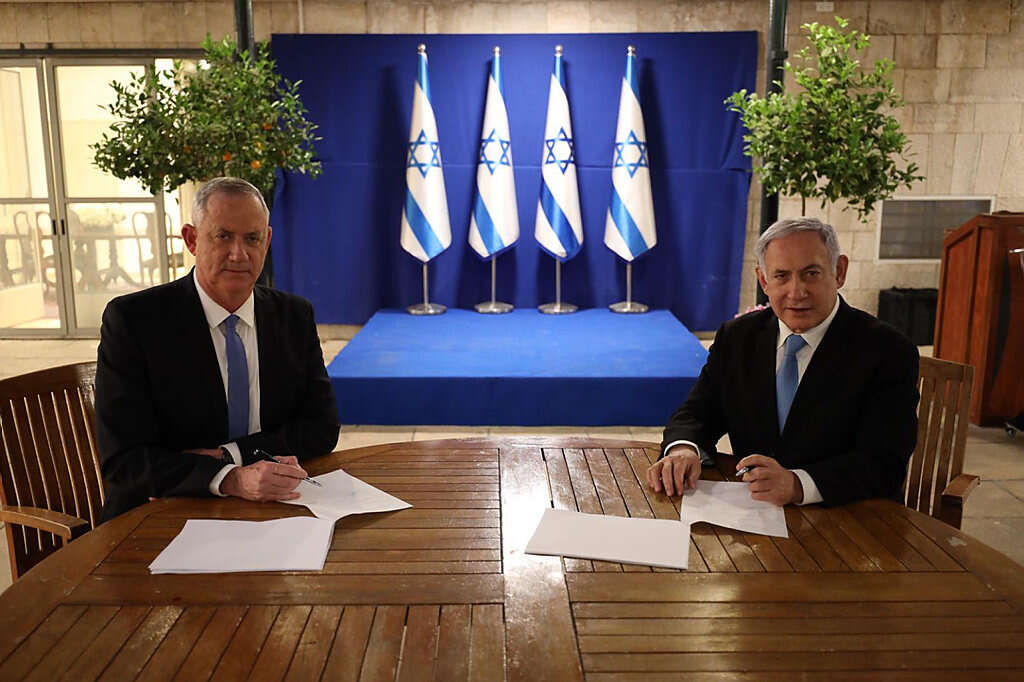
Ultimately, despite sky-high levels of skepticism and a general lack of trust in each other, Prime Minister Benjamin Netanyahu and Blue and White leader Benny Gantz treated each other with respect. The negotiations might have been tough, but they were fair. Looking back, after the unity deal was signed, it turned out that unlike what people had predicted, Netanyahu wasn't using tricks to wear down the talks and turn to other options like a narrow government or another election. From the first, he truly intended to sign a deal and give Gantz an equal place in a rotation.
Netanyahu did all that despite the strong temptations that popped up to dump Gantz, whose own party crumbled during the negotiation process, and even though nearly every day saw Gantz lose political assets that could have improved his position. The fact that a deal was signed testifies that in the end, each side treated the other honestly.
Follow Israel Hayom on Facebook and Twitter
But both sides being equally satisfied or dissatisfied does not mean that the agreement is good for everyone else. First, because of the rotation. In a year and a half, if nothing unexpected happens, Benny Gantz will be sitting in the prime minister's seat. Much good can be said about him – Gantz has devoted his entire life to serving and defending the nation. He is also, as many people have said, a good person. Easy. Likeable. Qualities that Netanyahu could stand to learn from.
But none of those characteristics qualify him to serve as prime minister. Not only does he lack the necessary experience to handle the demands of the job, but the experience he does have has also mostly been negative, indicating his lack of qualifications and his limited ability to assume the responsibility. His pleasant nature is appropriate for someone who wants to make friends, not someone serving in the toughest job in the world. His former colleagues in Blue and White who pointed out these traits after the ugly bust-up did not behave honestly when they hid the truth over the course of a year and three elections.
Netanyahu knows who Gantz is. The things he said about Gantz during the campaigns weren't merely propaganda – they expressed how he really felt about the man. The prime minister doesn't admire Gantz or have any faith in his abilities, but that didn't stop him from signing a deal that will make him leader 18 months from now. Why? Because he believed there was no other choice, and that the only alternative was another election, which would have been unacceptable. Others thought he did have a choice and should have kept negotiating until the very last minute to see if anything changed that would have allowed him to form a different kind of government, a narrow government or a unity government without a rotation for prime minister. But Netanyahu preferred to take the safer route, and thereby decided his own future.
Too early to celebrate in Judea and Samaria
The coalition agreement between the Likud and Blue and White gives the government the power and leaves the opposition powerless. The two sides divided things evenly and left nothing for anyone else. This was not entirely without precedent. In the brief period between the time MK Avi Nissankoren was appointed chairman of the Knesset Arrangements Committee and the time negotiations between the Likud and Blue and White began, members of the left-wing bloc – Avigdor Lieberman of Yisrael Beytenu and the Joint Arab List – had total control over the Knesset, its institutions, and its committees, and left nothing for the 58 MKs on the Right. Amazingly, no one on the Left cried about it like they're crying now about how the parliamentary booty is remaining in the hands of the majority.
The new government is supposed to do something historic, besides joining hands in the war against coronavirus and the ensuing economic crisis. It is expected to apply sovereignty to Judea and Samaria and apply Israeli law to areas it has never recognized. This will be a watershed moment, assuming it actually happens. With all the many concessions Netanyahu made to secure the new partnership, he never gave up on sovereignty for a moment, and it's good he didn't.
But no one can guarantee that the next government will be as good for the settlements as the one before it. Left-wing organizations, along with Arab activists, are filing petitions with the High Court of Justice to evacuate settler homes, neighborhoods, and entire communities. Until recently, the State Attorney's Office would hand over national assets without a fight. It would automatically respond to petitions of this nature by admitting that the structure, neighborhood, or settlement was illegal, which was how the High Court would rule. Former Justice Minister Ayelet Shaked changed that. She personally reviewed every response by the State Attorney's Office and threw herself in the way of scandalous rulings that would have destroyed homes and families. Who will do that now? Justice Minister Avi Nissankoren? Who, as defense minister, will make things easier for residents of the settlements? That job, too, has been handed to Blue and White.
The press conference Gantz held when he explained his decision to join Netanyahu in a government was another stage in his own personal declaration of independence. This past year, Gantz has been hampered by delusional vested interests who marched him to the brink of a personal abyss. Gantz isn't the stuff a prime minister is made of and he knows it. He isn't built for vicious political wars and prefers to take things easy. But they didn't let him. They expected the kitten to behave like a tiger, and he bowed to them. He followed them down until it seemed he couldn't go any lower. The first step he took to save himself was when he decided to join Netanyahu, and that the rest could go to hell. Luckily, his partners decided to leave him and dismantle the party. Yair Lapid was left to bathe in a puddle of hatred, along with Moshe Ya'alon and their new friend Lieberman.
Gantz is still tied to the left-wing camp that formed his base and now expects him to torpedo any right-wing moves to reform the courts, the State Attorney's Office, or law enforcement, but he might throw those shackles off, as well.
In a speech this week, Lapid predicted that the government wouldn't last because of the enmity that existed between Gantz and Netanyahu. He might not be right. The two don't think much of each other, but Lapid didn't take Gantz's easy character into account. The Blue and White leader isn't looking for trouble, even though he sometimes gets dragged into it. Mostly by people like Lapid.
It's not impossible that in order to pose an alternative leadership, Lapid and Lieberman will have to collaborate more closely and merge their parties into a single, and ultimate, "Anyone but Bibi" list. Its main message would be spreading hatred of others: Netanyahu, the ultra-Orthodox, settlers, and anyone like them.
Labor leader Amir Peretz also saw which side his bread was buttered on and was quick to join the government. He might have promised not to join a government under Netanyahu, but it was too cold on the outside. His Labor party, with its three seats, would have been wiped out entirely if he had stayed out, but now that he's in the government, he has some options, such as eventually joining Blue and White.
Peretz will face a tough fight in the Labor Party Central Committee, which has to approve the party joining the government. Labor MK Merav Michaeli, who has already announced she will not join the government either way, is working assiduously to convince the members of the committee not to approve the deal. It's not certain she'll win, since any Labor leader's proposal to join a government has always been approved by a large majority.