

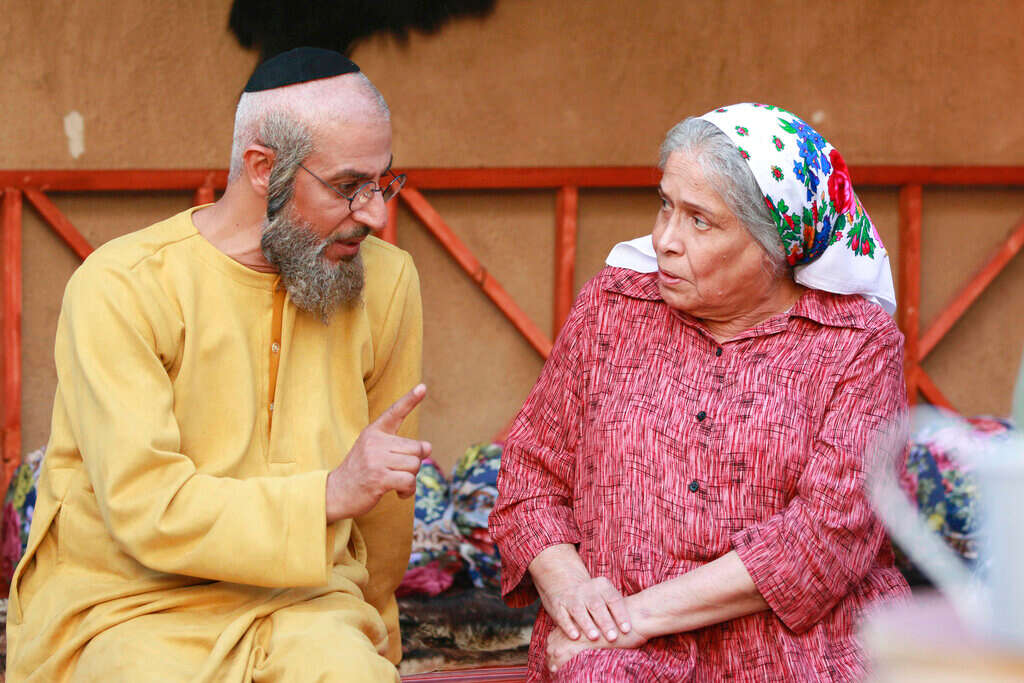
A television series aired by a Saudi broadcaster during the Muslim holy month of Ramadan has sparked controversy by offering a positive depiction of a Jewish community in the Gulf at the time of Israel's creation.
Critics say it and another series aired on the network promote normalization with Israel.
Follow Israel Hayom on Facebook and Twitter
Relations between Israel and Arab Gulf states have quietly improved in recent years as they have come to see Iran as a shared threat and Arab leaders have sought to curry favor with the Trump administration. Most TV shows in the Arab world are made by private companies, but producers must heed red lines set by the region's autocratic rulers.
Umm Haroun, Arabic for "the mother of Aaron," is set in an unnamed Gulf country in 1948. At that time, Jewish communities, some with ancient roots, could be found across the Arab world.
The series is being aired during Ramadan when viewership soars after Muslims break the daylong fast. It's like the Super Bowl for advertisers – even more so this year when many people are stuck at home because of coronavirus lockdowns.
The show portrays Jews and Muslims living together in peace and even features a romance between a Jewish woman and a Muslim man. Relations deteriorate after the creation of Israel.
In the years after the creation of Israel, Jews across the Middle East faced heightened persecution and hundreds of thousands emigrated to the new state. Once-thriving Jewish communities dwindled to only a handful of elderly holdouts or disappeared altogether.
Another Saudi-made series, Exit 7, has also struck a nerve.
A clip shared widely on social media features a debate between two main characters in which one defends the Palestinians while the other says he would be happy to do business in Israel. He accuses the Palestinians of being ungrateful for Saudi support and says they would attack the kingdom if they could.
The shows have prompted online calls for a boycott of MBC, the private, Saudi-owned satellite channel airing them. The Cairo-based Union of Arab Television Producers said they should be canceled, calling them "cheap works" meant to "brainwash" the Arab people.
The makers of Umm Haroun insist they have no political agenda.
"I wanted to write this drama to deliver the message that our societies were much more tolerant than they are today, and people should go back to the same values," Ali Shams, the head writer, told The Associated Press.
Producer Emad al-Enazy said the series was developed by MBC as well as Kuwaiti and Emirati production companies, with no governments involved.
For decades, Arab media frequently employed anti-Semitic tropes. But in recent years, show-runners have taken a renewed interest in Middle Eastern Jewish communities and pushed back against perceptions of the Arab world as intolerant and closed-minded.
The Jewish Quarter, an Egyptian series that aired in 2015, offered a positive portrayal of the pre-1948 Jewish community in Cairo and featured a love story between a Jewish woman and an Egyptian army officer. The deterioration of relations was largely blamed on the Muslim Brotherhood group, which in recent years has been the target of an unprecedented crackdown by Egypt's government. This year, Egypt has come under fire for airing a Ramadan sci-fi drama predicting Israel's destruction.
In Syria, a number of serials aired since the onset of the civil war have portrayed Jews and Christians in a positive light and blamed any sectarian strife on Western meddling – a view that aligns with the government's portrayal of the 2011 uprising as a foreign plot.
"The goal was to show how a mosaic of religious life was integral to the Syrian community prior to the onslaught of the West," says Rebecca Joubin, a professor at Davidson College who wrote a book about Syrian television dramas.
Joe Khalil, a professor at Northwestern University of Qatar and a former television producer, says the annual Ramadan line-up is always a "balancing" act.
"The programs should appeal to advertisers, respect the religious context, and often do advance political agendas," he said.
The two series have fed into longstanding tensions between the Palestinians and their critics in the Gulf, where many never forgave the late Palestinian leader Yasser Arafat for supporting Saddam Hussein's 1990 invasion of Kuwait.
Those tensions have boiled over on social media in recent days under the trending hashtags "Palestine is not my cause" and "Palestine is my cause." Saudis have depicted the Palestinians as violent ingrates, while Palestinians have accused their Arab critics of selling them out.
Saudi Arabia and other Gulf states welcomed the Trump administration's diplomatic efforts when the plan was announced in January while insisting they remain committed to a negotiated two-state solution.
Palestinian Authority Prime Minister Mohammed Shtayyeh said last week that the online insults did not represent the official position of either side.
"Saudi Arabia has always stood alongside us and has always supported us in the international arena," he said.
Prince Turki al-Faisal, a prominent member of the Saudi ruling family and former intelligence chief, denied there was any push for normalization in a prime-time interview that also ran during Ramadan.


