Friday Dec 5, 2025
NEWSLETTER
www.israelhayom.com
  • Home
  • News
    • Israel
    • Israel at War
    • Middle East
    • United States
  • Opinions
  • Jewish World
    • Archaeology
    • Antisemitism
  • Lifestyle
    • Food
    • Travel
    • Fashion
    • Culture
  • Magazine
    • Feature
    • Analysis
    • Explainer
  • In Memoriam
www.israelhayom.com
  • Home
  • News
    • Israel
    • Israel at War
    • Middle East
    • United States
  • Opinions
  • Jewish World
    • Archaeology
    • Antisemitism
  • Lifestyle
    • Food
    • Travel
    • Fashion
    • Culture
  • Magazine
    • Feature
    • Analysis
    • Explainer
  • In Memoriam
www.israelhayom.com
Home News Defense & Security

Israel demands major changes in UN peacekeeping force in Lebanon

"We are not calling to shut down the mission tomorrow morning but we want them to become more efficient," Israeli ambassador to the UN says of United Nations Interim Force in Lebanon. UNIFIL includes more than 9,400 ground troops and over 850 naval personnel in a Maritime Task Force. Its budget from July 2018-June 2019 was $474 million.

by  AP and Israel Hayom Staff
Published on  05-07-2020 13:52
Last modified: 05-07-2020 13:56
Israel demands major changes in UN peacekeeping force in LebanonAFP/Ali Dia

A peacekeeper of the United Nations Interim Force in southern Lebanon (UNIFIL) sits atop his armoured personel carrier as he monitors the border between Lebanon and Israel | File photo: AFP/Ali Dia

Share on FacebookShare on Twitter

Israel's UN ambassador said Wednesday that his government is demanding major changes in the way the UN peacekeeping mission in southern Lebanon operates on the ground and has support from the United States.

Ambassador Danny Danon told a video press briefing that Israel will insist that peacekeepers have access to all sites, that they have freedom of movement and that any time they are being blocked the UN Security Council must be immediately informed.

 Follow Israel Hayom on Facebook and Twitter

The peacekeeping mission in southern Lebanon, known as UNIFIL, was originally created to oversee the withdrawal of Israeli troops from Lebanon in 1978. The mission was expanded after a 2006 war between Israel and the Iranian-backed Hezbollah terrorist group so that peacekeepers could deploy along the Lebanon-Israel border to help Lebanese troops extend their authority into their country's south for the first time in decades.

Israel has repeatedly accused Iranian-backed Hezbollah militants of impeding the peacekeepers from carrying out their mandate.

"We have seen that slowly there is less places that the troops in the peacekeeping operation can actually travel in southern Lebanon," Danon said. "So we want them to have full freedom of movement."

"I have discussed it with the commander of the force and we tell them, `You are there, you cannot move and you can't inspect, so why you are there?,"' he said. "`You have to be more active, you have to move freely and you have to inspect all sites.'"
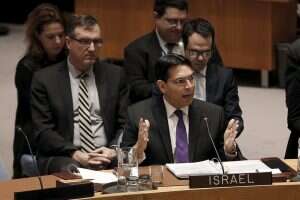
Israel's Ambassador to the United Nations Danny Danon addresses the UN Security Council (Reuters/Mike Segar)

UNIFIL includes more than 9,400 ground troops and over 850 naval personnel in a Maritime Task Force. Its budget from July 2018-June 2019 was $474 million.

Danon said Israel knows that on many occasions UNIFIL troops haven't been able to enter suspicious sites, "and we proved in the past that Hezbollah are digging tunnels, they are bringing weapons to the border, and only in the last few weeks we have had a few incidents on the border."

Danon said Israel will continue pushing for reforms before the mandate for UNIFIL is renewed during the summer and will be explaining Israel's position to council members. He said Israel is grateful for US Ambassador Kelly Craft's strong support.

He said the United States is raising the issue of the budget "and saying very clearly if they are not effective, why are we spending so much money on the troops?"

"We are not calling to shut down the mission tomorrow morning, but we are saying if they cannot change, if they cannot function, why you are spending so much money?" Danon said. "We don't want to send the troops back to their countries, but we want them to become more efficient."

On Monday, the UN Security Council met to discuss the implementation of a 2004 resolution that called for the Lebanese government to extend its authority throughout the country and all Lebanese and non-Lebanese militias to disband.

UN Secretary General Antonio Guterres' latest report said Lebanon's government continued with those efforts but Lebanese and non-Lebanese militias continue to operate outside government control in violation of the resolution and the Taif Accords that ended the country's 1975-90 civil war.

"Several groups across the political spectrum in Lebanon possess weapons outside government control," the UN chief said, adding that "Hezbollah is the most heavily armed militia in the country."

Guterres said he continues to urge Lebanon's government and armed forces "to take all measures necessary to prohibit Hezbollah and other armed groups from acquiring weapons and building paramilitary capacity outside the authority of the state."

He also urged countries with close ties to Hezbollah "to encourage the transformation of the group into a solely civilian political party, as well as its disarmament."

Related Posts

Israeli laser shield expected to become operational by December 30IDF Spokesperson's Unit

Israeli laser shield expected to become operational by December 30

by Lilach Shoval

Handover to IDF come after game-changing air defense proven in trials; next generations of development already underway.

'We will not allow terror to take root': IDF launches broad counter-terror operation in northern SamariaIDF Spokesperson's Unit

'We will not allow terror to take root': IDF launches broad counter-terror operation in northern Samaria

by Lidor Sultan

The joint mission by the IDF and Shin Bet targets specific hotspots where intelligence indicates terror cells are attempting to...

Israel opens defense export floodgatesCourtesy

Israel opens defense export floodgates

by Lilach Shoval

Defense Ministry streamlines licensing procedures and significantly enlarges list of approved countries for Israeli military equipment sales.

Menu

Analysis 

Archaeology

Blogpost

Business & Finance

Culture

Exclusive

Explainer

Environment


Features

Health

In Brief

Jewish World

Judea and Samaria

Lifestyle

Cyber & Internet

Sports


Diplomacy 

Iran & The Gulf

Gaza Strip

Politics

Shopping

Terms of use

Privacy Policy

Submissions

Contact Us

About Us

The first issue of Israel Hayom appeared on July 30, 2007. Israel Hayom was founded on the belief that the Israeli public deserves better, more balanced and more accurate journalism. Journalism that speaks, not shouts. Journalism of a different kind. And free of charge.

All rights reserved to Israel Hayom

Hosted by sPD.co.il

  • Home
  • News
    • Israel at War
    • Israel
    • United States
    • Middle East
    • Sports
  • Opinions
  • Jewish World
    • Archaeology
    • Antisemitism
  • Lifestyle
    • Food
    • Travel
    • Fashion
    • Culture
  • Magazine
    • Feature
    • Analysis
    • Explainer
    • Environment & Wildlife
    • Health & Wellness
  • In Memoriam
  • Subscribe to Newsletter
  • Submit your opinion
  • Terms and conditions

All rights reserved to Israel Hayom

Hosted by sPD.co.il

Newsletter

[contact-form-7 id=”508379″ html_id=”isrh_form_Newsletter_en” title=”newsletter_subscribe”]

  • Home
  • News
    • Israel at War
    • Israel
    • United States
    • Middle East
    • Sports
  • Opinions
  • Jewish World
    • Archaeology
    • Antisemitism
  • Lifestyle
    • Food
    • Travel
    • Fashion
    • Culture
  • Magazine
    • Feature
    • Analysis
    • Explainer
    • Environment & Wildlife
    • Health & Wellness
  • In Memoriam
  • Subscribe to Newsletter
  • Submit your opinion
  • Terms and conditions

All rights reserved to Israel Hayom

Hosted by sPD.co.il