


Blocking the infection cycle: Technion – Israel Institute of Technology scientists have developed effective and long-lasting disinfectants that, unlike household bleach and similar products used for disinfecting surfaces, target the virus infection mechanism and remain active for longer
Scientists from Technion's Wolfson Faculty of Chemical Engineering have developed smart disinfectants that destroy the coronavirus infection mechanism and remain active over time. These products are expected to replace household bleach and other chorine-based products whose disinfecting powers diminish rapidly.
Follow Israel Hayom on Facebook and Twitter
Asst. Prof. Shady Farah, head of the research group, has been awarded a European Institute of Innovation and Technology (EIT) Health COVID-19 Rapid Response grant in order to accelerate its development process and market launch.
This is the first time that a Technion scientist receives a prestigious EIT Health grant alone. "We are currently producing potential substances and testing them. We plan to select the optimal substance and begin mass production in the next few months," says Farah.
The SARS-CoV-2 coronavirus belongs to an extensive family of viruses that the world has been aware of for many years, some of which can also infect humans. The novel coronavirus closely resembles one of its predecessors, SARS-CoV, which also originated in China and spread to many other countries. But the steps that were taken to fight SARS-CoV are not effective enough against the current pandemic.
To date, there is no approved "knockout" treatment for SARS-CoV-2 and there is no vaccine against it.
The coronavirus can survive on various surfaces for extended periods of time, depending on the type of surface and other conditions. This fact increases the probability of infection from touching contaminated surfaces, in addition to person-to-person infection.
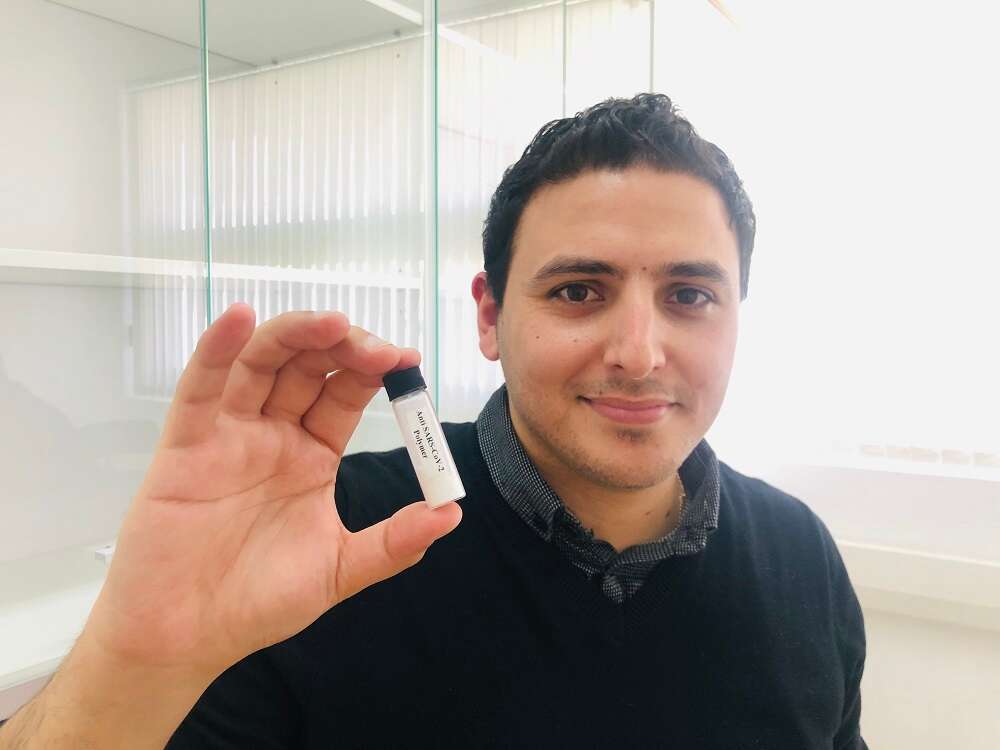
Farah's research group develops innovative polymers for medical use and smart drug delivery technologies. When the COVID-19 epidemic broke out, the research group immediately devoted itself to developing special anti-viral polymers that act on the virus in two ways: by altering and damaging its structure so that its infection capability is impaired; and by attacking and destroying the virus's envelope. No less important, the disinfecting substance is released in a controlled and continuous manner so that the new technology's effect is long-lasting.
Disinfectants have been used since the start of the coronavirus pandemic in order to prevent infection from contaminated surfaces – mainly by applying hypochlorite solutions, more commonly known as household bleach.
This method has several significant disadvantages: it evaporates quickly, and breaks down rapidly when exposed to sunlight. Consequently, its effectiveness is limited and short-term, requiring surfaces to be disinfected several times a day.
The new disinfectant technology developed by the Technion is based on low-cost and readily available raw materials.
"The materials we developed will be a gamechanger because they will block the cycle of infection from contaminated surfaces," Farah said.
"Infection from touching surfaces is a serious problem, especially in public places such as hospitals, factories, schools, shopping malls, and public transportation. Our polymers will make these places safer.
"Although this development was accelerated due to the current coronavirus crisis, in the future it will also be effective against other microorganisms. We are enriching the arsenal of tools available to us and adding a new family of disinfectants that release the active substance in a controlled manner. In this way, they remain effective for long periods of time."
Farah completed three academic degrees at the Hebrew University of Jerusalem, including a direct-track PhD in Medicinal Chemistry. He then pursued postdoctoral research at MIT (with Prof. Robert Langer and Prof. Daniel G. Anderson) and at the Boston Children's Hospital/Harvard Medical School. He is currently Assistant Professor in the Technion's Wolfson Faculty of Chemical Engineering, where he holds a Neubauer Chair, and is a fellow of the Russell Berrie Nanotechnology Institute (RBNI). He received a Maof Fellowship for Outstanding Young Researchers and his lab received generous funding from the Neubauer Family Foundation.


