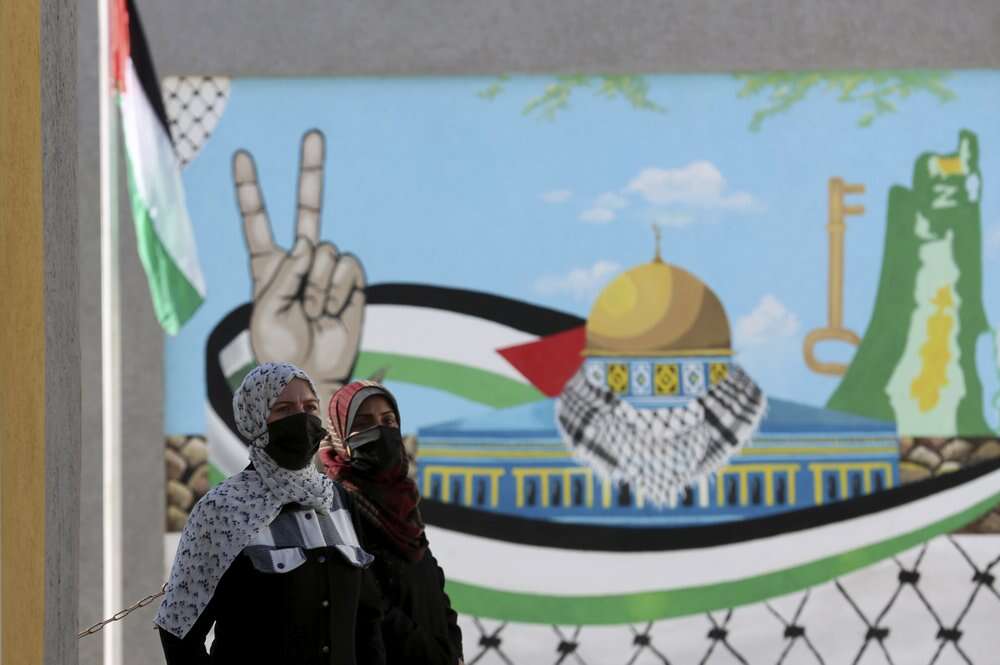
Palestinian poll workers fanned out across the Gaza Strip on Wednesday, where they found voters eager to register ahead of elections that could serve as the first referendum on Hamas' rule since the terrorist group seized power more than a decade ago.
Follow Israel Hayom on Facebook and Twitter
The outreach came a day after Palestinian Authority President Mahmoud Abbas' Fatah party and Hamas reaffirmed their commitment to holding parliamentary and presidential elections later this year, the first since Hamas won a landslide victory in 2006.
That led to bitter infighting, culminating in Hamas' violent seizure of the Gaza Strip a year later and leaving Abbas' administration limited to enclaves in the West Bank. Several attempts at reconciliation have failed, and the elections could still be canceled or postponed.
In a joint statement, representatives of Hamas and Fatah said they had agreed elections for the Palestinian Legislative Council would be held on May 22, and presidential elections would be held on July 31, with elections for the Palestinian National Council to be held one month later. The factions also agreed to set up a tribunal and an organizing committee to oversee election purity.
In the meantime, 28 teams from the Central Elections Committee deployed to help register voters in Gaza, where internet access is limited. Election officials said interest was high, with more than 90% of Gaza City's 385,000 eligible voters having already registered before a Feb. 16 deadline.
"There is a passion among the people," election official Mohammed Abu el-Khair said. "The last legislative elections took place in 2006 and now we are in 2021, so a large portion of the youth have never participated or voted in an election."
Gazans have also seen their living conditions severely deteriorate under Hamas rule. Israel and Egypt imposed a crippling blockade after the takeover, and the rival Palestinian factions have bickered over the provision of public services. As a result, unemployment hovers around 50%, rolling power outages last for several hours a day, and tap water is undrinkable.
Mohammed al-Jawabra graduated with a journalism degree shortly after Hamas took over and has yet to find a job matching his skills. Instead, the 34-year-old sells coffee and tea from a street cart.
"I want to see a change here in terms of the economy, unemployment and many things, like the crossing points," he said as he confirmed his information to a poll worker with a tablet. "I'm sorry to say that there are youths who can't work at this time and graduates who cannot be hired."
Israel says the blockade is needed to keep Hamas from importing arms. The terrorist group has fought three wars with Israel since 2007, compounding Gaza's suffering. The isolation is especially hard for university graduates, who face major obstacles in leaving the impoverished territory to seek employment or advanced degrees abroad.
It's unclear whether Gazans will punish Hamas in the polls. The terrorist group blames the territory's problems on Israel and Abbas' Palestinian Authority, and it retains a strong base of support among Gaza's population of over 2 million.
The 85-year-old Abbas, who has presided over an increasingly authoritarian Palestinian Authority since his presidential mandate ended in 2009, could also face a backlash.
After two days of talks in Cairo, the Palestinian factions said Tuesday that they had agreed on some key points for holding elections. Rank-and-file police in the West Bank and Gaza, who are seen as less beholden to the factions, will guard polling stations. The two sides also pledged to release political prisoners and allow freedom of expression and assembly.
They must still agree on the makeup of an election court to adjudicate disputes, and they plan to hold more discussions next month.
While Palestinians imprisoned in Israel for security and criminal offenses will be allowed to vote, those in refugee camps in Jordan, Lebanon, and Syria will not.
The Palestinians have vowed to hold elections in the West Bank, Gaza, and east Jerusalem, territories they want for their future state. If Israel refuses to allow voting in east Jerusalem, the Palestinian factions could cite that as a reason for canceling or delaying the elections.
Subscribe to Israel Hayom's daily newsletter and never miss our top stories!