

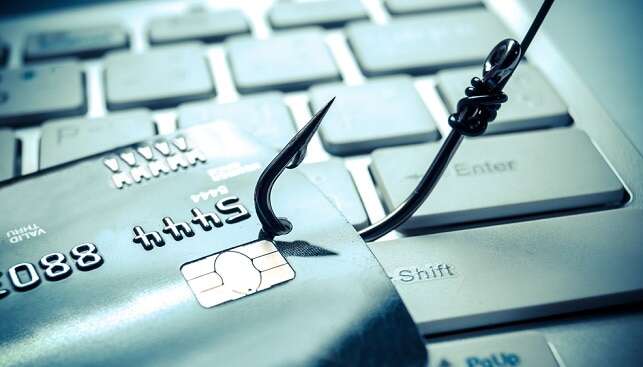
Who of us has not heard or even experienced the following email scams: a Nigerian prince wants to transfer large sums of money into your account, or a childless millionaire on her deathbed wishes to bequeath her fortune to you, or a widowed doctor is volunteering in Africa looking for true love and says you might be the one.
Follow Israel Hayom on Facebook and Twitter
In 2021, most people are not fooled by such scams. These emails, and sometimes Facebook messages, are suspicious the moment you read them, especially since they contain lots of grammar mistakes.
Nevertheless, despite the relatively high awareness of the issue in society, some do still fall prey to such fraud. These are primarily elderly, mentally ill, or financially challenged individuals.

Phishing, as such fraud is called, is common in every country, especially in English-speaking ones. Dozens of offices in India pretend to be call centers for Microsoft or Google and manage to rip off innocent customers.
One scenario involves a warning on an internet user's screen, something along the lines of "Your computer has been infected by a virus, call technical support immediately."
When the victim of the scam is the one who initiates the phone call, he is much more likely to believe that he is contacting a legitimate center.
The scammer will then ask the customer to download a program that will enable him to take over the computer "to fix the problem." The user, who thinks his computer has been infected with a virus, is asked to pay an exorbitant amount for the antivirus program, which will not be installed on his computer.
Sometimes, scammers claim the company is closing down, and they would like to refund the user for a payment he made in the past. For this, they connect to the victim's computer, ask to fill out a special form, and type in the amount of money to be transferred.
The scammers add a 0 at the end of the sun, and when the customer sees that he "mistakenly" arranged for a higher refund, the scammers ask to return the money by a gift card or money transfer.
In 2019, when the Facebook data leak happened, the information of more than half a billion users became available online. Full names, phone numbers, emails, dates of birth, you name it. Scammers jumped at the opportunity to use this wealth of personal information.
How to prevent such frauds from happening? The simple answer is: there is no real way to avoid such email scams except speak to your grandparents and explain to them that if they receive a message of this kind, they should not engage.
Some people have taken it upon themselves to eradicate the phone and internet scams and, to this end, created special YouTube channels. Israel Hayom spoke to three such YouTubers to find out their methods in fighting that which appears to be undefeatable.
Jim Browning's channel, which has 3.1 million subscribers, deals with exposing frauds like impersonating a company worker or a customer service representative in India. He aims to get these offices closed down and has succeeded several times already, when thanks to his work, the Indian police, which previously received countless complaints, but did nothing to stop the fraud, was finally under pressure to act.
Browning's videos include phone calls with scammers during which he pretends to be an innocent customer, and shows how he gets access to the scammer's phones, deletes data on their computers, and downloads lists of potential "customers," whom he later warns.
Sometimes he can save the victim in the middle of the fraud by calling the user while he is on the phone with the scammer. Surprisingly, most of the time, victims do not believe that they are being scammed. In fact, often, they think Browning is the scammer.
"These fraudsters manage to persuade the victims to part with their money because it is someone who seems trustworthy, so when I called them up saying, 'hey, you are being scammed,' they get suspicious," Browning explained.

Browning, which is an alias, lives somewhere in Europe. He is a computer and software engineer and has always been fascinated with internet fraud.
"I would call it 'professional curiosity.' I've always wanted to know how these scams work, how they are built, how to find the weakness in them, and repay the scammer what he deserves."
Browning's YouTube channel began by accident.
"I wanted to show one of the scammer's internet provider what he had done. I recorded it, uploaded the video to YouTube, and sent him [the provider] the link to have it [the scammer's internet] blocked, and people discovered the video and watched it. I never intended to become a well-known and popular YouTuber."
Dutch YouTuber, Deeveeaar, who has 136,000 subscribers, works with fraud exposers worldwide without knowing their real names or exact locations.
"Not only do we waste their [the scammers'] time, but we also cause them millions of dollars in damage," he said. "We hack into their websites, take over their computers and cause calls to overflow.
Another YouTube channel, ScamBait Central, with more than 39,000 subscribers, is run by a Londoner who calls himself Mr. Pricky. He is a veteran in the field and mainly deals with West African scams.
He does most of his work through Facebook live, during which he exposes scammers. Often Mr. Pricky tries to trick the scammer himself.
"I spoke to someone who "sells gold" in Ghana once a week for a year. It was a large sum of 234,000 pounds ($326,000). After several failed attempts, he agreed to send a colleague to the UK to collect the money. When he arrived at the meeting point in London, I photographed him standing and waiting for the money that never arrived."
Subscribe to Israel Hayom's daily newsletter and never miss our top stories!


