

Thousands of Afghans struggling to ensure the physical safety of their families after the Taliban took control of the country have an additional worry: that biometric database and their own digital history can be used to track and target them.
Follow Israel Hayom on Facebook and Twitter
UN Secretary-General Antonio Guterres has warned of "chilling" curbs on human rights and violations against women and girls, and Amnesty International on Monday said thousands of Afghans, including academics, journalists and activists, were "at serious risk of Taliban reprisals."
After years of a push to digitize databases in the country, and introduce digital identity cards and biometrics for voting, activists warn these technologies can be used to target and attack vulnerable groups.
"We understand that the Taliban is now likely to have access to various biometric databases and equipment in Afghanistan," the Human Rights First group wrote on Twitter on Monday.
"This technology is likely to include access to a database with fingerprints and iris scans, and include facial recognition technology," the group added.
The US-based advocacy group quickly published a Farsi-language version of its guide on how to delete digital history - that it had produced last year for activists in Hong Kong - and also put together a manual on how to evade biometrics.
Tips to bypass facial recognition include looking down, wearing things to obscure facial features, or applying many layers of makeup, the guide said, although fingerprint and iris scans were difficult to bypass.
"With the data, it is much more difficult to hide, obfuscate your and your family's identities, and the data can also be used to flesh out your contacts and network," said Welton Chang, chief technology officer at Human Rights First.
It could also be used "to create a new class structure - job applicants would have their bio-data compared to the database, and jobs could be denied on the basis of having connections to the former government or security forces," he added.
The most "dire circumstance" would be to use the data to target anyone who was involved in the previous government, or worked in an international non-profit, or was a human rights defender, he told the Thomson Reuters Foundation.
Even five years ago, the Taliban was using government biometric systems to target members of the security forces, checking their fingerprints against a database, according to local media reports.
On Monday, just hours after the militants rolled into the capital Kabul, there were fears that this was already happening.
"Taliban started door-to-door search" for government officials, former security forces members and those who worked for foreign non-profits, a Twitter user called Mustafa said on Monday, adding that journalists' homes were also searched.
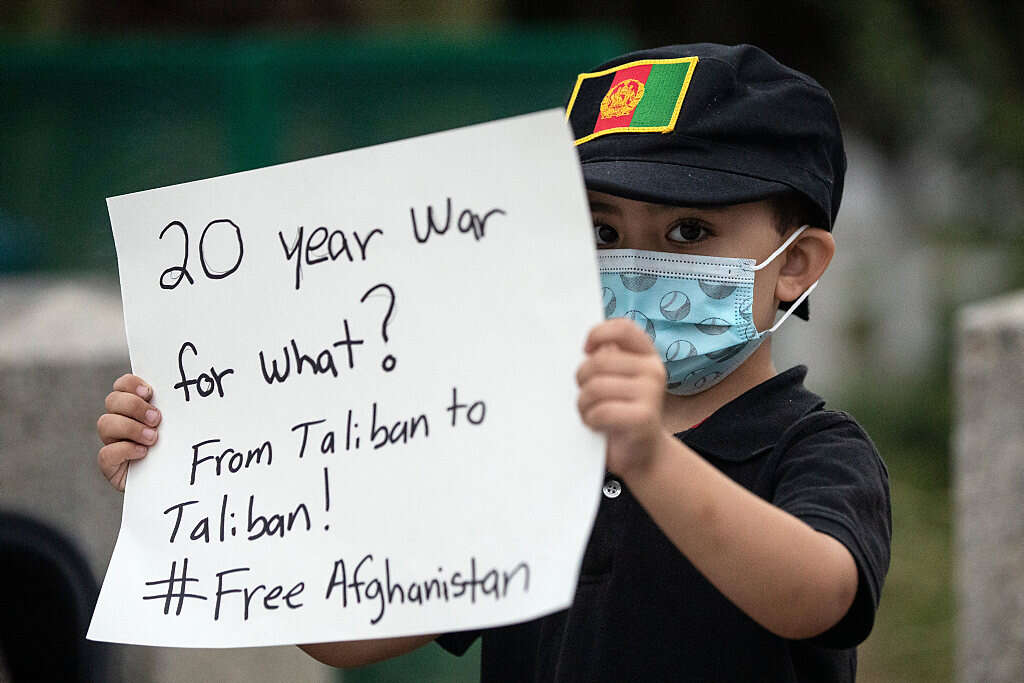
A young demonstrator holds a poster reading "20 year warfare what? From Taliban to Taliban! Free Afghanistan" during a rally in Los Angeles, Aug. 17, 2021 (EPA/Etienne Laurent)A Kabul resident said in a private message that she had heard of house-to-house inspections and that the Islamist militants were using a "biometrics machine."
The Taliban, in a statement, said it "assures all its citizens that it will, as always, protect their life, property and honor and create a peaceful and secure environment for its beloved nation."
But digital rights groups are already getting "significant numbers" of requests from civil society groups and activists on securing their digital presence, said Raman Jit Singh Chima, Asia Pacific policy director at Access Now.
"We are also very concerned about databases retained by aid agencies and other groups, and alarmed that there is no clarity whether mitigation measures are being taken to either delete or purge information that can be used to target people," he said.
The digital identity cards, the tazkira, can expose certain ethnic groups, while even telecom companies have a "wealth of data" that can be used to track and target people, he added.
The responsibility to secure data systems was ultimately that of the Afghan government, said Chang, although the U.S. forces and its allies probably had a role in "designing the systems in the first place and helping with implementation."
"Likely not enough deliberate planning was done at the outset of creating, maintaining and turning over the system in terms of risk assessments and prevention of misuse," he added.
Meanwhile, Afghans were doing what they could to scrub their digital profiles.
Boys and men were "frantically going through phones to delete messages they have sent, the music they've listened to and pictures they've taken," BBC reporter Sana Safi wrote on Twitter on Sunday.
Subscribe to Israel Hayom's daily newsletter and never miss our top stories!


