
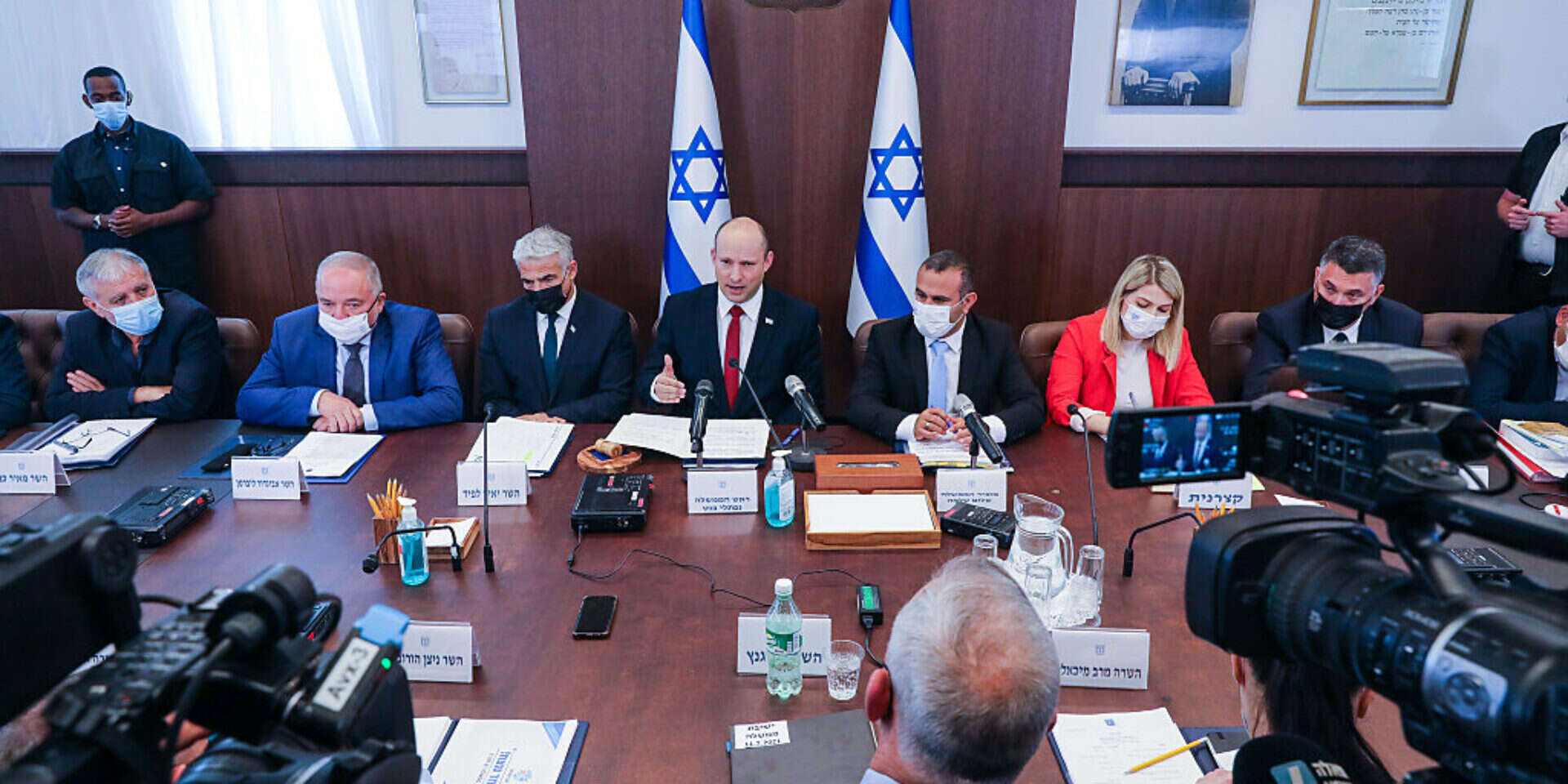
The coalition cobbled together by Yesh Atid leader Yair Lapid and Yamina chief Naftali Bennett government, which many did not believe could be formed, let alone make it through its first week, is completing nearly 100 days in office.
Follow Israel Hayom on Facebook and Twitter
During this grace period, the government faced several tests. How did the ministers, who were used to criticizing the previous government from the benches of the opposition do? Israel Hayom offers a special review.
Health: Living with COVID-19 come with a price
Health Minister Nitzan Horowitz began his term as Minister of Health with the statement that health is about a lot more than the coronavirus - he also inherited very low morbidity rates. But with the fourth wave of the pandemic, the virus is once again the focus of the minister's attention, and many other important issues have been neglected.
Horowitz and Prime Minister Bennett have succeeded, for the first time, to a great measure thanks to the booster vaccinations, in forming a strategy for living alongside the coronavirus. There has been a clear preference for as few limitations as possible - contrary to the position of the professional echelon in the ministry - even if this is at the cost of human life. The current wave has claimed 961 deaths and almost 4,000 severely ill.
Horowitz promised to strengthen the health system and made the positions added by the previous government "permanent". However, hospitals are still waiting for 100 doctors and 550 nursing staff promised in three increments.

Horowitz is currently facing several upheavals. In his short term, he has had to deal with a crisis in Israel's hospitals, including Hadassah and Shaarei Tzedek medical centers, and a strike that hit patients hard. He has a strained relationship with hospital directors who over recent days have claimed that he is inaccessible and ignores them, and is also on a crash course with one of Israel's largest health maintenance organizations.
Horowitz has succeeded in obtaining a significant budgetary increase of some NIS 2 million for the health system that will be used to widen the health basket and strengthen the mental health system.
Horowitz is no political novice and in his first 100 days in office he has managed to lead several processes, but these have been mostly sectorial such as allowing blood donations by homosexuals and shortening waiting lists for gender-reassignment surgery.
In his first address as Health Minister, Horowitz emphasized preventative medicine, beginning before patients reach hospitals. This is a promise that has yet to materialize.
Diplomacy: No extra points for being nice
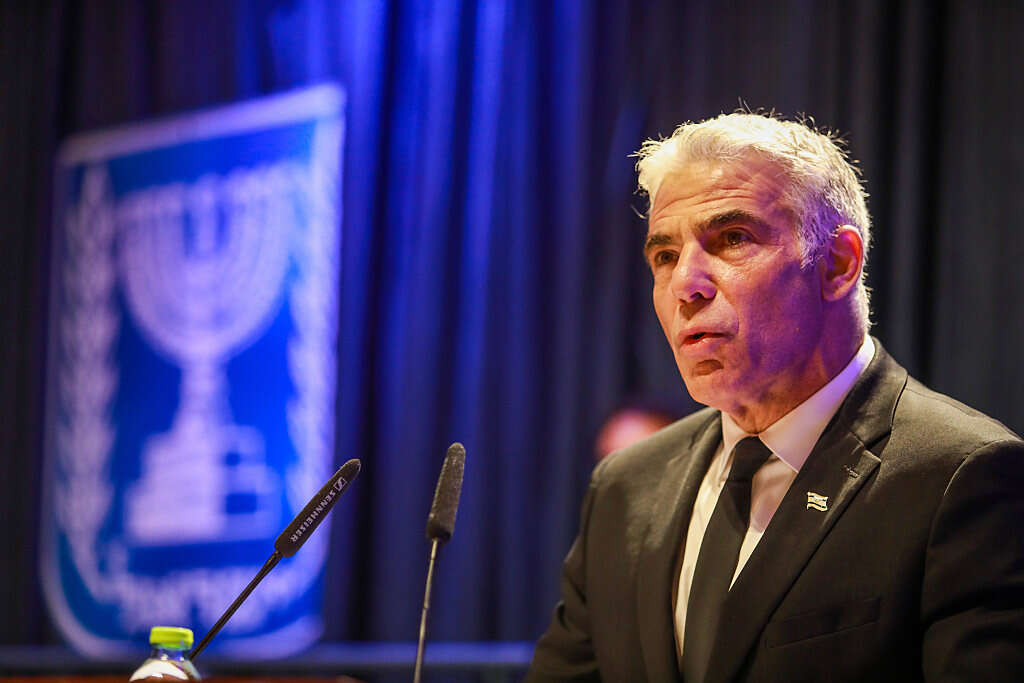
Benjamin Netanyahu left his successors a full tank on the diplomatic front, and they have certainly been making use - physically and metaphorically - of the jet fuel they received. Foreign Minister Yair Lapid dedicated the new Israeli representative offices in the United Arab Emirates and Morocco and is due to travel to Bahrain. The new government is also enjoying a tailwind from the hostility of Western liberal governments in Europe and the United States to Netanyahu.
After 12 years in which Netanyahu ignored the demands of the European Union and American liberals for withdrawals, Brussels and the White House are thankful for every moment they get to deal with other Israelis, those that are kind of nice and kind of naive. The trauma they are still suffering from Netanyahu is the main reason that the new government is enjoying kid gloves treatment from Western governments, and that, at present, there are no real pressures on Israel on the Palestinian issue.
But not every day is Christmas and the present situation won't go on forever. Alternate prime minister Yair Lapid, the dominant figure in Israel's foreign policy management, is putting his hopes in those liberal circles, some of which are antisemitic and all of which in any case are weak. They are not capable, and perhaps they just won't want to defend Israel when the day comes.
The key to building diplomatic strength is not being nice, it is being strong. Naive plans such as the one Lapid published this week with regard to Gaza, the government's growing occupation with the insolvable Palestinian issue won't improve Israel standing. With the exception of a few headlines in The New York Times, we won't score any points as a result.
The Abraham Accords, which the new government wishes to continue with, and Israel's standing in the world in general, weren't born out of niceties, or as a result of dealing with the Palestinian issue. In fact, the opposite is true. In the diplomatic world, it is the strong who gain respect - see China as an example - not those who are right or innocent. 100 days may have passed, but it is not too late to get back on the right track.
Education: Good plans, zero action
Ever since Yifat Shasha-Biton took up her post as Minister of Education it seems that the ministry has been far too involved in managing the coronavirus and far too little in education. All the decisions the ministry has taken since the new government came into power have been mostly technical – tests, vaccinations, green passes for teachers – and much less to do with pedagogical affairs.
Even though almost two years have passed since the coronavirus erupted, we have yet to see a real plan to narrow gaps between strong pupils and weak ones in the sciences, maths and English, subjects that are critical to success. Moreover, the whole issue of the digital divide has yet to be dealt with, primarily due to the absence of a budget for this. For comparison's sake, in the previous school year, then minister of education Yoav Galant allocated NIS 4.2 billion for this purpose, while this year only NIS 300 million ($93.5 million) has been allocated for reducing the digital divide, and the ministry has made far too many promises based on this sum.
At the end of the day, the ministry has missed the biggest opportunity of all – to reduce the number of pupils in classes. There is also a need to deal with psychological issues, however the education system is dealing with a massive shortage of educational psychologists in schools.
The new education minister came into the job with a lot of plans that could be good for the education system such as a five-day study week for junior schools and reducing the number of matriculation exams – the problem is that none of them have actually been enacted in practice. The bottom line: What won't be done now, won't be done later. A new school year with a new education minister has failed to bring any new tidings – that's how it goes when you don't want to clash with the teachers' union.
Defense and security: Escalation on every front
100 days into the Bennett-Lapid government it appears that the security situation is deteriorating, on almost every possible front.
The first and most challenging front is of course Iran. Despite the policy change made by the Bennett government, which, at the recommendation of the defense establishment, allowed Israeli diplomats, after years in which they were prohibited from doing so, to discuss with the Americans the renewal of the nuclear accords, the Biden administration's policy is unchanged and it still seeks to return as soon as possible to a nuclear agreement that is bad from Israel's perspective. Paradoxically, the only thing preventing that at the moment is the Iranians.
In the meantime, the defense establishment describes the situation with Iran as "dangerous" treading on water, with no credible economic or military threat against Iran to stop it from progressing with its nuclear program. At the same time, it has no commitment to comply with any nuclear agreement and this enables it to enrich uranium undisturbed. Israel's defense establishment believes that in practice, Iran is "crawling" toward a bomb.
In the Palestinian arena as well, it appears that the situation is going from worse to worse. Despite declarations by the defense minister and the heads of the defense establishment following Operation Guardian of the Walls that "things will no longer continue as they were" Israel has allowed easing of restrictions on the Gaza Strip, thus giving up its bargaining chips in exchange for temporary quiet, while Hamas has made no commitment to a long-term ceasefire and has shown no willingness to reach a solution on the issue of Israeli MIA's and captives.
Israel may have stepped up its military measures, striking Gaza even in response to incendiary balloons, but that hasn't stopped the terror organizations from firing rockets at the Western Negev for several days in a row. The common opinion in the defense establishment is that another operation in Gaza in the near future is a possibility. Add to that the public outrage at the death of Barel Hadaria Shmueli, a Border Police special forces sniper, during violent protests along the Gaza border after months of quiet on that front.
At the same time, in Judea and Samaria, Defense Minister Benny Gantz has registered an achievement of sorts after meeting a few weeks ago with Palestinian Authority Chairman Mahmoud Abbas in Ramallah, a meeting that both sides made public. The aim was to strengthen the Palestinian Authority, especially in view of the points scored by Hamas following Operation Guardian of the Walls. But Bennett was quick to dim even that achievement when a puzzling statement was issued in the name of a "senior political source" stating that "there is no diplomatic process ongoing with the Palestinians and neither will there be." This despite the fact that he was well aware of Gantz's meeting with Abbas.
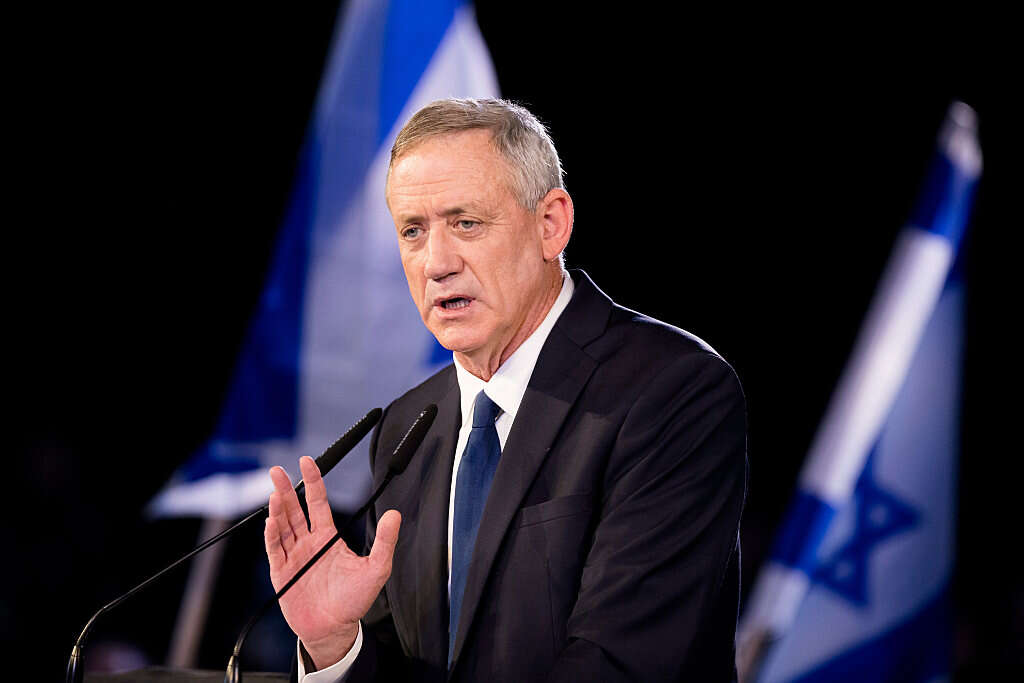
On a positive note, one of the biggest achievements scored by the defense establishment is an agreement on a long-term multi-year budget after years in which Israel did not have a budget. Prime Minister Bennett, Finance Minister Liberman and Defense Minister Gantz – all three of them defense ministers past or present – managed to reach an agreement without any publicized arguments, a fact that gives the defense establishment stability and the ability to build up its force on important issues such as preparation for a strike on Iran, upgrading of the border with Lebanon, and more. But it was a relatively esoteric issue – the victory of the Chief of Staff and the defense minister in the battle to increase military pensions - that led them to defeat in the public and media arenas, in particular given the fact that there was no parallel raise in the salaries of conscription soldiers.
Judea and Samaria: Status quo maintained, so far
The weak point of the Bennett-Lapid government is its diversity. A government composed of so many parties from such different sides of the political spectrum is liable to face difficulties in advancing significant diplomatic processes in Judea and Samaria. The leaders of the coalition understand this. The coalition agreements make no mention of one of the most burning issues of recent years - applying Israeli sovereignty to Judea and Samaria. That said, the status quo with regard to construction in Judea and Samaria has been maintained.
Construction in Judea and Samaria was one of the first challenges faced by the new government. While Netanyahu had the benefit of a friendly president, the Bennett-Lapid government is dealing with a president, who to put it mildly, is a little less enthusiastic about construction in the settlements. The new government did receive American support for convening the higher planning committee in order to advance plans for the construction of 2000 housing units in Judea and Samaria, but Bennett had to swallow the bitter pill of authorizing 1,000 Palestinian housing units. The majority of which had, by the way, been approved by the previous government. While the Planning Committee did improve planning for construction inside the settlements after a period of seven months in which had not convened, thousands of plans that have been waiting months or even years for approval were postponed to a later date.

The settlers' disappointment is understandable, especially when a comparison is made to 2020 when some 12,000 units were approved at various stages, but it should be recalled that it was the Netanyahu government that froze construction in Judea and Samaria in the months leading up to August. The last time the planning committee convened under the Netanyahu government was in January 2021, when it approved 800 units. Following that, under American pressure, the committee did not convene through to the end of the term of the previous government. Will the new government maintain the status quo and convene the planning committee in the coming quarters? The jury will be out on that.
On the other hand, the fact that heterogeneous nature of the new government could give it a significant advantage and allow it to advance processes that traditional right-wing governments have not been able to for years. That was what happened with the Bennett government's first major challenge: The Evyatar outpost when the settlers took advantage of the weakness of the previous government in its final days and the birth pangs of the new government to determine facts on the ground. Even the veterans of the settlement movement couldn't have imagined a scenario where the affair would end with the agreement in principle of this right-left government to establish a completely new settlement. This is something that hasn't been seen for decades (with the exception of the establishment of the settlement of Amichai as compensation for the settlers of Amona).
The Bennett-Lapid government faces two additional challenges, both of which it inherited from the previous government, so the grade it receives for the moment is no more than pass. One is dealing with the massive Palestinian takeover of Area C and state lands. This is a phenomenon that grew during the Netanyahu government. In opposition, Bennett and Shaked attacked the Netanyahu government's handling of this issue and proposed wide-reaching plans to deal with it.
However, 100 days into their reign, no significant moves have been made on the matter. The second challenge is the issue of demolishing Khan al -Akhmar, a step that the previous government postponed again and again. It came under attack for this by the right-wing members of today's coalition. So is it a case of not seeing from there, what they can see from here? Perhaps. For the moment, the new government has asked the High Court of Justice to postpone the demolition of Khan al-Akhmar for at least six months. Further down the line, we will see whether the heads of this government will stand behind their previous declarations and deal with this burning issue, or whether they will prefer to leave it to burn out of control.
Economics: Mass hysteria
You know the type of person who when he is told he has to fly overseas for a day or two starts to panic. He takes a big suitcase and, while muttering irrationally, starts to throw in all sorts of items that aren't connected in any way to the purpose of his voyage. That's exactly what this government has done from an economic perspective since being sworn in. It has clubbed together various components of various plans and put them into legislation - The Budget Law and various other ancillary laws. The only clear line that runs through all these arbitrary and indiscriminate bits of legislation is that the government mustn't raise taxes, but it needs to bring in more revenues. So, what to do? Club together with a few clauses from old bills that will send the government's hands into citizens' pockets, but won't fall under the definition of "taxes."
A levy on sweet drinks - marvelous! A hike in municipal rates - fantastic! A hit on pension linkage, going beyond the budget deficit defined by law - those aren't taxes, so why not? A cut in daycare for Haredi mothers, cuts in budgets for the ultra-Orthodox - that won't hurt potential voters!

It is a good thing that there is a budget and an economic arrangements bill, and it's a good thing that there is a government. Anyone that isn't an anarchist understands that a bad government is preferable to no government. A confused and contorted budget is better than no budget, especially now that the worst of the trauma caused by the pandemic is behind us. But there is nothing in this government's ragtag and random collection of economic decisions to suggest that it has a policy.
Public security: Crime in the Arab sector remains rampant
Despite the fact that the "government for change" was established with the support of the United Arab List, it has so far failed in its handling of crime in the Arab sector, and in general. Since the start of the year, 84 Israeli-Arabs had been murdered, 13 of them since Prime Minister Naftali Bennett launched a special division to deal with crime in the Arab sector. The nadir came when gunmen shot, for the first time, at the home of Chief Superintendent Jamal Hakroush, the head of the division for preventing crime in the Israeli-Arab sector.
Enforcement of coronavirus regulations has also run into difficulties due to the policy of "containment" adopted by the government. The number of citizens currently required to self-isolate stands at around 170,000, a figure that the Public Security Ministry describes as impossible to enforce in full.

But there is positive news. After years of operating without a multi-year budget, the Israel Police and Israel Prison Service this week signed a budgetary agreement for 2021/2022. The agreement was led by the director-general of the Public Security Ministry, Timer Lotan, and gives the police and prison services advanced tools to manage manpower and salaries effectively for the coming years while addressing planning processes, efficiency measures and force build-up.
After years of poor organizational management, the budget now requires the police and the prison services for the first time to regulate management of their organizations. Much to the indignation of some frustrated high-earning senior officers, the budget will lead to a build-up of these organizations in the technological and digital fields. There will be an addition of 800 positions for 2022, and a further 170 in 2023 for the benefit of training and national projects.
Legal affairs: No shift to the right
It appears that 100 days into the Bennett government when it comes to legal affairs at least, it is fair to say that the government has not moved "10 degrees to the right". It has postponed for another six months the debate on illegal Beduin settlement in Khan al-Akhmar, which received, illegally, aid from the European Union, and in regard to which the courts have already ruled that the settlement should be demolished. The procedure has been going on for a decade and the request for a further postponement is in direct contradiction to the criticism that Bennett addressed against the previous government, and to his promise that "in a country governed by the rule of law, laws are enforced even when the international community is opposed. My party will ensure that this does indeed happen." That, however, is not what happened and this sends a problematic message to foreign countries with regard to their interference in Israel's internal affairs.
It appears that things will be no different with regard to families that have illegally squatted in Jewish homes in the Shimon Hatzadik neighborhood in east Jerusalem, where we can also see international pressure. Indeed, the issue was raised in a meeting between Bennett and President Biden
On another matter, with regards to opposition representation in Knesset committees, the High Court of Justice issued a yellow card, when it ruled that "in view of the fact that the dialogue between coalition and opposition representatives failed to yield agreements, one could have expected that, in the absence of agreement, the Knesset speaker and the Knesset committees would have acted to determine a more balanced composition of the committees."
Justice Minister Gideon Sa'ar's commitment to divide the powers of the Attorney General has also so far failed to materialize, although the minister has promised that whoever is elected to replace the incumbent, Avichai Mandelblitt, will have to agree on a priori to divide his powers. The Basic Law: Legislation which Sa'ar and Ayelet Shaked have said they will promote is also stuck for the moment, and it looks like they will be defeated on this issue due to disagreements within the coalition.

However, Sa'ar can take satisfaction in the fact that the Basic Law: Legislation is currently being drafted and is due to go up for a reading in the Knesset's winter session. The law is supposed to regulate the rights of a suspect under arrest, in questioning, remand and legal hearings, and has won the support of the Israel Bar Association.
The Knesset Legislation Committee is scheduled to convene in the near future to elect four new Supreme Court justices. We will have to wait and see if there will be a shift "10 degrees to the right."
Welfare: Urgent issues in the pipeline
More than three months may have passed since the government was sworn in, but it seems that the Welfare Ministry has been busy primarily with public relations. Three weeks ago, the ministry put out an announcement that it was changing its name from the Ministry of Labor, Welfare and Social Services to the Ministry of Welfare and Social Security. This, it claimed, was necessary due to the fact that labor was passed over to the responsibility of the Ministry of the Economy.
There are however several issues that need to be dealt with immediately and have yet to be addressed. One of them is poverty, an issue that comes to the fore during this holiday period. According to the National Insurance Institute, some two million people in Israel live below the poverty line, and the coronavirus virus crisis has led to a significant decline in standards of living. The Welfare Ministry promised to increase allocations for food security to more than NIS 100 million, but this has yet to happen. The new Minister of Welfare, Meir Cohen, has yet to launch his program for a war on poverty, an issue he spoke passionately about when in opposition.
The Welfare Ministry has also not been particularly enthusiastic on the issue of increasing benefits for the disabled. While the disabled have been protesting in front of the Finance Ministry, it is in fact the Welfare Ministry that is responsible for the disabled, and it has not made its voice heard. Another issue that needs dealing with is the severe shortage of caregivers for the elderly, both in assisted living facilities and geriatric institutions and for elderly persons living at home. These institutions are short of some 2,500 caregivers. The solution is to bring to Israel foreign workers, or to provide financial incentives to Israeli workers. But meanwhile, while families and care institutions are collapsing under the burden, those responsible are dragging their feet.
Public transport: Stuck in traffic
The Ministry of Transport's budget may have grown, investments in infrastructure are progressing, roads are being built and so are metropolitan lite rails, and there are many more plans in the offing, but, and this is a big but, public transport is still stuck
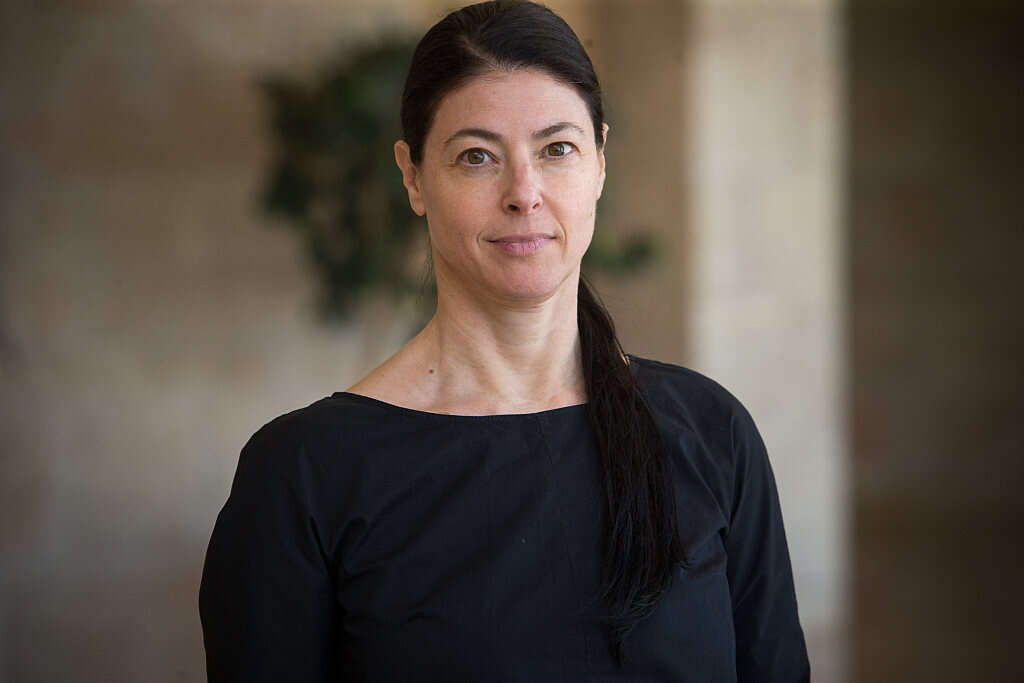
Transportation Minister Meirav Michaeli has declared several times since taking up the post that public transport is the core of the problem and the public is suffering. She knows that without rapid and efficient public transport the number of vehicles on Israel's roads will remain high and traffic jams will not be reduced.
The situation of Israel's public transport has been in decline for the past decade. Not one of the four transport ministers during that period, including Michaeli, have managed to solve the problem. The result is that people prefer cars.
Subscribe to Israel Hayom's daily newsletter and never miss our top stories!
The greater Tel Aviv area is packed with cars. Instead of using and enjoying public transport, wherever we wish to go into the metropolitan and to travel there and back from the periphery, without high-speed trains being available everywhere, and in particular, with problematic bus service (in some places lines have been cut, in others there are insufficient vehicles, the number of drivers is insufficient and new drivers are not being hired in sufficient numbers, while the pay is not attractive enough to attract drivers), and with taxi prices too expensive, we are still stuck, quite literally. In the three months that have passed since the government was sworn in, while plans have been drawn up, nothing has changed.
So if it's mobility you're looking for, you will still need a car, even if it means spending hours in traffic jams.
One can expect at least some regulations to come into effect quickly. There is no need for a year's work. If the Minister of Transport feels that her predecessor didn't do their work properly, she has the powers to make decisions and sign ordinances. Busses? If they even arrive that's a good sign... Complaints that busses don't arrive? That can be fixed immediately. Not enough bus lines? Find out where lines are short and make the changes. Poor scheduling? Instruct the companies to make changes immediately.
There is no need for committees for that. Metropolitan transport networks would solve a lot of problems. But these haven't been approved and it's doubtful that they will.
The big problem at the moment is that there is a Minister of Transport who has the authority to make things happen relatively quickly, but on the other hand, there are too many elements with responsibility for transport issues: The Ministry of Transport, advisers, department heads, local authorities, transport operators, etc. There is no constructive dialogue between all these elements that provides solutions. Only one party is harmed by this lack of coordination: The public.
Meital Yasour Beit Or, Ariel Kahana, Noam Dvir, Lilach Shoval, Eran Bar-Tal, Itzik Saban, Yair Altman, and Shlomi Diaz contributed to this report.


