
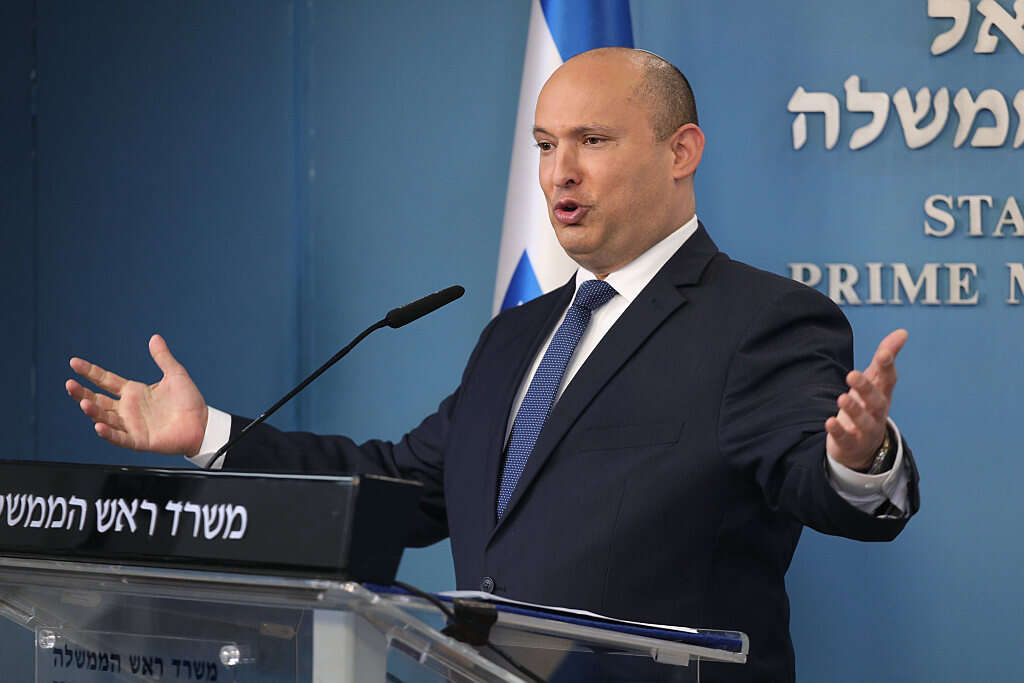
Senior IDF officers are up in arms over press briefings by the Prime Minister's Office on Saturday that they say endangered the lives of Israeli soldiers as they were carrying out strikes on the Gaza Strip.
Follow Israel Hayom on Facebook, Twitter, and Instagram
When rockets fired from the terrorist enclave landed off the coast of Tel Aviv on Saturday, in what Hamas claimed was the result of a technical mishap, senior political and defense officials discussed whether to respond and if so, with how much force.
Some of those involved in consultations reasoned that relative force should be used as just days earlier, a civilian contractor working for the Defense Ministry on the border fence sustained minor injuries from Palestinian sniper fire.
Yet most officials had called for a moderate response given ongoing efforts to reach a long-term agreement with Hamas. The concern was that too severe a response would lead to a counter-response from the terrorist group and an undesired escalation in tensions at a time when talks with the organization had reached a sensitive point. The Egyptians also pressured Israel to exercise caution so as not to inflame the situation.
On Saturday night, media outlets reported that Israel intended to respond to the rocket fire. It was an unusual report: Israel does not usually announce how it plans to respond, and certainly not that it plans to attack, so as not to allow the enemy to prepare in advance. There are two reasons for this approach: a desire to maintain the element of surprise in order to achieve maximal effect with the attack and the necessary effort to maintain information security to limit the threat to our forces.
The Israeli Air Force struck on Saturday night with fighter jets and attack helicopters. The IDF spokesperson said the attack targeted weapons-manufacturing infrastructure in Gaza. It was further reported that during the attack, shoulder-launched anti-aircraft missiles were launched at the helicopters, which did not sustain any damage in the incident.
Senior IDF officials were up in arms over the conduct of the Prime Minister's Office, as they said the PMO was responsible for the unprecedented press briefings, which were politically motivated.
"Hamas received advanced notice and knew we were coming. It waited for us. Those who issued the briefing put the forces at risk," one official said.
Another senior IDF official said, "This is the kind of red line you don't cross. The iron rule is that you never talk about operational activity before it is carried out."
Criticism was also leveled at what the officials called excessive expectations the press briefings fostered ahead of the IDF's response. In practice, the operation was minimal because Israel, in part due to Egyptian pressure, decided to suffice with a symbolic response that would send a message to Hamas.
"The gap between the tension created ahead of the IDF response and what happened in practice was ridiculous," a senior official said. "It makes us look unserious, both at home and to the other side."
In a statement, the Prime Minister's office rejected the criticism as "total nonsense."
The press briefings described were never held," it said.
The IDF Spokesperson's Unit issued a statement saying it was "unfamiliar with such criticism, and if it exists, it is not the opinion of the IDF and the chief of staff. The IDF does not issue criticism of the diplomatic echelon."
Subscribe to Israel Hayom's daily newsletter and never miss our top stories!


