Friday Dec 5, 2025
NEWSLETTER
www.israelhayom.com
  • Home
  • News
    • Israel
    • Israel at War
    • Middle East
    • United States
  • Opinions
  • Jewish World
    • Archaeology
    • Antisemitism
  • Lifestyle
    • Food
    • Travel
    • Fashion
    • Culture
  • Magazine
    • Feature
    • Analysis
    • Explainer
  • In Memoriam
www.israelhayom.com
  • Home
  • News
    • Israel
    • Israel at War
    • Middle East
    • United States
  • Opinions
  • Jewish World
    • Archaeology
    • Antisemitism
  • Lifestyle
    • Food
    • Travel
    • Fashion
    • Culture
  • Magazine
    • Feature
    • Analysis
    • Explainer
  • In Memoriam
www.israelhayom.com
Home Science & Technology

Technion researchers de-pollute drinking water

Current methods are already inexpensive, but inefficient, since they do not destroy the polluting "forever chemicals."

by  ILH Staff
Published on  01-16-2022 17:36
Last modified: 01-16-2022 17:36
Technion researchers de-pollute drinking waterJacek Dylag via Unsplash.com

PFAS pollutants contaminate drinking water sources, causing increased human exposure, which according to international studies can lead to cancer, heart and liver disease, fertility problems, birth defects, and damage to the immune system | Photo: Jacek Dylag via Unsplash.com

Share on FacebookShare on Twitter

Dr. Adi Radian and post-doctoral student Dr. Samapti Kundu of the Faculty of Civil and Environmental Engineering at the Technion-Israel Institute of Technology have developed an innovative technology for removing dangerous pollutants from drinking water.

Follow Israel Hayom on Facebook, Twitter, and Instagram

PFAS (Per- and Polyfluoroalkyl Substancesis) is a family of pollutants also known as "forever chemicals" because of their chemical stability and environmental persistence. PFAS substances can be found in various products ranging from non-stick pan coating to water-repellant additives. The forever chemicals find their way into groundwater through agricultural irrigation that uses treated wastewater and when fire-fighting substances seep into the soil.

Once in the ground, PFAS pollutants contaminate drinking water sources, leading to increased human exposure, which according to international studies can lead to cancer, heart and liver disease, fertility problems, birth defects, and damage to the immune system.
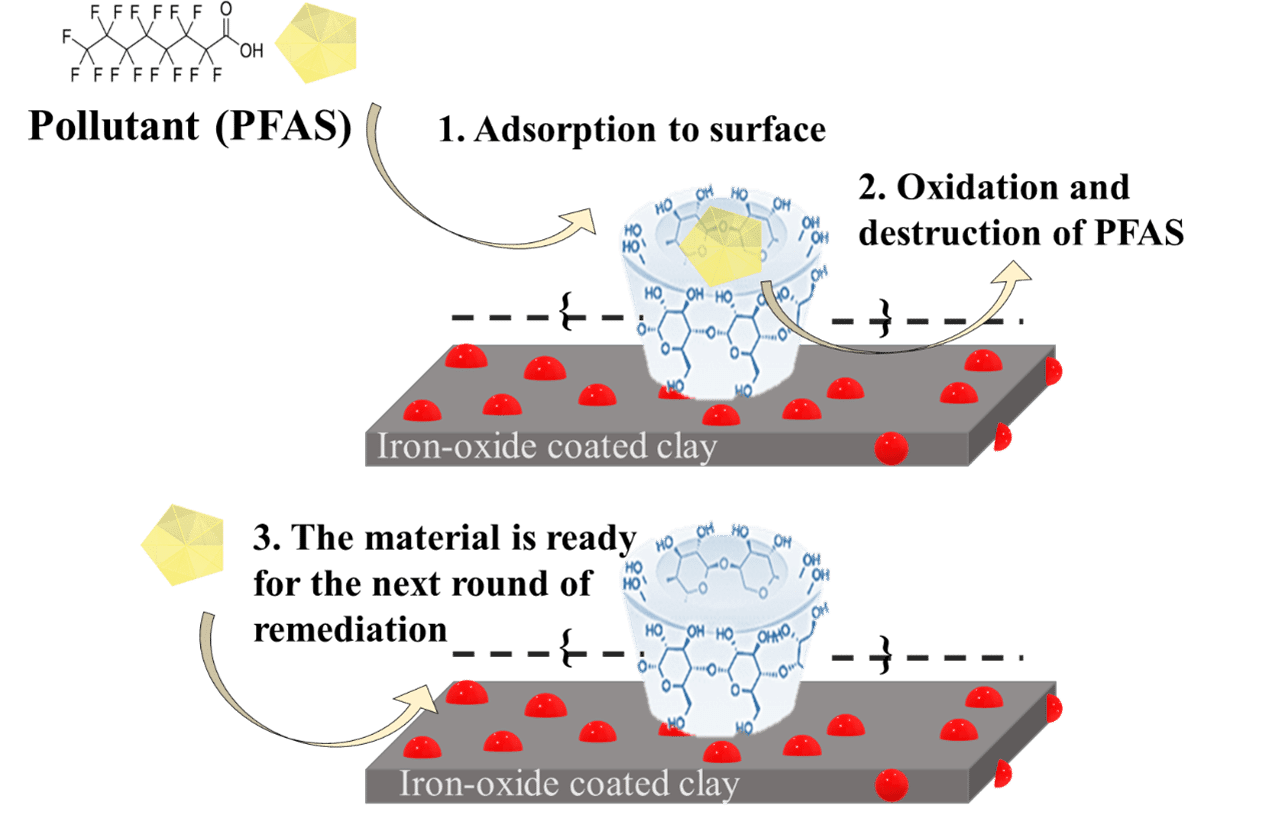
Depiction of how the system works: 1. The pollutants are separated from the water and confined to the surface of the clay-polymer composite; 2. The pollutants are oxidized to create non-toxic substances (water, CO2, and fluoride ions); 3. The system is regenerated, and at the end of the oxidation process, a new cycle of removal and degradation can begin Technion via Facebook

Israel now monitors these substances, and last summer stopped pumping potable water in the region surrounding Haifa after a large concentration of PFAS was identified in the area.

It is fairly simple and inexpensive to remove PFAS chemicals from drinking water. The downside of the existing methods is that they are inefficient, and also that they do not eliminate the pollutants – they transfer them from the water to absorbent material.

Another disadvantage to the technology currently in use is that they can wind up removing substances that are essential for public health.

The new Technion research, published in Chemical Engineering Journal, examined the possibility of combining two new solutions – the use of oxidation processes and targeted polymers – that to date have not demonstrated satisfactory results, then applying advanced oxidation processes to eliminate the chemicals.

The findings indicate that proper planning leads to high efficiency under a wide range of acidity (pH) and salinity. The method depicted in the article demonstrates the removal of seven types of PFAS – even when all of them are found in the same unit of fluid – at a level of efficiency that approaches 90%, within a few minutes.

The system described in the article is based on safe and inexpensive natural materials. The researchers used soil minerals – iron oxides and clays – in combination with cyclodextrin polymers. The clay-iron-polymer composites act as accelerators that confine the PFAS on the water surface and then accelerate the oxidation process that reduces the pollutants into non-toxic substances (fluoride ions, water, and carbon dioxide). This combination efficiently removes the PFAS and does not release unwanted substances in water used for drinking.

In their article, the researchers show that this system makes complementary processes such as heating, UV radiation, and using sound waves unnecessary.

The research was conducted in the Soil Chemistry Laboratory in the Faculty of Civil and Environmental Engineering. The researchers wish to thank the Lady Davis Foundation for Samapti Kundu's post-doctoral research grant.

Subscribe to Israel Hayom's daily newsletter and never miss our top stories!

Tags: drinking waterwater

Related Posts

Why Nvidia exec became hostage families' voiceYehoshua Yosef

Why Nvidia exec became hostage families' voice

by Roi Bet Levi

"Before October 7, I never led a convoy and never spoke at a demonstration. I volunteered in parent leadership at...

Israeli tech firm finds AI vulnerability – Gemini susceptibleReuters/Dado Ruvic/Illustration

Israeli tech firm finds AI vulnerability – Gemini susceptible

by ILH Staff and Miri Weissman

They exploit how AI browsers interpret instructions after the hashtag symbol. This effectively creates a new subcategory of cyber threats...

Nvidia vs. Google: Chip war escalatesJim WATSON / AFP; AP Photo/Jeff Chiu, File; Yossi Hai Hanuka;

Nvidia vs. Google: Chip war escalates

by Erez Linn

Nvidia shares fell 3% after reports that Meta, a major customer, may switch to Google's TPUs. CEO Huang claims its...

Menu

Analysis 

Archaeology

Blogpost

Business & Finance

Culture

Exclusive

Explainer

Environment


Features

Health

In Brief

Jewish World

Judea and Samaria

Lifestyle

Cyber & Internet

Sports


Diplomacy 

Iran & The Gulf

Gaza Strip

Politics

Shopping

Terms of use

Privacy Policy

Submissions

Contact Us

About Us

The first issue of Israel Hayom appeared on July 30, 2007. Israel Hayom was founded on the belief that the Israeli public deserves better, more balanced and more accurate journalism. Journalism that speaks, not shouts. Journalism of a different kind. And free of charge.

All rights reserved to Israel Hayom

Hosted by sPD.co.il

  • Home
  • News
    • Israel at War
    • Israel
    • United States
    • Middle East
    • Sports
  • Opinions
  • Jewish World
    • Archaeology
    • Antisemitism
  • Lifestyle
    • Food
    • Travel
    • Fashion
    • Culture
  • Magazine
    • Feature
    • Analysis
    • Explainer
    • Environment & Wildlife
    • Health & Wellness
  • In Memoriam
  • Subscribe to Newsletter
  • Submit your opinion
  • Terms and conditions

All rights reserved to Israel Hayom

Hosted by sPD.co.il

Newsletter

[contact-form-7 id=”508379″ html_id=”isrh_form_Newsletter_en” title=”newsletter_subscribe”]

  • Home
  • News
    • Israel at War
    • Israel
    • United States
    • Middle East
    • Sports
  • Opinions
  • Jewish World
    • Archaeology
    • Antisemitism
  • Lifestyle
    • Food
    • Travel
    • Fashion
    • Culture
  • Magazine
    • Feature
    • Analysis
    • Explainer
    • Environment & Wildlife
    • Health & Wellness
  • In Memoriam
  • Subscribe to Newsletter
  • Submit your opinion
  • Terms and conditions

All rights reserved to Israel Hayom

Hosted by sPD.co.il