

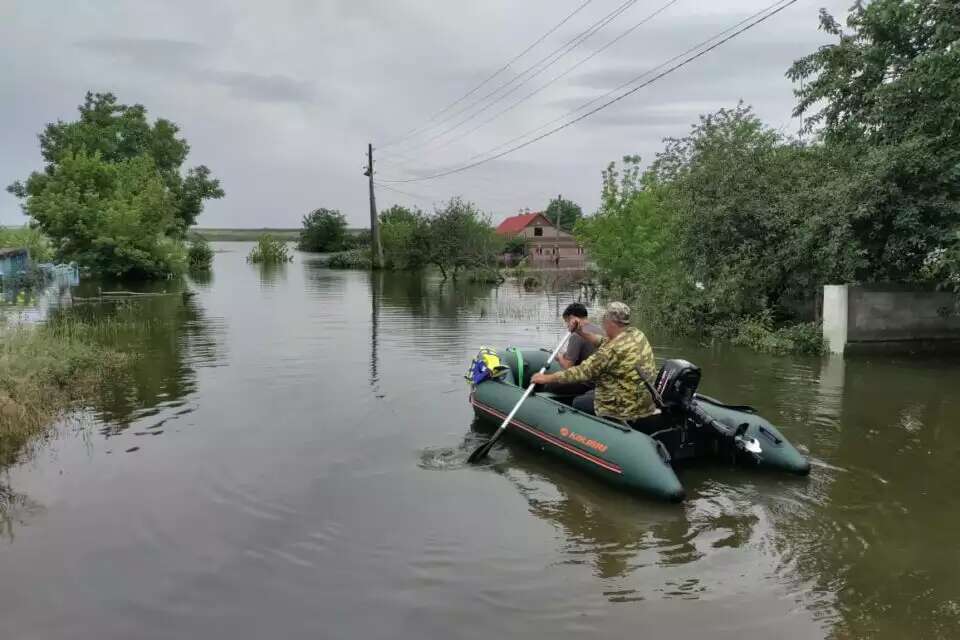
Traveling in Ukraine's Kherson region has become a nightmare. The rise of the water level in the rivers and streams, following the explosion of the Nova Kakhovka Dam, led to much more than just a series of roadblocks, many of which are still closed because of the landmines left behind by the withdrawing Russian military, but also a restriction of access in the area, and every intersection has become a military checkpoint.
Follow Israel Hayom on Facebook, Twitter, and Instagram
At one of these checkpoints, I meet the members of a family who are waiting patiently near soldiers with serious looking expressions. Petro and Lyudmila Dodik live with their daughters Anya and Hana in the village of Afensivka, in the east of the Kherson oblast. The water rising from the Inhulets River, a tributary of the Dnieper, completely flooded the village and the army evacuated the family to the nearby town of Snihurivka.
"We will clean it all up and rebuild everything"
"We left everything at our home. Electrical appliances, furniture, groceries. We left just us and our dog. Now we are waiting here until they let us try to enter our home and save our property," says Petro, but the family is surprisingly optimistic considering the situation. "We will clean it all up and rebuild everything. The Russians will not succeed in discouraging us," Lyudmila says with determination and a smile.
I arrived there together with a volunteer unit that has come to distribute drinking water to the villages affected by the floods. "Ironically, because of the extreme rise in the water level, all our pumping stations have been flooded and more than two thousand people in the Oblast have no drinking water. People here are drowning, but they have no safe water to drink," says Ivan Kohta, head of the civil administration in the town of Snihurivka.
The signs of destruction are distinct
"More than two hundred buildings have been damaged. It will be impossible to live in them, because the local villagers build with clay bricks and the moisture will just destroy the houses from the foundation. This is a fatal blow to a tiny district that has lost almost four hundred buildings during the Russian occupation and war," says the young officer, who was appointed by the army to oversee the damaged district during the ten months of Russian occupation. Signs of destruction are still clearly visible in the small town.
In the nearby village Yurivka, the village head, Valodya Yurievich, greets us emotionally. The small water tanker that drove up alongside our commercial vehicle goes to work and the villagers line up to receive clean drinking water. In the meantime, Yurievich takes me to see the enormous lake that swallowed up half of the small village.
"I don't know what to say about this anymore. The invasion was a tragedy, the bombings were a disaster, but this, this is a crime for which I have no name," says the village head, on the verge of tears, to the sound of the frogs croaking in the background, where chickens and geese gather on the roof of one of the homes.
The surreal sight of furniture and personal belongings floating in the water, reeking of fuel and filth. "I have no doubt that the Russians are to blame for this. This is their ultimate weapon of terror. This is the use of unconventional weapons against people, they can no longer abuse," says Yurievich.
"The enemy is cruel and I cannot ignore the suffering "
Down the middle of the flooded street, volunteers from the Ukrainian army arrive on motorboats to provide urgent aid to citizens whose houses were cut off from the road. The villagers set up a makeshift kitchen to feed the soldiers, who have come to support them through this difficult time. Dmytro (not his real name) is a soldier in the Ukrainian army who came as a volunteer to help the stricken district.
This is not really what I planned to do on my vacation," he says. "I have less than two weeks off after six months on the frontline. But our enemy is cruel, and I cannot ignore the plight of my people. Anyway, look at the amazing lunch they prepared for us here," he laughs and the grandmothers who cooked smile proudly.
"A Moment of Apocalypse"
Zina, the grandmother of one of the volunteers, lives nearby in a small house surrounded by cherry trees that produce an astonishing quantity of fruit. In a powerful and painful way, she recounts the moments when the villagers realized that the Inhulets River had begun to flow in the opposite direction and overflow.
I have lived here all my life, this river has been here every day, all day. Seeing it start to flow in the opposite direction was a moment of apocalypse for me. Imagine the sun rising in Tel Aviv and setting in Jerusalem," she says, showing familiarity with where I come from.
Subscribe to Israel Hayom's daily newsletter and never miss our top stories!
If we thought that something was left of the rural tranquility at the crux of the disaster, it is disrupted only a few moments later when Russian shells start to fall on the other side of the river. A few minutes later a Ukrainian MIG-29 shows up in the sky and the firing stops. The Ukrainians around me seem pleased.
"We will win"
"Since we received anti-aircraft weapons from the West, we hardly see Russian planes anymore. Only ours. Now the Russians are going to be afraid to shoot, so that we won't locate their cannons," says the village head Yurievich, with a strange combination of satisfaction, defiance and anger.
Just then we witness citizens taking out the meager furniture from their flooded home and drying it in the mid-June sun. Despite dealing with the floods that have made their lives miserable, no one here forgets that this is not a natural disaster and humans are responsible for this horror. "We will win," concludes Yurievich with the same defiant expression.


