
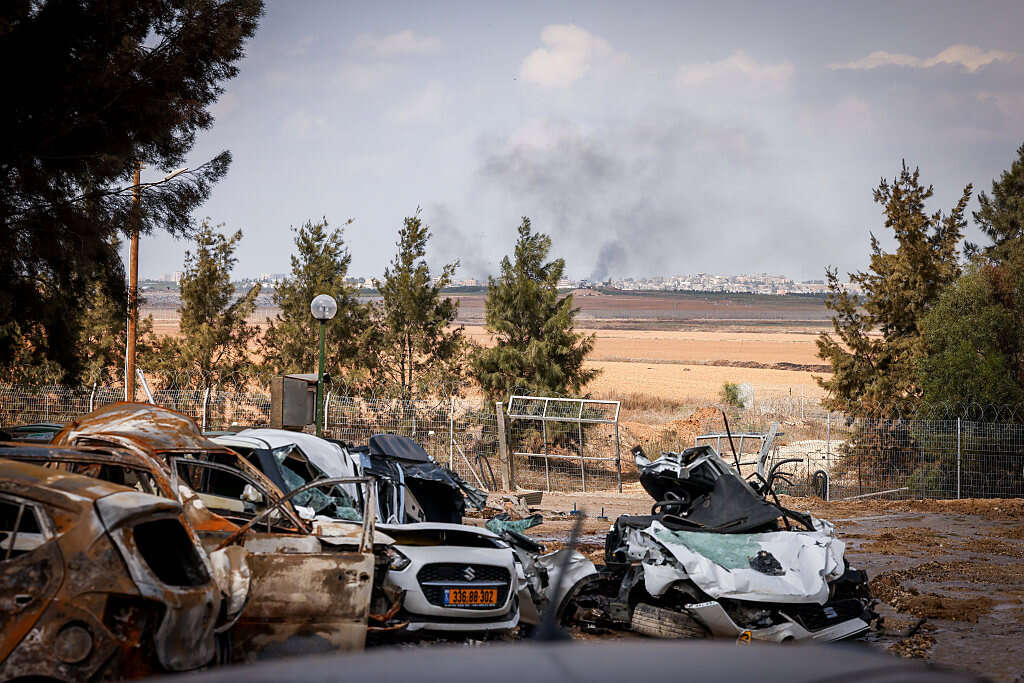
The morning of October 7 found Major R. of the combined special operations task force of the 99th Infantry Division in the middle of a routine bike ride. When his phone broke into incessant alerts, however, he quickly realized that something very out of the ordinary was happening in southern Israel.
"I went home, started to talk with commanders in the unit, and I understood that a force from the unit intended to rush to the south and engage the enemy. I made a quick calculation: Where I should go in order to be with the first force, to sign out equipment, and to go down? I leaped into my uniform. A combat jacket was waiting for me there at Tel Nof, and from there it took us only a quarter of an hour to set out," he related.
Follow Israel Hayom on Facebook, Twitter, and Instagram
Major R., an officer on study leave, began moving southward with the training company of the unit that was on alert that Saturday, and another force from the unit, headed out a short time later under its commander, Col. Ro'i Levy.
Levy's signalman was Sgt. Maj. A., 22, from Bet Shemesh. "My father woke me up Saturday morning and told me something was happening in the south. I was on pre-discharge leave; I was supposed to be out already. Right away I called Ro'i [Levy – L.S.] and asked him whether I should come. He said he didn't know how big the incident was yet and that we'd talk in another two hours.
"I'm not the kind who waits around. I drove straight to the base; I told myself that if it's nothing I'll go back home. What actually happened was that Ro'i came in, we rounded up some equipment, and we drove out a few minutes after the training company headed southward."
The first destination of the forces was the blood-drenched site of the rave at Re'im, where they were asked to go after a report of an intrusion came in. "We drove really fast; we realized from the media that it was not an individual terror cell but a large-scale incident. At the southern entrance to the Re'im compound, we came to a checkpoint set up by Egoz, with a commander of Egoz and a forward command post. We tried to understand whether we'd be able to advance, and he said they were fighting right here and that we'd join," Major R. related.
"There were around twenty of us and we began to advance toward the gate of Re'im There we saw a police unit evacuating casualties and we planned to circumvent the kibbutz. It was about a two-kilometer hike, and we preferred to do it by foot because the ground was full of terrorists."
"The kibbutz looked like a war zone"
Major R.'s force, headed by team commander Capt. Yotam Ben-Bassat, found a hole in the fence not far from the cemetery. It went through it and by getting directions from civilians it reached the kibbutz's security team. "Terrorists engaged us, we opened fire, and then Ro'i arrived with his forward command post," Major R. related.
"There were all kinds of people in the area. I didn't know who they were, they'd arrived on their own, they'd come with whatever they had, some had weapons and others didn't, some had uniforms and others didn't. It was hard to know who was a terrorist. We were afraid of firing at each other. It was real chaos."
At this stage, the training company force already engaged in exchanges of fire, Col. Ro'i Levy's force also arrived. "When we entered the kibbutz, they fired at us," Sgt. Maj. A. recalls. "Stones next to us shattered and you piss in your pants. But Ro'i tells us: Storm the source of the gunfire. I said, "Are you out of your mind?" Then he stood up and you follow him. If he does it, who are you not to do it?"
Col. Levy and four soldiers from his unit entered Kibbutz Re'im at around 11:00 a.m. The kibbutz' security team joined them and they advanced from house to house, fighting the terrorists tenaciously, and later they joined up with the training force as well. "The place look like a war zone," A. relates. "They fired at us, we wiped out terrorists, grenades, IEDs, lots of gunfire. I was inside an Israeli village and the houses were full of bullet holes; cars had gone up in flames."
As they reached the fourth row of houses, Col. Levy sustained two wounds to the hand from grenade fragments. He was bleeding. "I told him, let's move back and I'll apply a tourniquet." He refused. He told me to put a simple dressing on it so he could continue fighting. Then he told me, "Wipe the blood off me; I don't want to hurt the soldiers' morale." He functioned okay with the hand even though he had one fragment at the base of the palm and another in his elbow," Sgt. Maj. A. recalled.
"Not ready to give up on him"
At this stage, terrorists who had barricaded themselves in one of the houses engaged the force and Col. Levy decided to order the training force to flank the building while he and the soldiers remaining with him would cover them. "As we managed the battle, Ro'i was next to me and he decided at some stage to phone them to see what their situation was. He asked for the handset; I passed it to him. Just as he started talking, he took a bullet to the heart and was killed on the spot.
"I knew he was gone but I wasn't ready to give up on him," Sgt. Maj. A. recalls. "I yelled, 'Ro'i, get up! Get up, we need you!' He didn't get up. I was confused for a few moments. Then I told myself, pull yourself together, you've got a task to do. Finish it and then you'll have time to regain your senses."
Sgt. Maj. A. was the first who got his senses back and began to pass out orders. "We returned fire massively. Everyone emptied two or three magazines. We moved Ro'i back, put him in a clinic, but by then nothing could be done about it. We kept fighting."
At this stage, Major R., with the flanking force, did not know that the commander of the unit had been killed. "The force was out of contact because Ro'i knew where we were and the rest of the force didn't understand so much. He was the commander; he was in control. I didn't know at that stage that he'd been killed. But we continued doing what we'd planned to do, the force that was with me," he related.
"We were a small force, we provided cover and flanked in order to open fire. At this stage, one of our men was wounded. Later on, the platoon commander of the training force, Capt. Yotam Ben-Bassat was also hit. We realized that his injury was serious and we evacuated him to the rear. Eventually, he died from it."
"I have no time to be clingy"
At a certain point, Major R. managed to contact the main force of the unit and waited for a larger force in order to gain victory. "The main force arrived with the commander of a combat platoon. They began to close in on us from Ro'i's area and continued to advance. Then reinforcements from the Border Police tactical unit arrived. Almost thirty fighting men joined up with us, so we moved back from where we'd been most of the time and continued fighting." The battles at the kibbutz lasted until night, when the last of the terrorists were wiped out by a shell from a tank that had been brought there especially.
"Analyzing it in retrospect, we realized that there'd be a time for us to gather ourselves and grieve, to understand that somebody had been killed next to us, but at that moment we had to fight," Sgt. Maj. A. concludes. "They're firing at us and I've got no time to be in shock. I'd never experienced anything that approached this. I hadn't been with Ro'i for long; he'd spent a little more than three months with the unit. A great man: whatever he said, you knew there was thinking behind it, every word he said.
"He was an inspiring figure. Someone who stood up in the face of gunfire, fired back, an idealist. For him, the most important task was to look out not for himself but for his men and for the State of Israel. After the fighting's over, I'll probably visit his wife. I'll get clingy and I'll have time to cry. Now I don't have that time, and I have only one thing in mind: to make the unit as combat-ready as it can be.
"When we go in, I'll do everything so that no one with me will be injured again. Despite the ones who were killed, the unit's morale is high. What we want is to do something that will have a historical effect on our future as a state."
Subscribe to Israel Hayom's daily newsletter and never miss our top stories!


