Friday Dec 5, 2025
NEWSLETTER
www.israelhayom.com
  • Home
  • News
    • Israel
    • Israel at War
    • Middle East
    • United States
  • Opinions
  • Jewish World
    • Archaeology
    • Antisemitism
  • Lifestyle
    • Food
    • Travel
    • Fashion
    • Culture
  • Magazine
    • Feature
    • Analysis
    • Explainer
  • In Memoriam
www.israelhayom.com
  • Home
  • News
    • Israel
    • Israel at War
    • Middle East
    • United States
  • Opinions
  • Jewish World
    • Archaeology
    • Antisemitism
  • Lifestyle
    • Food
    • Travel
    • Fashion
    • Culture
  • Magazine
    • Feature
    • Analysis
    • Explainer
  • In Memoriam
www.israelhayom.com
Home News Israel at War Gaza War

Study finds Hamas starved hostages despite ample Gaza aid

Findings show approximately half a million tons of food were transferred from January 2024; "if the population didn't receive food, it's because distribution wasn't equitable by those controlling the territory, meaning Hamas," one of the study's authors said.

by  Maytal Yasur Beit-Or
Published on  02-12-2025 09:00
Last modified: 02-18-2025 19:28
Study finds Hamas starved hostages despite ample Gaza aid

People gather to collect humanitarian aid after trucks arrived in the Gaza Strip via the Kerem Shalom crossing, on January 19, 2025 (Photo: Eyad Baba/AFP)

Share on FacebookShare on Twitter

An Israeli study analyzing food quantities entering Gaza as humanitarian aid has found that sufficient amounts of diverse food with adequate caloric content were delivered during most months of the war. The food met most international humanitarian standards, despite complex challenges on the ground. This underscores that Gaza had no food shortage, highlighting that hostages are being deliberately starved.

The research, published in the scientific journal of the "Israel National Institute For Health Policy Research," examined aid volume from January 2024, approximately two months after the ground operation began, until July 2024. Senior officials from the Ministry of Health, Ben-Gurion University, Hebrew University, and the University of Haifa conducted the study. Additionally, researchers analyzed data from the Coordinator of Government Activities in the Territories regarding all food shipments transferred to Gaza through land crossings and airdrops.

The findings show that during the examined period, approximately 478,229 tons of food were transferred to Gaza, after adjusting for expected food loss. Consequently, each Gaza resident received an average supply of about 3,000 calories per day. Protein quantity stood at 98 grams daily (13% of total energy), fat consumption reached 61 grams daily (18% of total energy), and iron supply was 23 mg per day.

The study also found that food transferred to Gaza contained all nutritional components, except iron, in quantities exceeding the World Health Organization's standard for minimum food requirements for populations in crisis. Additionally, a consistent upward trend was observed in food quantities transferred to Gaza, except for a decrease in February compared to January.
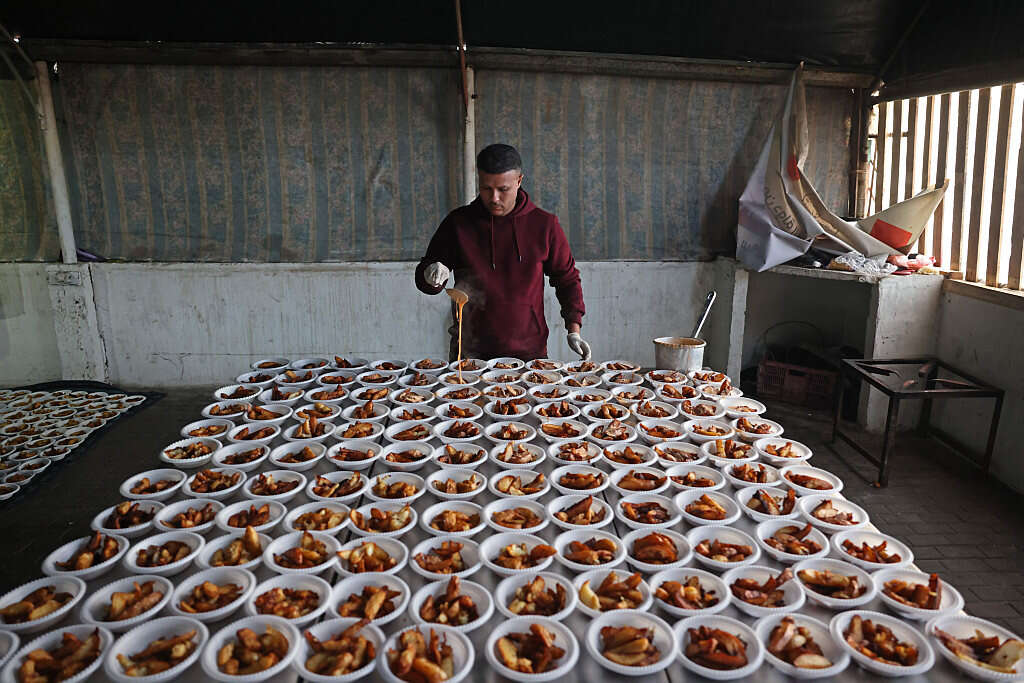
A Palestinian man prepares a meal for displaced people in Khan Yunis in the southern Gaza Strip on January 16, 2025. Photo credit: Bashar Taleb/AFP

"Claims are incorrect"

However, researchers emphasize they lack reliable data regarding actual food accessibility to residents and its consumption on the ground. "The data shows that sufficient quantities of nutritious food were transferred to Gaza during most of the first half of 2024," the researchers noted. "However, increased cooperation between all involved parties is needed to overcome barriers and improve communication and information sharing."

The research provides a comprehensive snapshot of the food supply to Gaza during the examined period, emphasizing the importance of continued monitoring and assessment of the nutritional situation in the region. The findings may assist in better planning future humanitarian aid efforts.

Professor Ronit Endevelt, nutritionist at the University of Haifa School of Public Health and former director of the Ministry of Health's Nutrition Department, who co-authored the study, stated: "In most months when humanitarian aid was transferred, the quantity and quality of food entering was reasonable to good, meaning if the population didn't receive food, it's because distribution wasn't equitable by those controlling the territory, meaning Hamas.

Hamas terrorists ride on top of a humanitarian aid truck in Rafah, Gaza Strip, Dec. 19, 2023. Photo credit: AP

"Claims echoing worldwide about insufficient food in Gaza are incorrect. Hamas had the ability to adequately feed the hostages yet consciously chose to starve them. This is beyond other shocking physical and mental torture, such as various restraints, lack of exposure to sunlight and daylight, inability to move – causing life-threatening malnutrition, damage to skeletal systems, immune system, hormonal system, and internal organs to the point of death risk.

"Israel, unlike other nations at war that don't feed the enemy, didn't prevent humanitarian aid to the civilian population," Endevelt emphasized. "Ultimately, Hamas seized control of much aid, profited from it, and thus accumulated funding for activities."
Tags: Gaza WarHamasIsraeli hostages

Related Posts

From Hamas prisoner to militia leader: The Palestinian collaborating with IsraelArab Networks

Gaza militia leader Yasser Abu Shabab killed

by Hodaya Busheri and Lidor Sultan

Abu Shabab, who established an independent Gazan militia and opposed Hamas rule, was critically wounded in an assassination attempt and...

Pro-Palestinian activist accused of fracturing officer's spine with sledgehammerAlishia Abodunde/Getty Images, Screenshot: Social media

Pro-Palestinian activist accused of fracturing officer's spine with sledgehammer

by Adi Nirman

Six Palestine Action members face charges after alleged Bristol raid on Israeli defense firm left officer with fractured spine.

US Gaza aid fund stops operations in wake of ceasefireEyad BABA / AFP

US Gaza aid fund stops operations in wake of ceasefire

by ILH Staff

The US-backed has distributed over 187 million meals in Gaza. Attributing its success to "the Trump administration’s call for innovation...

Menu

Analysis 

Archaeology

Blogpost

Business & Finance

Culture

Exclusive

Explainer

Environment


Features

Health

In Brief

Jewish World

Judea and Samaria

Lifestyle

Cyber & Internet

Sports


Diplomacy 

Iran & The Gulf

Gaza Strip

Politics

Shopping

Terms of use

Privacy Policy

Submissions

Contact Us

About Us

The first issue of Israel Hayom appeared on July 30, 2007. Israel Hayom was founded on the belief that the Israeli public deserves better, more balanced and more accurate journalism. Journalism that speaks, not shouts. Journalism of a different kind. And free of charge.

All rights reserved to Israel Hayom

Hosted by sPD.co.il

  • Home
  • News
    • Israel at War
    • Israel
    • United States
    • Middle East
    • Sports
  • Opinions
  • Jewish World
    • Archaeology
    • Antisemitism
  • Lifestyle
    • Food
    • Travel
    • Fashion
    • Culture
  • Magazine
    • Feature
    • Analysis
    • Explainer
    • Environment & Wildlife
    • Health & Wellness
  • In Memoriam
  • Subscribe to Newsletter
  • Submit your opinion
  • Terms and conditions

All rights reserved to Israel Hayom

Hosted by sPD.co.il

Newsletter

[contact-form-7 id=”508379″ html_id=”isrh_form_Newsletter_en” title=”newsletter_subscribe”]

  • Home
  • News
    • Israel at War
    • Israel
    • United States
    • Middle East
    • Sports
  • Opinions
  • Jewish World
    • Archaeology
    • Antisemitism
  • Lifestyle
    • Food
    • Travel
    • Fashion
    • Culture
  • Magazine
    • Feature
    • Analysis
    • Explainer
    • Environment & Wildlife
    • Health & Wellness
  • In Memoriam
  • Subscribe to Newsletter
  • Submit your opinion
  • Terms and conditions

All rights reserved to Israel Hayom

Hosted by sPD.co.il