Ahead of Jerusalem Day, celebrations across Israel mark the liberation of the city with ceremonies throughout its neighborhoods. Against this backdrop, we sought to better understand the claim that Jerusalem is holy to Judaism, Christianity, and Islam. Is the city truly sacred to the same degree for all three religions? And are there other religions or groups that have sanctified the city?
To explore this, we spoke with two experts on religions and their connection to the city – Professor Eyal Ben Eliyahu from the University of Haifa and Dr. Daniella Talmon-Heller from Ben-Gurion University.
Judaism: Holiness developed gradually
Professor Ben Eliyahu begins by noting that even in Judaism, Jerusalem became sacred later than commonly believed, and the process was slow.
"In the Bible, in the Five Books of Moses, Jerusalem is not mentioned at all. This is an interesting point where the Torah and the Quran are equal – because the city is not mentioned in either. The first place Jerusalem is mentioned is in the Book of Joshua, but even there, there is no special relationship to the city. The first time it becomes sacred is when King David brings the Ark of the Covenant to it. After him, King Solomon builds the Temple there. Later, in the Book of Chronicles II, it is mentioned that the Temple was built on Mount Moriah. This note throws us back to the story of the binding of Isaac and adds to the city's holiness," Professor Ben Eliyahu said.

Professor Ben Eliyahu adds that after the biblical period, the question arose of why Jerusalem is barely mentioned in it. Maimonides answered that the city was hidden to prevent quarrels between the tribes and so that the nations of the world would not want to conquer it. The sages during the Second Temple period and afterward also intensified the city's holiness and established circles around it – the Temple Mount as the holiest, then the entire city, and finally all of the Land of Israel.
Christianity: Problematic, political, and complex holiness
Professor Ben Eliyahu emphasizes that Jerusalem's holiness for Christianity was established from political motives.
"When examining the Christian attitude toward Jerusalem, you see that it is very complex. Jerusalem rejected Jesus as the Messiah, and he also prophesied its destruction. Jesus was crucified in the city and did not even sleep there when he arrived. Christianity was shaped in the Galilee – which is why to this day the Pope does not sleep in Jerusalem when visiting the land. Christians speak of the heavenly Jerusalem. The one who nevertheless sanctified the city, mainly for political reasons, was the Byzantine Emperor Constantine, during whose time the place of Jesus's crucifixion was discovered at the Church of the Holy Sepulcher," Professor Ben Eliyahu said.

Dr. Talmon-Heller adds that the process of sanctifying the city began because Jesus acted and was crucified there.
"Helena, the mother of Constantine, discovered through a miracle the place of the crucifixion and the cross on which he was crucified. She built the church at the site. During this period, Christianity was not interested in the Temple Mount, but when the Crusaders arrived, they saw the Islamic buildings on the Temple Mount – the Dome of the Rock and Al-Aqsa Mosque – and appropriated the place for themselves. Initially, the King of Jerusalem resided there, and later the Templar order. Additionally, Christian holiness was also strengthened with the establishment of the Via Dolorosa, the path Jesus walked to the crucifixion, by the Franciscan order during the Mamluk period," Dr. Talmon-Heller said.

Islam: Immediate but different holiness
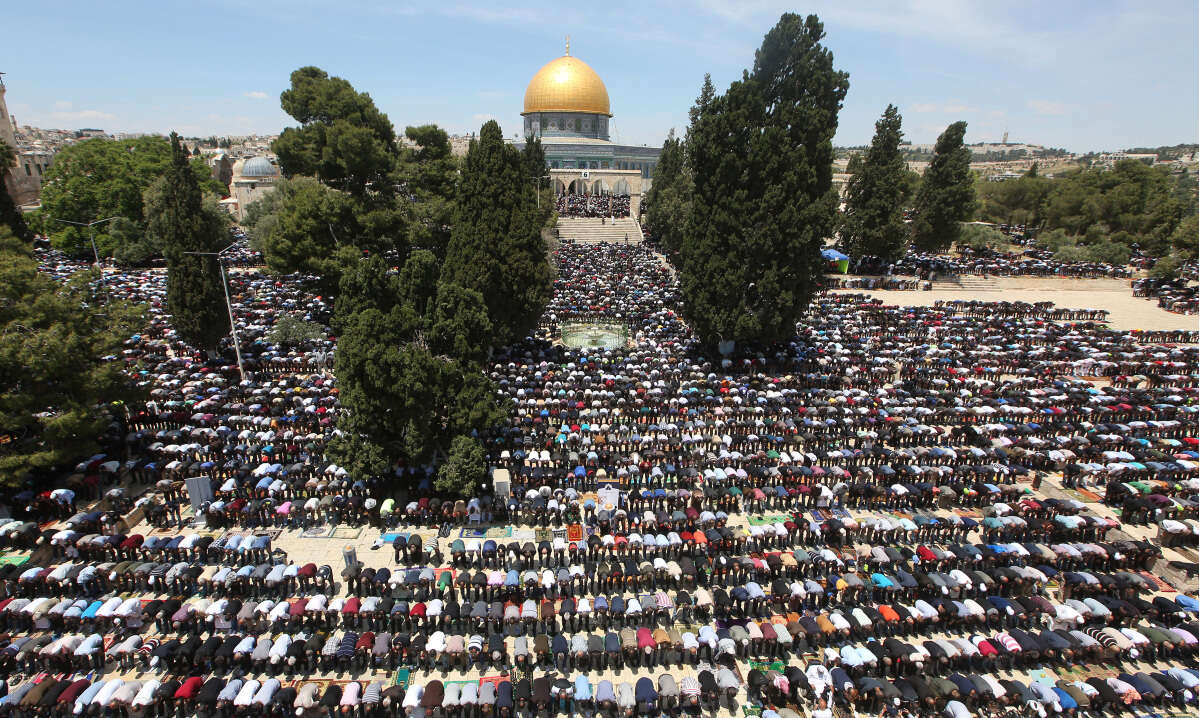
Regarding Islam, Dr. Talmon-Heller notes that Jerusalem's holiness was immediate from the beginning of Islam.
"Jerusalem is indeed not mentioned in the Quran, but it was Muhammad's first direction of prayer for the first 12 years. Already in 692, the Dome of the Rock was built, and later Al-Aqsa Mosque as well – both in great splendor. Jerusalem is third in holiness in Islam, after Mecca and Medina, so there is an Islamic pilgrimage and continuous investment in its development by Muslim rulers," Dr. Talmon-Heller said.
However, among Shiites, the attitude is different.
"Among Shiites, there is concentration around the graves of the Imams, descendants of Muhammad. The burial place of Ali's son, in the city of Karbala, is considered more sacred than Jerusalem in their eyes, and there are even hints that it is holier than Mecca. Therefore, Shiites devote less attention to Jerusalem," Dr. Talmon-Heller said.

Additional religions and sects
Beyond the three monotheistic religions, it turns out there are additional streams, mainly those that broke away from Christianity, that sanctify Jerusalem.
Professor Ben Eliyahu explains that the Mormons, a half-Christian, half-pagan sect with multiple deities, sanctified Jerusalem.
"They tried to settle there over the years, partly because, according to their tradition, the founders of the religion left Jerusalem for the United States. Therefore, the city symbolizes a spiritual idea for them. Additionally, there is also a practical consideration – parties that had a foothold in the city received many donations and pilgrims," Professor Ben Eliyahu said.
Ben Eliyahu adds that there was also an American-Swedish Protestant utopian sect that operated in the city during the Ottoman period – the American Colony.
"This group, which operated in the 19th century, advocated for equality of property and a strict internal regime. Later, it disbanded, and its descendants now own the famous American Colony Hotel in the city," Professor Ben Eliyahu said.