


A storm is shaking the Orthodox world in the US following a complex case where a rabbinical court permitted a Cohen to marry a convert, contrary to Jewish law. Now, prominent rabbis are threatening the entire rabbinical court, ruling that "the Beth Din of the Vaad of Lakewood is not presumed to be a valid rabbinical court, and there is no obligation to respond to summons from them."
The affair, brought to light in a detailed 50-page document, exposes a controversial process that led to approval of a marriage that leading halakhic authorities define as "a serious breach in the sanctity of Israel."
The story began when the groom, known as a member of a priestly family, became engaged to a bride who had undergone Orthodox conversion about two years before the engagement. The bride's mother underwent Conservative conversion in 2003, and the daughter underwent an additional "stringent" conversion years later. Jewish law clearly states that a Cohen is forbidden to marry a convert, so initially it appeared the marriage would not be possible.
Behind the religious ruling stands a rabbi from Lakewood who issued an initial permit claiming the groom has no status as a Cohen, since his grandfather was born to someone who does not observe Torah and commandments, and according to Rabbi Moshe Feinstein, there is no credibility to the claim that he is a Cohen. When the groom did not want to give up his status as a Cohen and even performed the priestly blessing during Sukkot after receiving this ruling, the rabbi offered a second reasoning - that it's possible to rely on the mother's Conservative conversion, so the daughter is not a convert but rather the daughter of a convert, who is permitted to a Cohen.
Many rabbis opposed these permits and signed a public declaration in early December. The letter stated, among other things, that the groom's family has the presumption of being Cohens and there is even a grave of five generations with "the Cohen" written on it, and that Rabbi Moshe Feinstein ruled that Conservative conversion is completely invalid and there was no acceptance of commandments. It further stated that even if the Conservative conversion were valid, the girl's father is a Cohen, and if he married a convert, the daughter would be a chalala (ritually disqualified) and forbidden to a Cohen.
The case was brought before a special rabbinical court comprising three judges. The court investigated the mother's conversion as well as the priestly status of the families involved. According to them, they found four main lines of defense – the bride's mother's conversion was performed by Orthodox rabbis, according to DNA testing the mother's family originates from Spain and there are traditions pointing to Marrano origins, the bride's father is definitely not a Cohen, and the groom's family are definitely not Cohens.
The document details how the rabbinical court conducted extensive investigations, including secret phone recordings with family members, DNA tests, and an investigation of family roots. According to opponents, the investigations are based on testimony from secular people who have no halakhic credibility, and the evidence presented is distorted and inaccurate. They claim the investigation was based on wrong assumptions about the religious character of the groom's grandfather, and that the conclusions against the priestly status are based on unfounded testimony.
At a certain point, one of the judges from the Beth HaVaad, who was related to the matter, decided to testify and explain that there is no doubt in the family and that the grandfather was religious when the father was born. The rabbinical court decided that since there are family members on the court, "we cannot complete the research," so the court removes itself from the matter and wrote that there is no permit that can be relied upon in this matter.
Despite this, some of the judges continued to say in many cases that there is a permit, and eventually, an additional rabbi became the one promoting the permit side based on the court's findings. The question was also presented to a rabbi expert in lineage matters from Israel, and he responded in a written answer that he sees no place for a permit based on the facts presented to him, and that there is a presumption of priestly status and also "he makes himself a piece of forbidden matter."
About two weeks before the wedding, a four-hour conference call was held that included family members, as well as the person who did the research for the rabbinical court, and several involved rabbis. The permitting side presented their position, and the family presented their counter-arguments, which completely answered all the permitting side's claims. It appeared that all objections to the priestly status fell completely, and the consensus of the call participants was that he is not a Cohen.
At this stage, many additional rabbis wrote letters against the permit, including the four heads of Lakewood Yeshiva and other leading rabbis. Meanwhile, the groom and his family, as well as the marriage officiant, received clear notices from one of the judges informing them that the original permit from the rabbinical court remains in force, and finally, based on these assurances, the wedding took place as planned in February 2024.
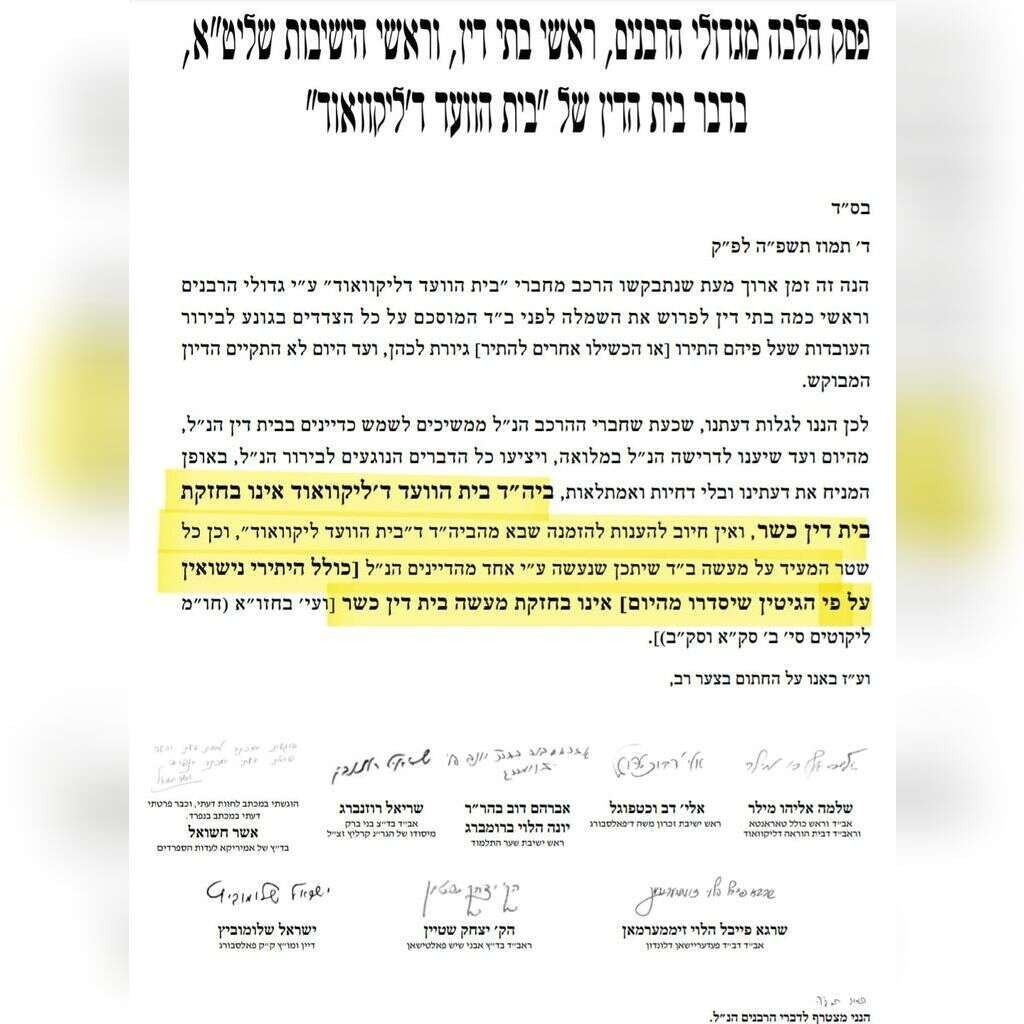
Following the case, a real storm developed in American Judaism, with calls for a boycott of "the Beth HaVaad of Lakewood." On June 30, leading rabbis published a sharp letter in which they declared that from today until they respond to their demand to fully clarify the matter, "the Beth Din Beth HaVaad of Lakewood is not presumed to be a valid rabbinical court, and there is no obligation to respond to summons from the court, and any document testifying to a rabbinical court action that might have been performed by one of the aforementioned judges is not presumed to be a valid rabbinical court action."
Many leading rabbis signed the sharp letter, including heads of yeshivas, heads of study halls, and judges. They demanded that court members present all investigations, processes, evidence, and findings on which they based their ruling that permitted a Cohen to marry a convert.
The detailed document presents sharp criticism of the entire process, claiming the permit is based on unreliable testimony and erroneous interpretations of Jewish law. It details how the mother's Conservative conversion was done without true acceptance of commandments, and how claims against the family's priestly status are based on people who have no halakhic credibility. It further claims the investigation was not conducted thoroughly and objectively, and there were attempts to hide important information.
The affair stirred waves of shock in Orthodox communities in the US, and difficult questions were raised regarding decision-making processes in rabbinical courts and the level of adherence to serious Jewish laws. Critics of the religious ruling claim the case emphasizes the importance of preserving the authority of leading halakhic authorities and established procedures in halakhic decision-making. The issue goes beyond the specific case and touches on the very approach to giving serious permits in Jewish law, calling for thorough clarification to prevent similar breaches in the future.


