


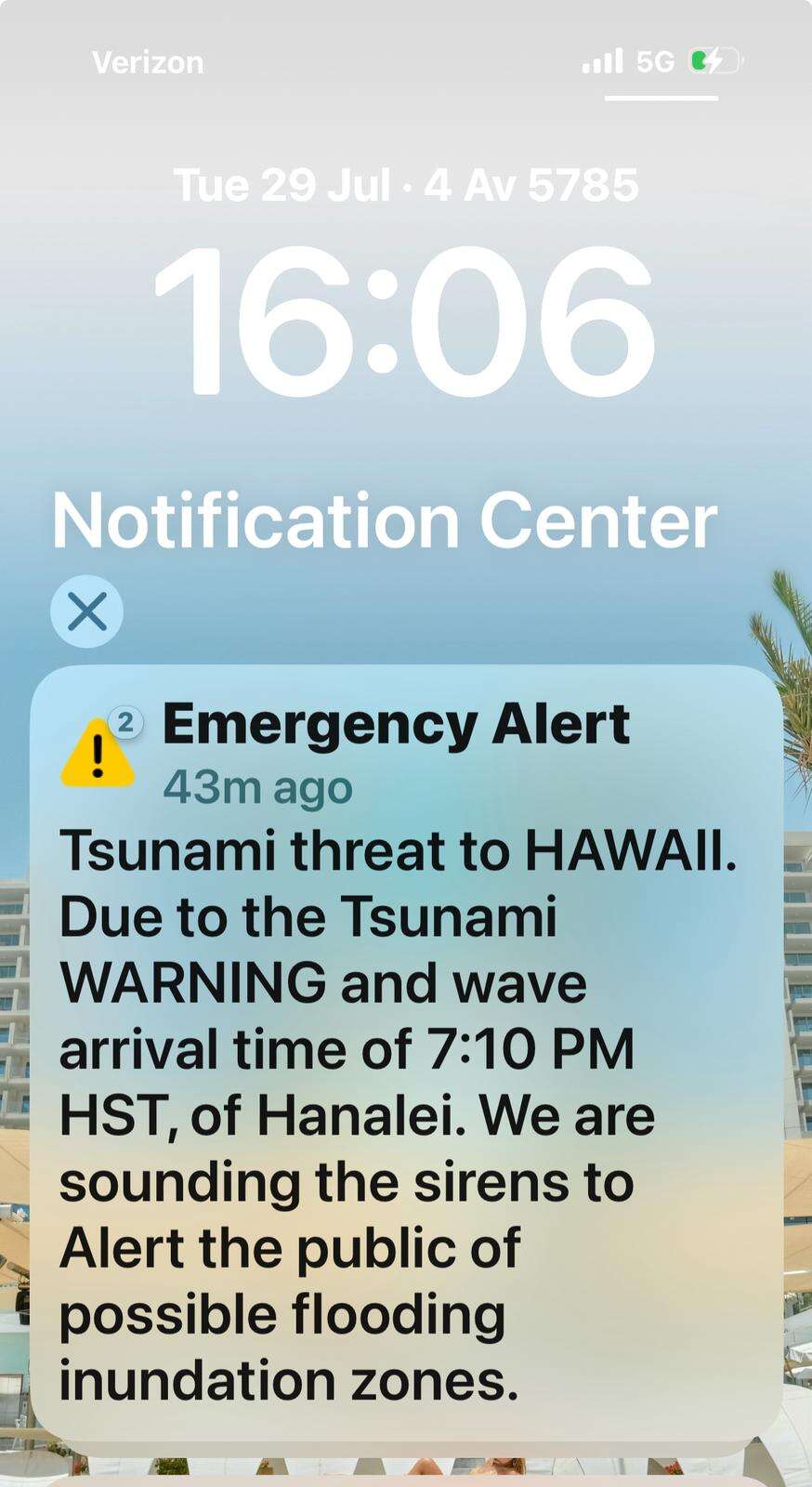
In Hawaii, residents reported a dramatic retreat of the sea, often a precursor to incoming tsunami waves. Hawaiian Governor Josh Green ordered the cancellation of all flights at Maui's airport, though he noted that "so far, we haven't seen a significant wave." Two-meter (6.5-foot) waves were recorded at sea near Midway Atoll. Honolulu's iconic Waikiki Beach was completely deserted, and traffic jams were reported as locals fled to higher ground. Hotel guests across the islands were ordered to move to upper floors. The US Coast Guard instructed all vessels to head out to open sea.
The most severe impact was reported in Kamchatka, where tsunami waves up to 5 meters (16 feet) struck the town of Severo-Kurilsk, according to Russian news agency RIA. Surfers captured footage of extensive damage to the Russian Navy port in Petropavlovsk-Kamchatsky, where Russia's Pacific Fleet nuclear submarines are docked.
The waves partially flooded a harbor and a fish processing plant, sweeping vessels from their moorings. Other videos showed damage to homes, a hospital, and industrial zones. While no casualties had yet been confirmed, the extent of the destruction suggested injuries were likely.
Kamchatka Governor Vladimir Solodov described the earthquake as "the strongest in decades." The Russian Academy of Sciences confirmed it was the region's most powerful quake since 1952. The quake was shallow, just 19.3 kilometers (12 miles) deep, intensifying its destructive power. "It felt like the walls were about to collapse. It lasted at least three minutes," said Yaroslav, a resident of Petropavlovsk-Kamchatsky. Several injuries were reported, including a person who jumped from a window in panic. Power was cut in the Sakhalin region.
In Japan's Iwate Prefecture, a 1.3-meter (4.3-foot) tsunami was recorded. Tens of thousands of residents were evacuated, including workers at the Fukushima nuclear power plant. In Chiba Prefecture, whales were seen washed ashore due to the waves' force. Japan's Meteorological Agency warned that additional waves could strike up to 24 hours after the initial quake. In Hokkaido, residents were seen fleeing to rooftops, and carmaker Nissan suspended operations at several factories.


