

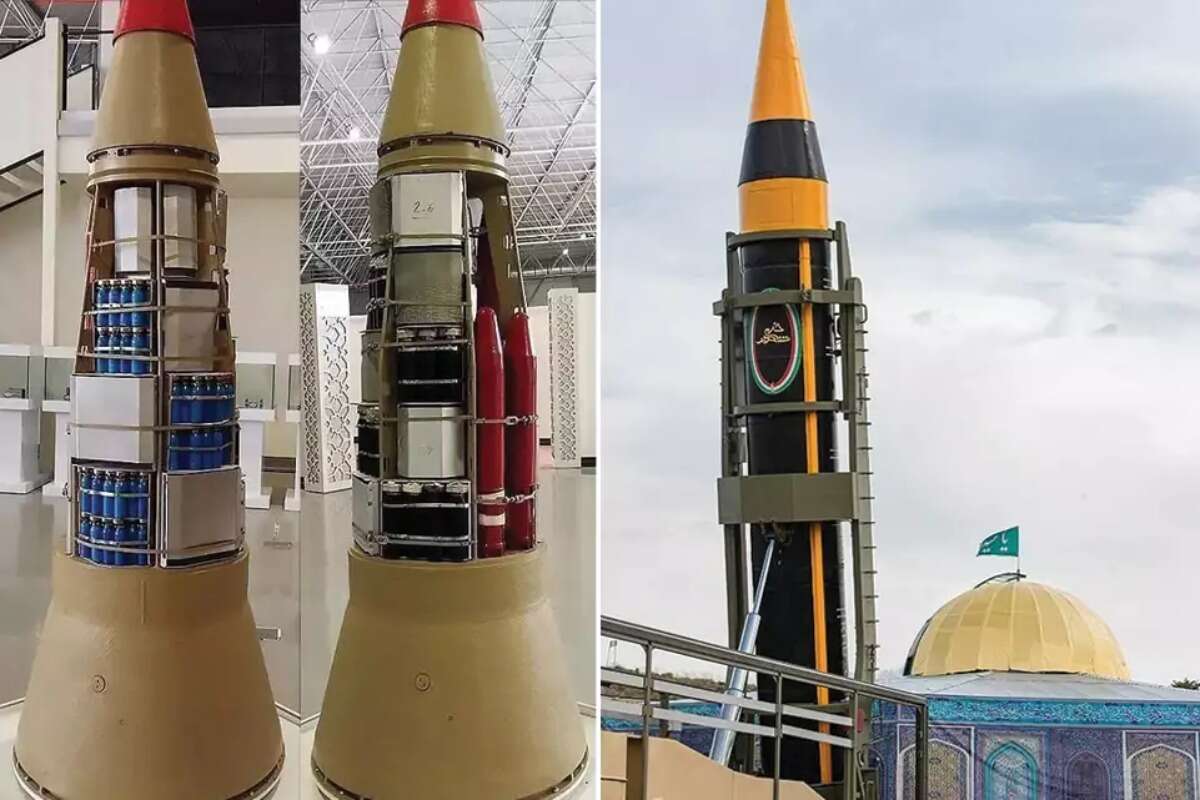
The IDF is examining whether a missile launched from Yemen on Friday night was equipped with a cluster warhead. The investigation follows reports that the missile broke apart in flight, prompting the Israeli Air Force to fire interceptors at its fragments, which fell in several locations across central Israel.
Military officials are now trying to determine whether the debris were in fact submunitions, each carrying its own warhead.

The IDF first encountered such a missile during Iran's large scale attack on Israel earlier this year, when commanders noted that it was the first time they had faced this type of weapon on the ground. In such an event, the missile itself does not strike the ground intact; instead, its warhead opens in midair, releasing dozens of smaller bomblets.
During the Iranian strike, the bomblets scattered across an area with an 8-kilometer (5-mile) radius. Each bomblet weighs between 2.5 and 2.7 kilograms (5.5 to 6 pounds) and is fitted with an impact fuse, meaning it explodes upon hitting the ground.

One of the most well known missiles of this type is the Iranian Khorramshahr-4, unveiled in May 2023. It is capable of dispersing dozens of small warheads, each resembling a Grad rocket or similar projectiles used by the Hezbollah terrorist organization against Israel.
Contrary to Iranian claims at the time, this is not a multiple independently targetable reentry vehicle (MIRV) system like those developed by the US and Russia, which allows each warhead to navigate separately. Rather, it is a conventional cluster warhead designed to blanket a wide area with explosives, functioning much like cluster bombs.
According to Iran, the Khorramshahr-4 has a declared range of 2,000 kilometers (1,240 miles) and a payload capacity of up to two tons.


