


The Oron was supposed to become operational in early 2024. It is a state-of-the-art mission aircraft, almost unparalleled worldwide, developed by the Defense Ministry and Israel Aerospace Industries, a peak achievement of Israeli ingenuity. Col. B., head of the systems department at the Defense Ministry's Directorate of Defense Research and Development, calls it "an intelligence machine." But then came October 7.
Barely two weeks later, before the ground maneuver in Gaza had even begun, the aircraft was inaugurated. "It wasn't supposed to be ready for wartime, but because of operational needs we managed to put it into service just weeks after the war began," B. recalls.
The Oron, which has been crisscrossing Middle Eastern skies for the past two years, was born deep inside the directorate. The organization dedicated years and massive research budgets to creating this platform, with its mission of ensuring Israel's technological superiority. The Oron may be the most striking expression of that mission.
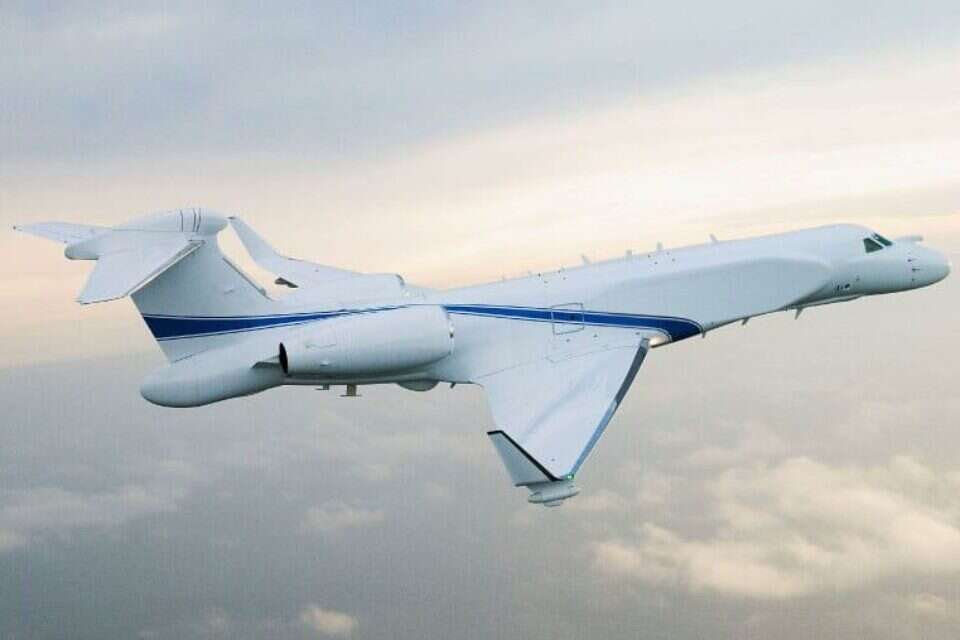
On September 2, the directorate's R&D unit will receive the Israel Defense Prize for developing the Oron, a platform that has become one of Israel's most valuable intelligence assets in the Iron Swords War. But beyond the award, the story is one of how years of vision, cutting-edge technology, and wartime urgency converged to produce an aircraft capable of delivering real-time intelligence to ground, air, and naval forces.
Crown jewel
The Oron is the crown jewel of Israel's mission aircraft fleet, which also includes the veteran Shavit, in service for more than a decade with strategic intelligence capabilities, and the Eitam, which provides unique airborne command and control. The Oron combines the two. "This is a next-generation aircraft that enables very broad, high-quality intelligence capabilities," says B. "It integrates technologies including imagery intelligence, signals intelligence, and airborne command and control."
The chosen platform was a Gulfstream 550 business jet, within which lies a technological powerhouse possessed by only a handful of nations. It is a multi-mission aircraft, delivering a unique fusion of intelligence and control capabilities. "It integrates several capabilities into a single aircraft, providing intelligence that can scan vast areas and generate situational awareness for decision-makers."
On board, alongside the flight crew, are several specialist teams who continuously collect and analyze information across the Middle East. "The analysts know how to intercept electronic signals and turn them into high-quality intelligence," B. explains. They not only collect data but process it in real time. "They can produce everything that is required while still in the air."
The technological leap
What makes the Oron unique is not only its content but the dramatic technological leap it represents. Among the most significant advances is its use of artificial intelligence for data processing. "The AI-driven data analysis is a major step forward," says B. "It lets us handle massive information loads and still generate the required outputs in real time."
Israel's choice to adapt executive jets rather than larger military platforms is deliberate. "Israel occupies a very unique position in the development of such mission aircraft," B. says. "Few countries, if any, have similar capabilities. The US is one, but it usually opts for much larger aircraft."
The smaller size was an operational decision. "There are advantages to using a civilian jet, reliability, lower maintenance costs, and more. Our uniqueness lies in choosing a small business jet, and that requires extremely advanced technology to fit strategic capabilities into such a small platform."

Beating the clock
The Oron project was a years-long joint effort. "It was a deep partnership between Israel's defense industries, the Defense Ministry, the Israel Air Force as the leading operator, along with Military Intelligence and the navy as end users," B. notes.
Normally, integrating a system this complex would take much longer, but war changed everything. "Operational activity began just weeks after the war broke out. Usually, full integration is a lengthy process, especially for such a complex system, but in wartime we work differently. With a concentrated national effort, we managed to move up the schedule. Even during the fighting we kept refining capabilities, a process that continues today."
Over the past two years, the Oron has been working nonstop. "The workload is extremely intense," B. says. It has already taken part in operations "across multiple theaters, in Gaza, Lebanon, and Syria, as well as further afield." Asked if this means Iran or Yemen, he declines to answer. "We don't provide our enemies with information."
The Oron, B. stresses, is not tied to any single branch but serves as a joint platform. "It provides for Military Intelligence, the air force, and the navy. It's essentially a flying command-and-control unit, serving a broad range of operational needs."
"Each branch brings its own perspective and requirements, but we've concentrated everything into a single system that produces outputs everyone can use," he explains. In simple terms: it gives a strategic aerial picture. "If you want to understand what's happening over a vast area, this platform provides the intelligence needed for decision-making at the highest level."
Naturally, not all capabilities can be disclosed, but it is clear that the Oron has played a critical role in the Iron Swords War, and now it has won the Israel Defense Prize. "This war proved just how effective the system is. The award is recognition of this outstanding operational achievement."

Recognition of contribution
"There's hardly a major IDF operation in any theater where the mission aircraft fleet has not played a decisive role," B. emphasizes. "Yes, I'm biased because this is my field, but the award is the committee's recognition of the aircraft's contribution."
Ultimately, he says, "this was a technological breakthrough years in the making, born from vision, creativity, and close cooperation with the IDF. That vision wasn't always accepted, but the people behind it deserve recognition for their achievement. Without the partnership between the directorate, IAI, Elta, and the military, it simply wouldn't have happened."
Work continues today on the next generation of mission aircraft. "Based on the experience we've gained in this war, we're developing the next generation that will give us full-spectrum capabilities, both intelligence and offensive," B. reveals.
And what about unmanned aircraft in this role? "We're not there yet. I come from the UAV field, but the technology and analysis in this domain still require people physically in the aircraft."
The Oron, he concludes, "is unique, with technology that is among the most advanced in the world. We are in constant contact with leading nations, including European partners, and the lesson keeps repeating itself: Israel is at the forefront of global military technology."
"Yes, we have immense pride in this achievement. This is a wholly Israeli aircraft, built on Israeli infrastructure and technology," B. says. "It's a source of enormous pride, and an opportunity to thank the many people who worked on it over the years."


