


A comprehensive postwar strategy for Gaza circulating among Trump administration officials, reflecting President Donald Trump's pledge to "take over" of the territory, would establish American trusteeship for a minimum decade while converting the area into a luxury tourism destination and advanced technology center.
The 38-page prospectus viewed by The Washington Post details a vision that includes the temporary relocation of Gaza's entire population of more than 2 million people. This would be accomplished either through what the document describes as "voluntary" departures to other countries or by moving them into restricted, secure zones inside the enclave while reconstruction is underway.
According to the report in The Washington Post, individuals who own land would be presented with a digital token from the trust in return for the rights to redevelop their property. This token could be used to finance a new life in another location or could eventually be redeemed for an apartment in one of the six to eight new "AI-powered, smart cities" slated for construction in Gaza. Each Palestinian who agrees to leave would receive a cash payment of $5,000, along with subsidies to cover four years of rent and a year's worth of food.
A screenshot of the plan leaked to the Washington Post (Screenshot:WashingtonPost.com)
The plan calculates that each individual departure from Gaza would result in savings of $23,000 for the trust, when compared to the expenses of providing temporary housing and what it refers to as "life support" services within the secure zones for those who decide to stay.
The proposal is named the Gaza Reconstitution, Economic Acceleration and Transformation Trust, or GREAT Trust. It was formulated by some of the same Israeli individuals who established and operationalized the US- and Israeli-supported Gaza Humanitarian Foundation (GHF), which is currently distributing food inside the enclave. The financial planning for the trust was conducted by a team that was working for the Boston Consulting Group at the time.
Sources familiar with trust planning and administration discussions regarding postwar Gaza spoke anonymously about the sensitive topic. The White House directed inquiries to the State Department, which refused comment. BCG stated that trust planning work lacked express approval and that two senior partners leading financial modeling were subsequently terminated.
Wednesday saw Trump hosting a White House meeting to explore ideas for ending the nearly two-year war and subsequent developments. Attendees included Secretary of State Marco Rubio and special presidential envoy Steve Witkoff; former British Prime Minister Tony Blair, whose Gaza future perspectives have been solicited by the administration; and Trump's son-in-law Jared Kushner, who managed much of the president's first-term Middle East initiatives and maintains extensive private regional interests.
No meeting summary or policy decisions were announced, though Witkoff stated the previous evening that the administration possessed "a very comprehensive plan."
Whether the detailed GREAT Trust proposal represents Trump's intended approach remains unclear. However, major components, according to two people familiar with planning, were specifically designed to actualize the president's vision of a "Riviera of the Middle East."
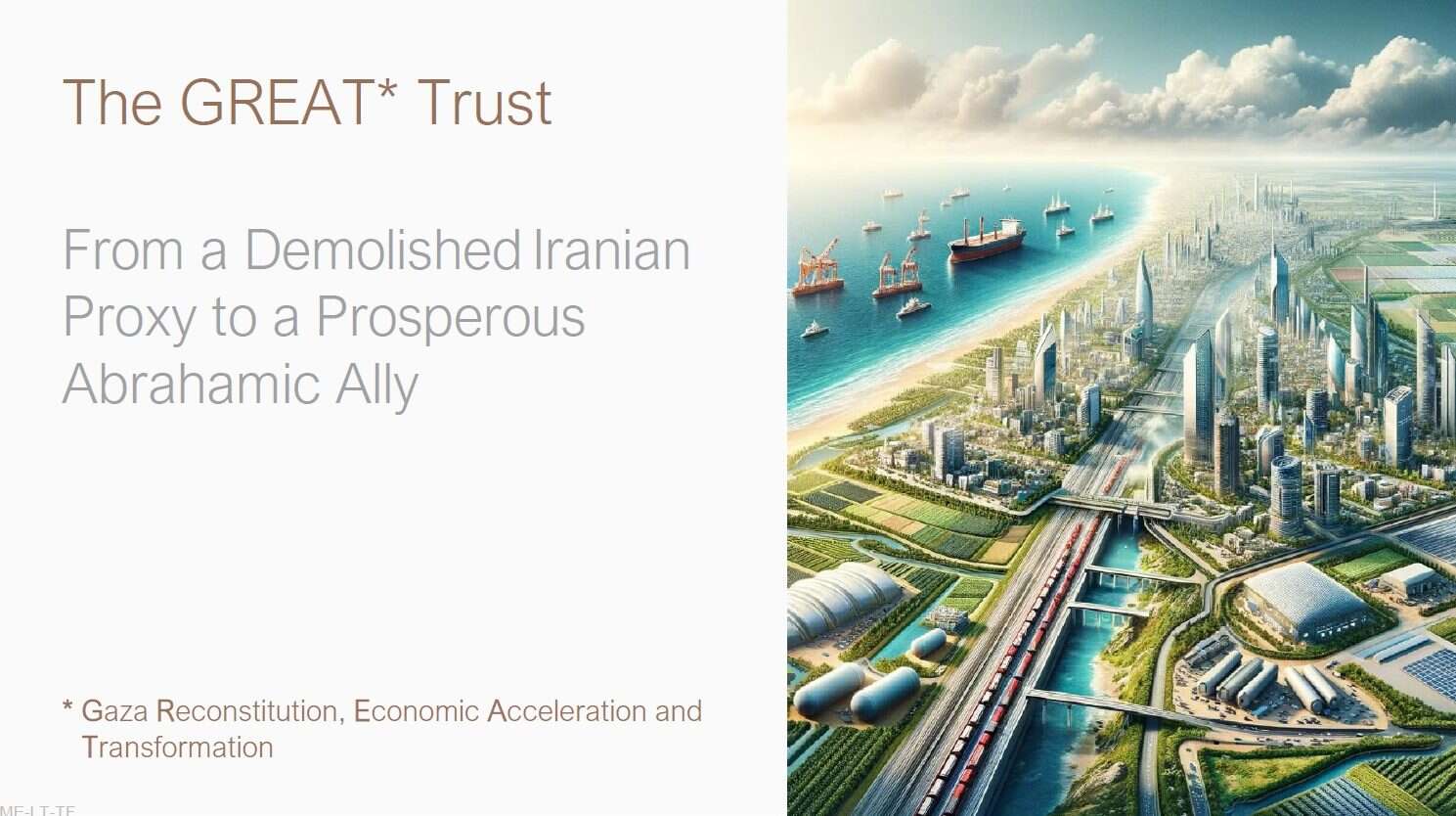
Perhaps most attractive, it claims to require zero US government funding while offering substantial investor profits. Unlike the controversial and sometimes financially strained GHF, which employs armed private US security contractors for food distribution at four southern Gaza locations, the trust plan "does not rely on donations," according to The Washington Post report of the prospectus. Instead, financing would come from public and private-sector investment in "mega-projects," ranging from electric vehicle facilities and data centers to beach resorts and high-rise residential buildings.
Calculations within the plan project nearly fourfold returns on $100 billion investment after ten years, with continuing "self-generating" revenue streams. Certain proposal elements were initially reported by the Financial Times.
"I believe [Trump] is going to have a bold decision" when fighting ends, stated one person familiar with internal administration deliberations, as reported by The Washington Post. "There are multiple different variations where the US government could go, depending… on what happens."
Which plan will emerge?
Proposals for post-conflict Gaza have multiplied almost since the war began October 7, 2023, when Hamas fighters invaded southern Israel, killing approximately 1,200 people and seizing about 250 hostages.
Early in the conflict, Israeli proposals emerged for creating Hamas-free zones or "bubbles" under Israeli military protection in Gaza where Palestinians could receive humanitarian assistance and gradually govern themselves as fighting concluded.
In January, less than a week before President Trump was inaugurated, then-Secretary of State Antony Blinken laid out the Biden administration's postwar path to statehood. It advocated for an "interim administration" for Gaza, supervised by the United Nations with security supplied by vetted Palestinians and unspecified "partner nations" that would ultimately transfer power to a "reformed" Palestinian Authority.
The Palestinian Authority, Egypt, and the United Arab Emirates have each presented their own plans. During a March summit, Arab leaders backed the Egyptian proposal, which details the establishment of a government of Gaza technocrats and Palestinian Authority officials, with financial support from Persian Gulf states. In addition to the potential for deploying Arab peacekeepers, officials in Cairo have indicated that members of the largely defunct Gaza police force are undergoing training in Egypt to provide security once Hamas is disarmed.
American security contractors working for the GHF have also discussed with Israel and potential humanitarian partners a plan whereby they would clear Gaza of unexploded ordnance and debris, securing zones where Palestinians would temporarily live during reconstruction.
Prime Minister Benjamin Netanyahu has never provided clear vision for Gaza's future beyond stating Hamas must be disarmed and all hostages returned. The prime minister has insisted Israel must maintain security control of the territory and rejected future governance by the West Bank-based Palestinian Authority, as well as Palestinian statehood prospects.
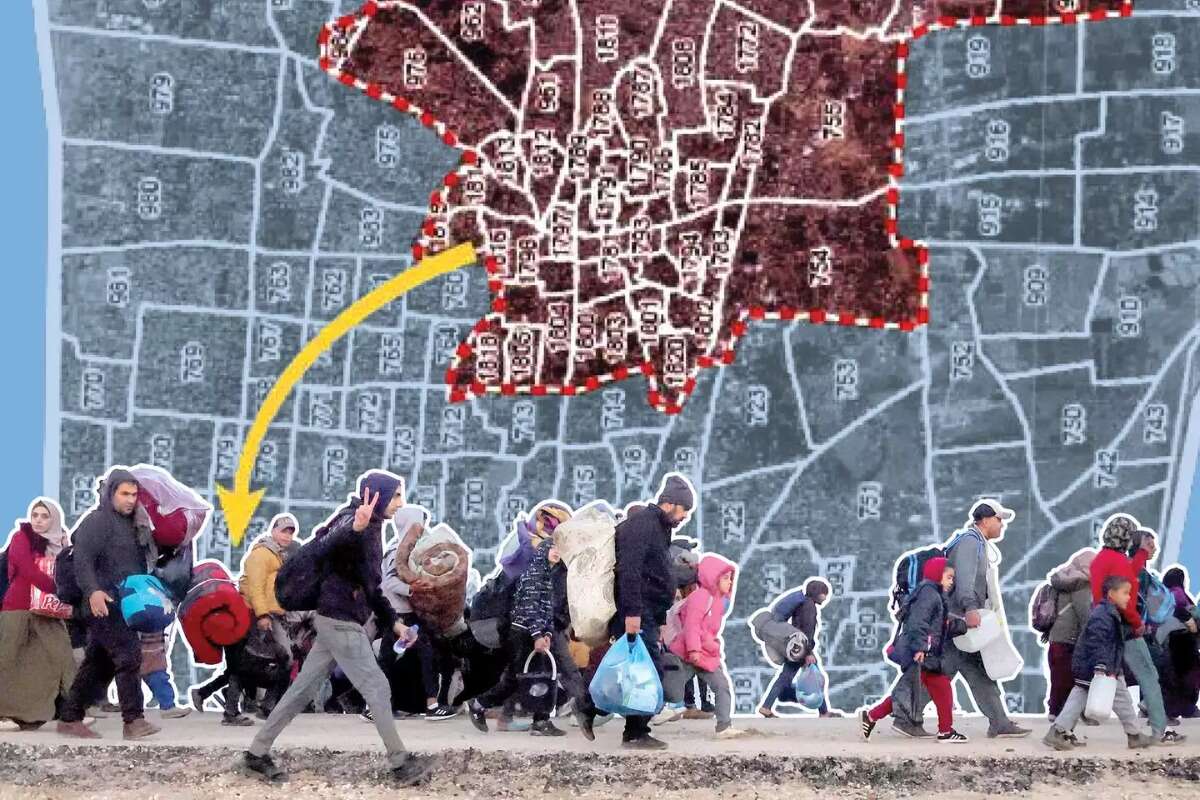
Israel, claiming its forces now control 75% of the territory, has approved a new offensive to capture the remainder.
Members of Netanyahu's coalition government from the far-right have supported permanent Israeli occupation. Finance Minister Bezalel Smotrich, who has advocated for the annexation and Israeli resettlement of Gaza, declared at a Thursday news conference that "Israel must completely hold control of the entire Strip, forever. We will annex a security perimeter and open the gates of Gaza for voluntary immigration."
In more recent weeks, Netanyahu has indicated his intention to assume control of a Hamas-free Gaza but has stated, "We don't want to keep it."
Trump's vision
During his 2024 election campaign, Trump promised he would quickly end the Gaza war. However, when he returned to the theme as president, it primarily involved discussing how he would employ his property developer expertise once Gazans were relocated.
"I looked at a picture of Gaza, it's like a massive demolition site," Trump told reporters while signing executive orders in the Oval Office two days after inauguration, according to The Washington Post. "It's got to be rebuilt in a different way." Gaza, the president stated, was "a phenomenal location… on the sea, the best weather. Everything's good. Some beautiful things can be done with it."
Two weeks later, at a White House news conference with Netanyahu, Trump declared "the United States will take over the Gaza Strip." Describing a "long-term ownership position," he added that everyone he consulted about it "loves the idea."
"I've studied this very closely over a lot of months, and I've seen it from every different angle," Trump stated, as reported by The Washington Post. "I don't want to be cute. I don't want to be a wise guy. But the Riviera of the Middle East, this could be something that could be so magnificent."

In the wake of Arab outrage and widespread charges that any forced removal would violate international law, both Trump and Netanyahu more recently have stressed that any postwar Gazan relocation would be voluntary and, if Palestinians chose, temporary. Meanwhile, Israel has moved to corral Gaza's approximately 2 million population in a narrow southern waterfront strip while preparing its northern Gaza City offensive.
The 'Riviera' plan gets upgraded
Trump's February vow to own and redevelop Gaza offered both authorization and a roadmap for the group of Israeli businessmen, led by entrepreneurs Michael Eisenberg, an Israeli American, and Liran Tancman, a former Israeli military intelligence officer. They had moved on to address the postwar challenge in consultation with international financial and humanitarian experts, potential government and private investors, and some Palestinians, according to individuals familiar with the planning.

By spring, a Washington-based team from BCG, which had been separately contracted to collaborate with the main US contractor establishing the GHF food distribution program, was engaged in detailed planning and financial modeling for the GREAT Trust.
Eisenberg and Tancman chose not to comment for the Washington Post article. A person with knowledge of the planning mentioned that the prospectus was finished in April with very few changes since then, but that there was significant flexibility for adjustments.
"It's not prescriptive, but is exploring what is possible," the person told The Washington Post. "The people of Gaza need to be enabled to build something new, like the president said, and have a better life."
Those acquainted with the initiative in both Washington and Israel likened it to the US trusteeships of Pacific islands following World War II, and to the postwar governance and economic functions performed by Gen. Douglas MacArthur in Japan and Secretary of State George C. Marshall in Germany.
As detailed in the trust document, Israel would transfer "Administrative Authorities and Responsibilities in Gaza to the GREAT Trust under a US-Israel bilateral agreement" which would "evolve" into a formal trusteeship. The outline projects eventual investments from "Arab and other countries" that would transform the arrangement into a "multi-lateral institution." Trump administration officials have brushed off the insistence of Arab governments, especially in the Persian Gulf, that they will only back a postwar plan that leads to Palestinian statehood, viewing it as mere public posturing.
Israel would retain "overarching rights to meet its security needs" throughout the first year of the plan, while the vast majority of internal security would be handled by unspecified "TCN" (third-country nationals) and "Western" private military contractors. Their involvement would diminish progressively over a decade as trained "local police" assume control.
The trust would govern Gaza for a multiyear period that it projects will last 10 years, "until a reformed and deradicalized Palestinian Polity is ready to step in its shoes."
The document contains no mention of eventual Palestinian statehood. The unspecified Palestinian governing body, it states, "will join the Abraham Accords," which was President Trump's first-term negotiation that resulted in the establishment of diplomatic ties between Israel and four Arab nations. Trump has indicated he plans to broaden that accomplishment before his term ends.
The plan discusses Gaza's location "at the crossroads" of what will become a "pro-American" region, giving the United States access to energy resources and critical minerals, and serving as a logistics hub for the India-Middle East-Europe Economic Corridor that was first announced during the Biden administration but derailed by the Israel-Gaza war.
Gaza's reconstruction would begin with removing massive amounts of debris and unexploded ordnance, along with rebuilding utilities and the electrical grid.
Initial costs would be financed using as collateral the 30% of Gaza land that planners have stated is already "publicly" owned and would immediately belong to the trust, according to The Washington Post. That is "the biggest and easiest. No need to ask anyone," Tancman noted in the margin of one trust planning document seen by the paper. "I'm afraid to write that," Eisenberg replied in a note, "because it could look like appropriation of land."
Investor-financed "mega-projects" include paving a ring road and tram line around Gaza's perimeter, which planners flatteringly label the "MBS Highway," after Saudi Crown Prince Mohammed bin Salman, whose approval of such an initiative would significantly advance regional acceptance. A modern north-south highway through Gaza's center is named after United Arab Emirates President Mohammed bin Zayed al-Nahyan. A new port and airport would be built in the far south, with direct land connections to Egypt, Saudi Arabia and Israel.
Gazan families who remain, or leave and then return after residential areas are completed to exchange their land tokens, would be offered ownership of new 1,800-square-foot apartments the plan values at $75,000 each.


