

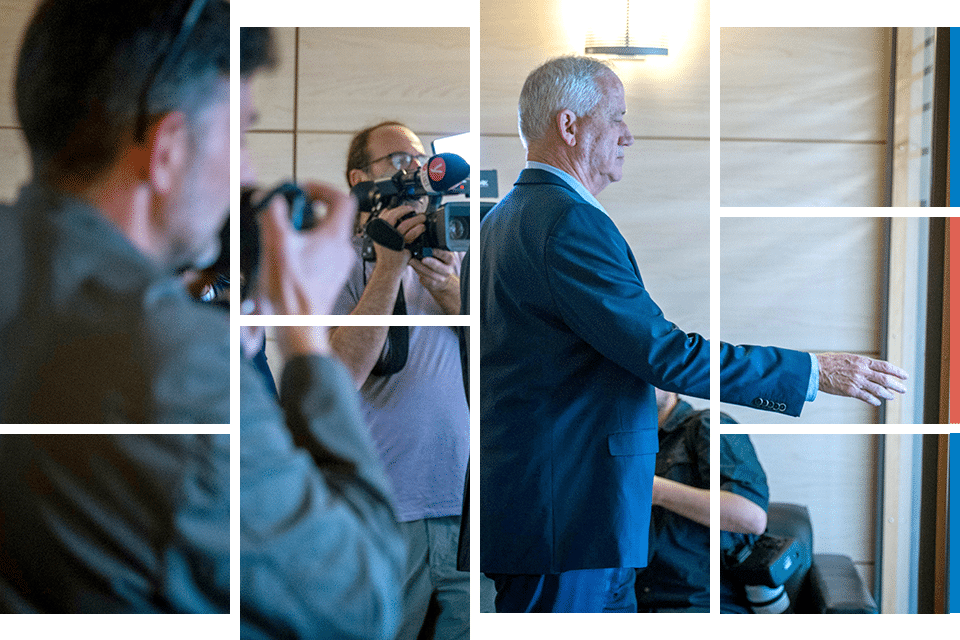
The lonely man to the Knesset
In a moment of mischievous humor last Saturday night, Avigdor Liberman suggested to opposition leaders that their next meeting be held at his home in the Nokdim settlement. "I actually spent a lot of time there during my army service," Yair Golan noted in response.
Either way, wherever it takes place, it's doubtful a photo will emerge from it, and it's fair to assume that this will be Naftali Bennett's condition for the meeting he is expected to attend next week. For Bennett, a photo with the left-wing Yair Golan is like Benjamin Netanyahu being photographed with Itamar Ben Gvir before the last elections: a political partner, yes; a partner for a single photo? Absolutely not.
But the odd man out at this meeting will actually be Benny Gantz. His statement last week could turn out to be a pivotal moment in the elections. First, on the personal level, until now he was the lame son of the "change bloc," the one failing to pass the electoral threshold and therefore likely to be forced to drop out.
But now he has detached himself from the bloc and its pressures. He has a different audience, and no obligation to crown Bennett or Gadi Eisenkot as prime minister. And he has all the time in the world — perhaps even a year — to scrape together the fraction of a percent he needs to cross the threshold. According to estimates, the "unity government" camp, made up of both the anti-Bibi crowd and those opposed to the "Just Not Bibi" pack, counts for about 20 of the Knesset's 120 seats. Indeed, it's not far-fetched to think that Gantz could pick up the one extra mandate he's missing.
On the strategic level, this declaration is no less important. Netanyahu cannot run on a platform of breaking away from the ultra-Orthodox or Ben Gvir. Liberman, Golan and Yair Lapid have long locked themselves in with vows and bans against joining Netanyahu (though they've yet to match the level of former Labor leader Amir Peretz, who, like in an ancient shamanic ritual, shaved his mustache while taking the oath).
That leaves Bennett and Eisenkot. Bennett, in an interview in June, answered with a single "correct" when asked if he'd refuse to sit under Netanyahu, but observers paid more attention to the three minutes of evasiveness that preceded it. He doesn't want to say more, so as not to anger voters on the right or lose voters on the left. Eisenkot, meanwhile, has yet to state his position outright, but it can be assumed he'll sharpen his stance once he decides who to ally with.
Another issue looms: many polls suggest no decisive outcome. In that case, many voters may ask whether a unity government is preferable to an endless caretaker government of Ben Gvir, Bezalel Smotrich, and the ultra-Orthodox. As has happened time and again in recent years, we are presented with an upside-down world: voters are far more moderate and unity-minded than most of their leaders.
Party judgment
Two men have launched legal proceedings in the past year against former Defense Minister Yoav Gallant. The first is International Criminal Court Prosecutor Karim Khan. The second is Likud activist Rami Ben-Yehuda, known for his tirades.
The party's internal tribunal will discuss next week a petition to expel Gallant from Likud. The reasons: his warning about the security risks of continuing the judicial reform, which led to his first dismissal; his "oppositional politics toward the prime minister" due to his support for returning the Palestinian Authority to Gaza; and his call for a broader draft law for the ultra-Orthodox.
Gallant has no intention of backing down without a fight. Unlike in the past, he's unlikely to run in the next primaries. But contrary to rumors, he doesn't plan to leave Likud. He will likely try to run for party leadership in the post-Netanyahu era, when Likud will have to decide if it's more nationalist than liberal, or more liberal than nationalist.
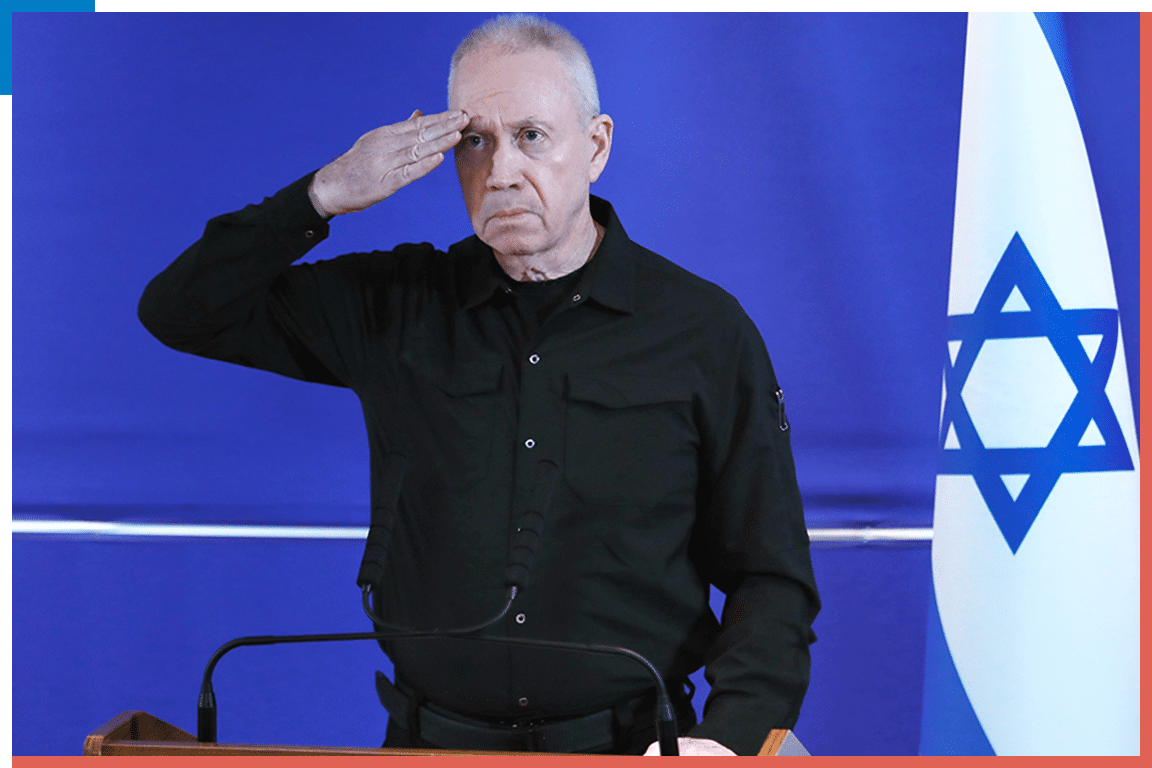
Gallant isn't expected to apologize for his stances on the hostages and the ultra-Orthodox, either. He will likely repeat what he has already said in faction meetings: that Likud is heir to Menachem Begin's politics, not Ben Gvir's.
An unexpected boost for the former defense minister came last week in a letter sent to the tribunal's presiding judge by former MK Uriel Lynn, a longtime party man. "Anyone holding a state office must not act with blind obedience," he wrote. "He bears personal responsibility for his organization's actions, and is supposed to serve the entire country, not just the party. Differences of opinion with the prime minister are entirely legitimate."
Lynn also added a historical reminder: "In the past, Likud knew how to handle a decision not to obey the party central committe. The center voted 70 percent against direct-election reform, claiming it endangered Likud. But when I brought that bill to the Knesset plenum, MK Benjamin Netanyahu was the only member of the party who stuck to his support and voted for it. The party accepted this with understanding, and that spirit should apply again this time."
Indeed, Likud did not expel Tally Gotliv, who defied the faction in the judicial appointments committee vote and helped elect the opposition's representative. Neither did it expel those who voted for the Gaza disengagement, against the outcome of the party referendum. Nothing will happen if it leaves Gallant's political future in the hands of party members as well.
The Chinese Wall
"China and Israel are nations with thousands of years of history," Netanyahu boasted a few years ago at China's National Day ceremony in the ambassador's residence. In that sense, it seems only a moment has passed since that unprecedented high point in relations.
Two years ago, at the peak of the Biden administration's boycott of him, Netanyahu announced he would make an official visit to Beijing. Officially, he said this was coordinated with the Americans and would not harm ties with Washington. In practice, it was a clear signal: if you keep undermining us, we have other strategic anchors. When China's vice president visited Israel, Netanyahu proudly noted that Israel was one of the few countries whose leader attended both the American and Chinese independence celebrations.
Well, not anymore. It wasn't a slip of the tongue last week when Netanyahu named China and Qatar as two of the world's greatest producers of antisemitism and anti-Israel sentiment. He said it once at the Finance Ministry, and repeated it that evening at the Foreign Ministry: "Israel is under a media siege from the West, funded by vast sums of money from Qatar, and from countries like China."
Everyone knows about the money Qatar invests. But what about China? The reference is to TikTok and its algorithm. Officially, the app is privately owned, but in China such a thing doesn't really exist. In Israel, TikTok's algorithm alone is blamed for damage on par with two foreign armies. It has trapped Western youth into a worldview where Israel is the villain and Hamas the hero. I tried a short experiment this week: I opened a video on Gaza — three minutes later, my whole feed had turned genocidal.
Not everyone at the top liked this new front. "Do we really need another battlefield in this war — to take on China too?" a senior diplomatic official asked this week. He noted that if TikTok is such a problem, it could be raised in the ongoing talks between Israel's and China's foreign ministers. After all, on the front marked most important, there have been gains: the Iranians feel completely abandoned by Beijing during and after Operation Rising Lion, with weapons supplies and oil imports far less than the ayatollahs expected.
Perhaps this is a gift to President Trump. In a divided Washington, where each party has its own weather forecast, the only bipartisan consensus is hatred of China. Israel has nearly halted the infrastructure deals with China that were so common here a decade ago, and the Shin Bet has already warned Israelis against trading sensitive security information with Beijing. Perhaps this is Israel's way of signaling to Trump: you're with us, and we're with you.
Sudden longing
It took unusual stamina to sit through the long ceremony in the Supreme Court last Thursday. For more than two hours, farewell speeches were delivered for Justice Yosef Elron, retiring at age 70. And yet, not a bird chirped as one speaker after another repeated the same points, recalled the same rulings, and offered the same praise. Only one, former Justice Minister Moshe Nissim, protested loudly when Attorney General Gali Baharav-Miara's speech neared the half-hour mark without any sign of ending.
Still, it was a fascinating event. Usually, such teary eulogies are saved for funerals, when the deceased cannot complain about hypocrisy. Here, Elron had to exercise almost superhuman restraint not to interrupt. Even Supreme Court President Yitzhak Amit, Elron's sworn enemy, offered him praise, asserting that "Justice Elron's unique voice was clearly evident in his rulings, enriching his judicial writing and adding depth to his decisions."
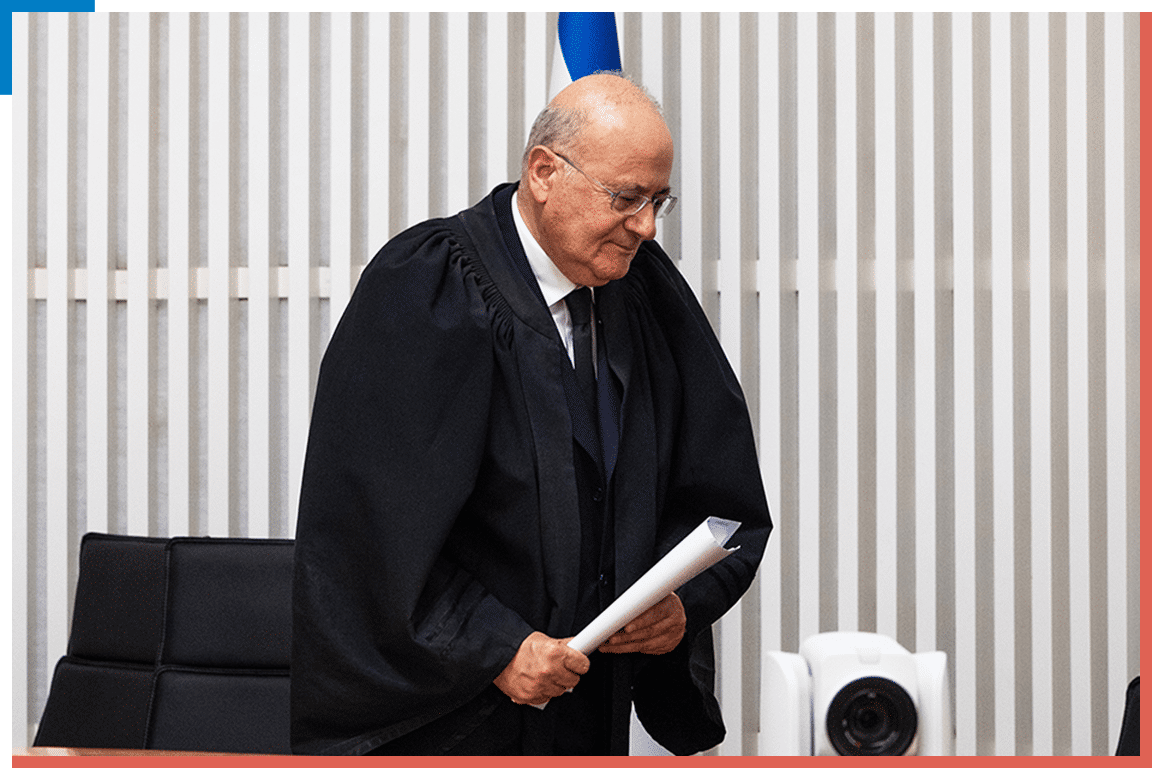
Indeed, Amit's praise was almost grand enough to forget that it was precisely his personal hatred for Elron that saw him drag the entire Supreme Court into a months-long battle to block his appointment, in favor of the other candidate, Ron Sokol. In the end, only the insistence of ministers Moshe Kahlon and Ayelet Shaked — both of whom also attended the ceremony — secured Elron's seat.
And therein lies the court's problem: whenever criticized for lacking diversity and intellectual variety, they point to names like Noam Sohlberg, Yosef Elron, David Mintz, and others. But if it had been up to the justices alone, as it was before the law changed in 2007, those justices would have only seen the Supreme Court as petitioners or on guided tours. The court is not a family; it's a crucial arena of power struggles and passions. Elron, one of only two Mizrahi justices on the bench, made a huge contribution to its diversity.
When he was appointed, newspapers were filled with anonymous smears about his political ties and his lack of fitness for the role. Now, they already miss him. My sense is that when the next round of appointments comes, they'll miss him even more.


