


President Donald Trump claims that since returning to the White House in January, he has succeeded in "ending seven wars" – Israel and Iran, Armenia and Azerbaijan, Cambodia and Thailand, Rwanda and Congo, India and Pakistan, Serbia and Kosovo, and Egypt and Ethiopia (some of these wins are disputed). The winner of the Nobel Peace Prize will be announced in Oslo on October 10, 2025.
Given the global attention to the Middle East, which has been at the top of headlines for two years, it seems impossible to ignore the achievement. But prediction platforms are not impressed. The procedural problem – the deadline for submitting nominations closed on January 31, exactly when Trump returned to office, and so too did the recommendations submitted for his victory from various heads of state, including from Israel.
This year, 338 nominations were submitted. The initial screening process takes place in February, and it converges into a shortlist by August. The details are kept secret for 50 years. Any head of state, minister, parliament member, social science professor, or previous Nobel laureate can make a recommendation.
The BBC was permitted to attend one of the final discussions held in the room on Monday, four days before the announcement. According to the description, the five members read aloud the criteria that Nobel established in his will in 1895 – the prize will be awarded "who shall have done the most or the best work for fraternity between nations, for the abolition or reduction of standing armies and for the holding and promotion of peace congresses."
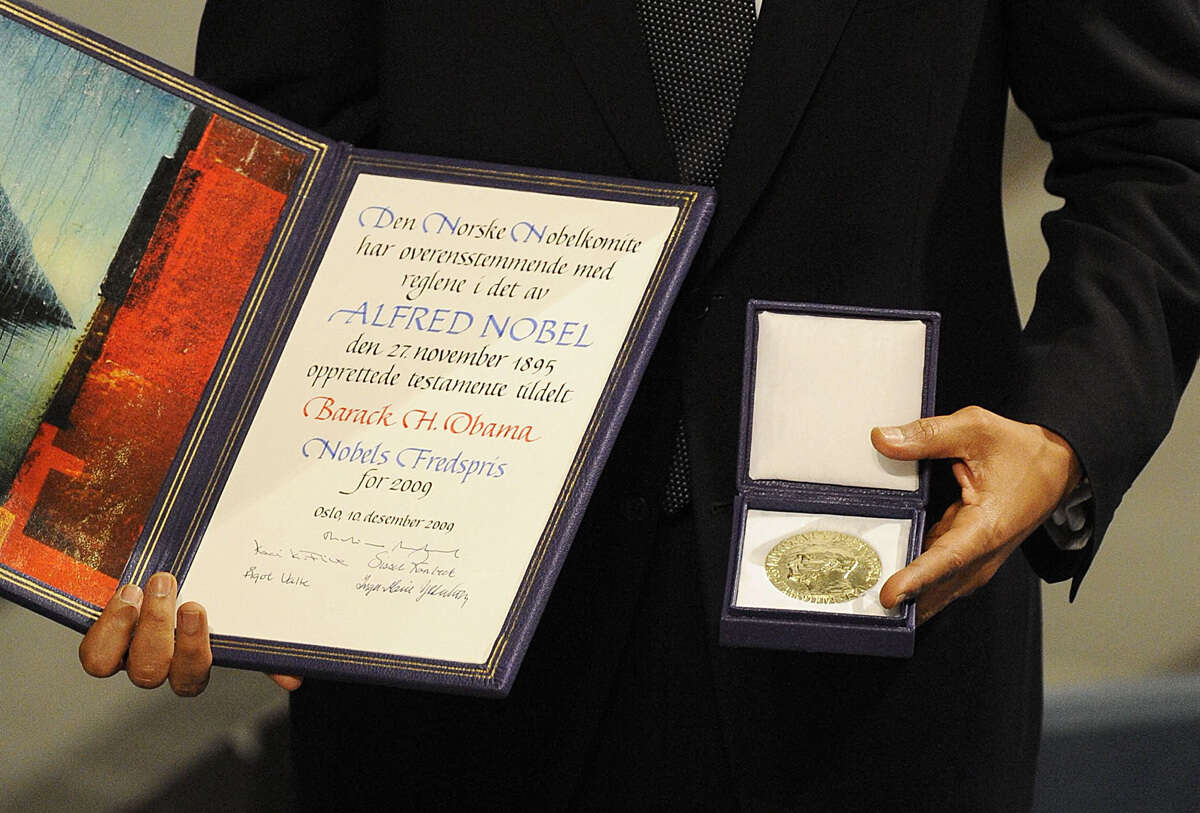
"Every year we receive thousands of letters, requests, people say 'this is the one who should be chosen,'" said Jorgen Vatne Frydens, the committee chair. "This campaign, the pressure – this is not something new," he added, but admitted that this time "we feel the world is listening. We must remain strong and principled." Frydens, who leads the Norwegian branch of an organization for promoting freedom of expression, has previously criticized Trump's steps to suppress freedom of expression in the US.
The Norwegian committee, whose members are elected by the Norwegian parliament, decides on the peace prize. Earlier this year, Norwegian media reported that Trump called Jens Stoltenberg, former NATO secretary-general and now Norway's finance minister, to discuss promoting his victory. Another concern in Norway is that Trump will take revenge on the country if he does not win the prize, similar to how the People's Republic of China behaved after the prize committee awarded the honor in 2010 to an opponent of the communist regime.
On the leading prediction platforms, Polymarket and Kalshi, Trump's odds jumped yesterday from about 2% to 7%, but moderated during Thursday and stand at 6–7%. In contrast, on the FanDuel betting site, the odds of his victory seemingly place him in third place with 20.8%.


