

New Middle East
The last time the Knesset convened during the festival of Sukkot was on October 16, 1973. Prime Minister Golda Meir stood before the plenum to announce that the IDF had crossed the Suez Canal into Egyptian territory. That was the moment it became clear to everyone that the tide of the Yom Kippur War had turned. The leader of the opposition, Menachem Begin, rose after her and quoted Winston Churchill: "What is our aim? It is victory—victory at all costs."
On October 12, 52 years later, barring any last-minute change, Donald Trump will address the Knesset. The accent will be Golda's, who grew up in Milwaukee; the language less restrained than Begin's.
Despite the separation of more than half a century, the situation is strikingly similar: a war that began with a surprise attack on Israeli soil ends beyond the enemy's lines. A sober look and an honest reckoning will show a victory greater than it may appear through the unbearable pain of war, through news of another fallen soldier, the hostage videos, and the grim procession of bodies from Gaza that at times seemed endless.
Even after the 1967 Six-Day War, there were those who struggled to grasp the scale of the achievement. The writer Yovav Katz captured that ambivalence in his bittersweet song, My Daughter, Are You Crying or Laughing?, about a young girl from Kibbutz Gadot in northern Israel, who emerges from a shelter at the war's end only to find her home destroyed by shelling:
Look up, my daughter, to the mountain,
The mountain that was like a monster
There are still cannons, my child, on the mountain,
But they now threaten Damascus.
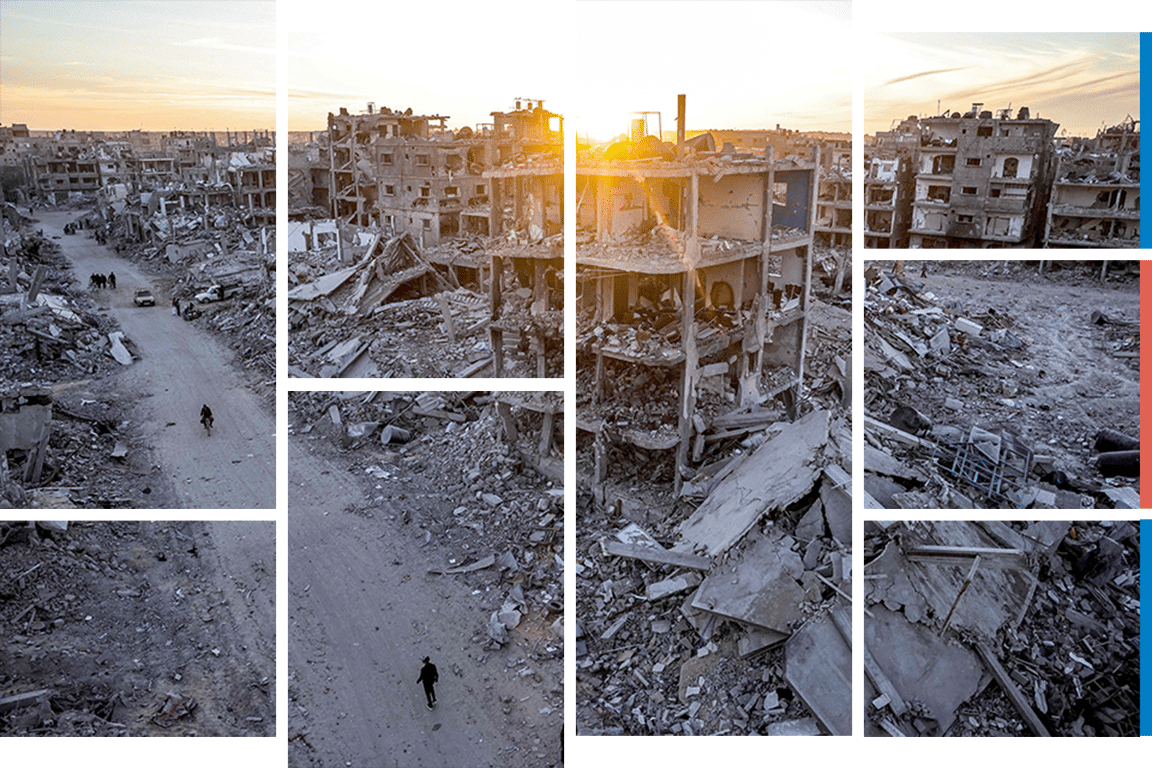
After two years of war, the IDF's cannons—or more precisely, its fighter jets—now threaten Damascus. They have struck six Muslim capitals. Gaza, once the world's epicenter of terror, lies in ruins. Hamas no longer threatens Israelis, and if Israel resists the temptation to return to its old habits of restraint, it will not rise again. Iran has been dealt a severe blow, and its nuclear project crippled. Hezbollah, Israel's most dangerous enemy since Gamal Abdel Nasser's Egypt—is taking hits daily and no longer dares fire even a single mortar at the Jewish state.
For the first time, there is real hope that children living near the Gaza border will grow up without sirens and rocket alerts every few weeks. There will be no new "round" with Gaza anytime soon, and if there is, it will take place under entirely different conditions. For the first time in two generations, the security of Israeli citizens matters more than the exact line of the international border—in Lebanon, in Syria, in Gaza, and even in the skies above Tehran.
In the War of Independence, one percent of Israel's population was killed, yet everyone understood that it ended in victory—a victory that is still celebrated to this day. This war, too, though it has yet to be given a name, will be remembered the same way.
It will be the end of the war when the agreement is signed, texted a member of the delegation from Sharm el-Sheikh. Then he immediately corrected himself: the end of the war in its current form. And now that the war's primary objective has been fully achieved, the real question becomes: will Israel be able to act to destroy Hamas? Will it be prevented from doing so? Or will Hamas, paradoxically, grow stronger?
Some say Israel's unstated goal is to avoid moving forward with the next, complicated, and mostly fantastical phase: Arab soldiers policing Hamas with the heavy price of IDF withdrawals from the Gaza Strip, as well as a future, however unlikely, return of the Palestinian Authority to the area. No international actor, from the days of the British Mandate onward, has truly succeeded in maintaining peace or disarming terrorists in the region.

The Israeli goal is actually "Lebanonization" — but not in the original 1980s sense of armed militias. Rather, it's the modern version: an active ceasefire in which Israel operates from the air to eliminate threats, and on the ground beyond the international border.
Will Donald Trump allow that? It depends on whether the American president's overriding objective is the return of the hostages or the end of the bloodiest war in the history of the Arab-Israeli conflict. Trump's rhetoric points to ending the war. But those who know him in Israel, the same people who correctly predicted his moves on Iran and Hamas — say his priority will be the hostages. They believe he will give Israel a free hand to continue acting against Hamas rearming. But what about the guarantees already given to the terrorist organization?
The return of the living hostages, and most of the bodies of the dead hostages, dramatically changes the situation in Gaza. Since October 7, time has worked against Israel. From now on, it works against Hamas. The organization is besieged, encircled by the IDF on all sides.
In areas under Israeli control, mechanisms for "the day after" can finally begin to take shape. Reconstruction will come only in exchange for demilitarization. That is, of course, assuming that international pressure to improve the lives of Gazans doesn't once again push Israel to fold, and allow goods and materials to flow in, fueling Hamas's resurgence.
The future may reveal what role, unwittingly, was played by IDF Chief of Staff Eyal Zamir's objections and the Kaplan Street protesters in shaping the ground operation in Gaza City. It was the shouting matches in the cabinet, the road blockades, the talk of illegal orders, the warnings that the IDF was being sent to kill hostages — all of this convinced Hamas that its greatest asset, 20 living Israelis, was a wasting commodity. In Prime Minister Benjamin Netanyahu's eyes, they concluded, its value was approaching zero and is better disposed of now.
That, of course, was not true. And it's doubtful whether Gaza City could have been taken under the constraints the army imposed on itself with the cabinet's approval. But the core principle adopted by the "axis of resistance" — that a hostage is a joker card to be played at the right moment, was shattered. The day after the massacre, Hamas offered to return hostages in exchange for guarantees that the IDF would not enter Gaza at all. Later, it offered hostages for a full withdrawal from the strip. Now, instead of Hamas holding on to all of Gaza, the hostages prevented the destruction of what was left of Gaza City.
For two years, Israel failed to deal with the city's underground, Hamas' final stronghold. Roughly 50 miles remain of the group that once dreamed of transforming the Middle East. It succeeded, but not in the way it intended.
I have never met Brigadier General Omer Tischler, the leading candidate to command the Air Force. He may be a bold pilot, a hands-on combat commander, keen on direct action, as many in the Air Force say. But through the fog of ignorance, one thing is clear: according to the criteria set by the Defense Minister himself, Tischler cannot be Israel's next Air Force Commander.
Israel Katz determined that anyone in a command role on October 7 would not be promoted. This prevented the appointment of Southern Command operations chief Ephraim Avni as the head of the Paratroopers Brigade, blocked the promotion of Southern Command Chief of Staff Brig. Gen. Menor Yanai, and thwarted that of Brig. Gen. Eliad Moati, commander of the Border Defense Corps on the day of the massacre.

Perhaps Katz is wrong. Perhaps the decree is overly harsh. But as long as it stands, why should there be an exception for someone who commanded, on the morning of the massacre, one of the key points of failure — the Air Force operations center — when the Air Force failed to construct an accurate operational picture? Tischler was effectively in charge as the Air Force waged the wrong war: striking deep targets rather than the obstacle, failing to grasp that the fence was breached and the infiltration was above ground.
Does he bear no responsibility for the fact that until 8:30a.m., Air Force command orders went unexecuted, and until 10:30, the operational picture was unclear? No, the exoneration in the Air Force's internal review is far from sufficient. Its reliability, like that of other military reviews during the previous IDF chief of staff's tenure, remains questionable.
Even if Katz changes the promotion policy, it should not happen before Tischler presents to the public his account of the Air Force's actual readiness. Was "operational capability deeply and increasingly impaired," as the commander said before the massacre, or "there was no impairment at all," as the same commander said after? The Air Force inquiry conveniently ignored the tough questions, but perhaps Tischler can shed light.
Until two months before the war, he was the Air Force's chief of operations, during a time when skeptics boasted that "Israel has no Air Force." He must explain, before any appointment, how the near-total lack of training in the operations center six months prior to the war (along with a significant number of aircrews) had no impact on the Air Force's operational response. If so, why train weekly at all? A miracle apparently ensured readiness.
Netanyahu is said to be a supporter of the candidate. Perhaps. Tischler's accomplishments are numerous, across many arenas. But one of his most important responsibilities, if appointed, will be to ensure, beyond a shadow of doubt, that the citizens of Israel can rely on their Air Force. Above all, he must guarantee that politics will never again intrude into the Air Force's sacred core — neither the operations center nor the cockpit. As a prospective commander, he must uphold the Air Force's long-standing tradition of rigorous and honest self-scrutiny.


