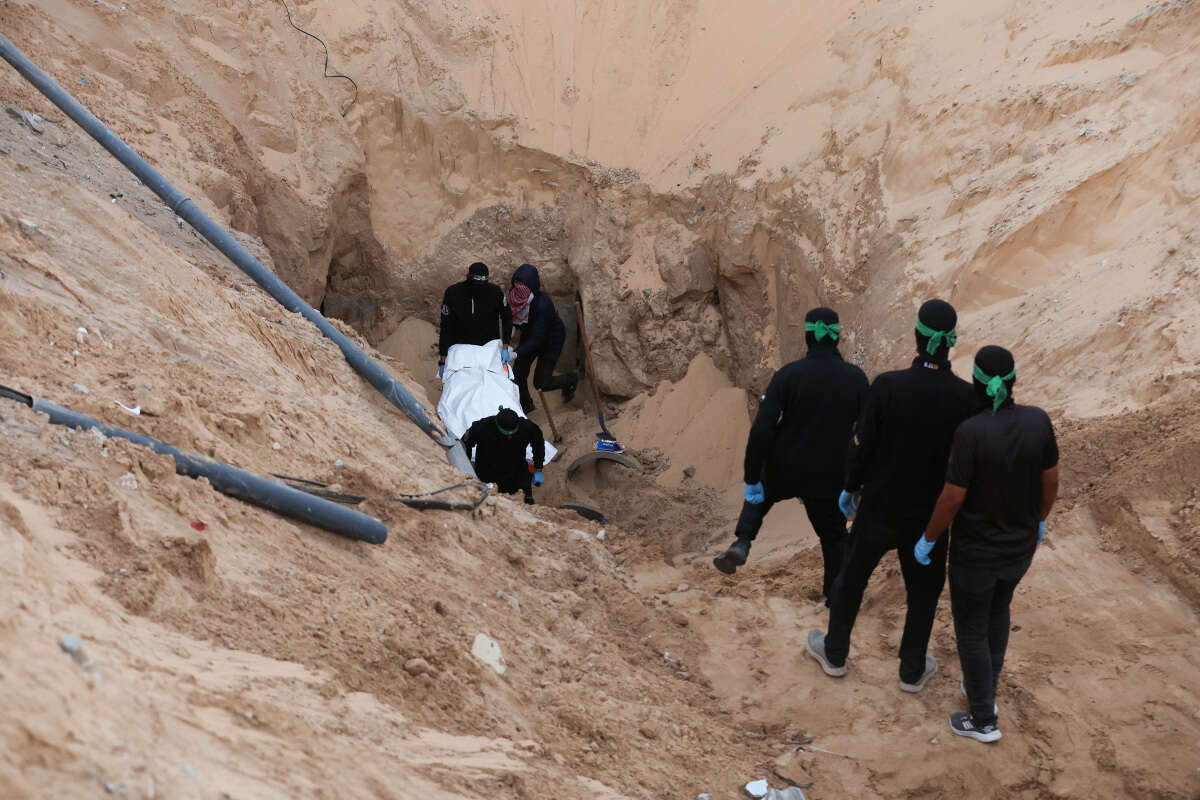
Two months have passed since Hamas pledged to return all living and deceased hostages within 72 hours. Only one living hostage remains in Gaza, Sgt. 1st Class Ran Gvili. Against this backdrop, the terror organizations have issued various excuses for the ongoing delay and complained that Israel has not implemented the entirety of the first phase of the ceasefire agreement.
Meanwhile, regional countries have accused Israel of the failure to open the Rafah Crossing in both directions, the activity to demolish buildings in the "yellow line" (buffer zone) area, and strikes against terrorists defined as "violations." For instance, an Arab source told Israel Hayom in a conversation that it remains unclear why Israel insists on not opening the Rafah Crossing completely, as far more Palestinians would leave than enter.
According to him, "Honestly, this is a strange and thoughtless decision. If Netanyahu had agreed at the beginning to open the crossing according to the agreement, he would have achieved the following things – respect from the international community, embarrassment for Egypt, hundreds of thousands of Palestinians would have left, only a few hundred would have entered, and the US would have received this as a gift. This is a diplomatic failure."
Nevertheless, Israel views this as an appropriate sanction for the ongoing delay in delivering all deceased hostages.
Egypt
Egypt is conducting talks with the Americans, during which it warns against the collapse of the ceasefire agreement. Senior officials in the country have conditioned the opening of the Rafah Crossing on it being in both directions, not just for exits.
Ahead of phase two, Cairo proposes the following framework: deploying a Palestinian police force trained in Egypt and Jordan, deploying an international stabilization force, storing and "non-use" of weapons by the terror organizations, a rehabilitation process for the Strip, and guarantees that attacks will not be carried out against Israel. Furthermore, the Egyptians demand the renewal of the political process with the PA.
Turkey
Turkey still seeks to participate in the international stabilization force. Turkish Foreign Minister Hakan Fidan, who maintains contact with Hamas, said over the weekend that the US must pressure Israel to implement the conditions for moving to phase two.
In an interview with Al Jazeera, Fidan said Turkey is working with Egypt, Jordan, Saudi Arabia, Qatar, and the United Arab Emirates to implement the ceasefire agreement. "We are now waiting for the implementation of several things, and especially for the establishment of the Peace Council, the transfer of Gaza's management to the Palestinians, and the establishment of a police body," the Turkish official said. He estimated that the stabilization force "will not encounter problems in its work. At some stage, Palestinian forces will receive security responsibility, but there must not be armed groups," he added.
Qatar
Qatar joins the demand from Israel for immediate and complete withdrawal from the Gaza Strip as part of phase two. Currently, Doha is focusing primarily on contacts with the Americans to apply political pressure on Israel.
According to an Arab report, Qatar and Turkey support postponing the "disarmament process" until the end of phase two – a situation that could actually lead to the issue being blurred.
That is, first a Palestinian police force would be deployed, then a technocratic government would be established, and the PA would return to managing the Strip, and only at the end would the disarmament process begin. According to this proposal, the weapons would pass to the custody of the Palestinian Authority, which would oversee their storage, and its role would be to prevent terrorists from accessing them. It has also been reported that Doha and Ankara are proposing an alternative to the PA: "international supervision."
Palestinian Authority
The PA proposes a similar framework: immediate Israeli withdrawal to the October 6 lines, international forces that would be deployed in the border area and "maintain security," entry of a PA force that would be responsible for security, holding internal Palestinian elections (with demands that would prevent Hamas from competing directly), and the start of the rehabilitation process.
According to sources in the PA, Hamas simply needs to "move aside and not interfere." Furthermore, in Ramallah, they accuse Hamas of its insistence on weapons stemming from its desire to continue collecting taxes and protecting its people, when this should be the government's role. Unlike the framework proposed by Qatar and Turkey, the PA has publicly demanded several times that Hamas hand over its weapons to them immediately.
Gulf States
The Gulf states currently prefer not to intervene in phase two of the ceasefire agreement. The initial condition from their perspective is Hamas' disarming. In this, they align with the PA. Accordingly, the two countries seek to push Hamas as much as possible out of Gaza's management and believe the PA should be involved in any solution.
However, in Riyadh and Abu Dhabi, they are aware that the PA requires significant reforms. The Gulf states' demand for change has also been directed toward Israel.
Saudi Arabia
Only recently, a senior official at the Saudi Foreign Ministry declared that the current government in Israel "does not constitute a partner." Until then, Saudi Arabia and especially the United Arab Emirates have been conducting humanitarian projects in the Gaza Strip.