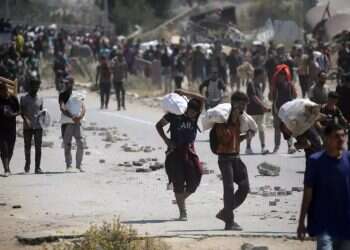
The return of the body of Ran Gvili to Israel likely marks the true end point of the Gaza War in its current form. With each passing day, Hamas is strengthening its civilian grip, largely due to the massive number of humanitarian aid trucks entering the Gaza Strip, far beyond what is required in practice.
Senior IDF officers believe the number of aid trucks entering Gaza should be significantly reduced. At present, roughly 600 trucks enter the strip each day, about 4,200 per week, three times the amount actually needed to meet Gaza's humanitarian requirements. According to these officials, the excess supplies are being exploited by Hamas to reestablish its economic base and consolidate its control.
The IDF assesses that Israel should conduct coordinated staff work with the Americans and sharply scale back aid deliveries. Sources stress that flooding the area with aid does not lower prices for civilians, since Hamas imposes taxes on merchants. In their assessment, Gaza is already awash in supplies, and there is no justification for allowing more than 134 to 200 trucks per day to enter the strip.
According to IDF data, about 112,000 aid trucks have entered Gaza since the war began, roughly 56,000 of them since the ceasefire came into effect around three months ago.

The explanatory failure
IDF officials insist that throughout the war there was no famine in the Gaza Strip and that no deaths from starvation were recorded, including during what they describe as Hamas' "starvation campaign," when aid trucks were barred from entering Gaza for three months. This, they say, was because the strip had already been saturated with supplies beforehand.
However, these officials argue that Hamas' starvation narrative was never met with an effective countercampaign from Israel. In their view, no Israeli body managed to mobilize all the relevant actors, including the National Public Diplomacy Directorate, the Foreign Ministry, the IDF and the Coordinator of Government Activities in the Territories, leaving the international arena largely in Hamas' hands.
Security officials add that in hindsight, some international actors privately came to understand the situation after receiving professional briefings. Publicly, however, their superiors abroad continued to side with the Palestinians and vilify Israel for political reasons. According to these officials, Israel was subjected to a double standard, condemned while the world largely ignored events in Ukraine or the massacres in Syria.

It is well known that conditions in Gaza were difficult even before October 7, and there is no doubt they deteriorated significantly after the war, during which an estimated 70,000 Palestinians were killed. Security officials say the most acute problem in Gaza today is dire sanitation, with sewage flowing through streets and garbage mounds reaching heights of nearly 20 meters.
Israel's security establishment acknowledges that aid trucks are also used for smuggling, but stresses that these are limited to consumer goods and that no weapons have been smuggled into the strip so far. Additional smuggling, according to the officials, takes place through the border fence using operational platforms, such as contractors entering Gaza for civilian works.
They add that, as exposed in the recent "security affair," many Israelis are making significant sums of money as a result of the war. The next chapter, they estimate, will be the reconstruction of Gaza, which is expected to become a major source of profit for Israelis involved in the process.
No reconstruction without demilitarization
The security establishment is warning against the emergence of a "Hezbollah model" in the Gaza Strip. According to these assessments, Hamas is likely to remain in key positions and preserve its military capabilities under a technocratic committee made up of former Palestinian Authority officials. Another option is the replacement of some functionaries, but even in that scenario, officials believe Hamas would be able to rebuild itself within a few years. A third possibility is chaos.
The most plausible assessment, according to security officials, is a reality somewhere between the first and second scenarios, namely a Hezbollah-style model and the rebuilding of Hamas' power within a few years.

Security sources emphasize that demilitarization of the Gaza Strip is a fundamental condition and that reconstruction without demilitarization is impossible. They note, however, that it is doubtful any actor other than Israel would be willing or able to disarm Hamas, and warn that proposals requiring Hamas to store its weapons in depots inside Gaza are deeply problematic.
Israel, they conclude, must prepare for the possibility of a return to fighting. Within the IDF General Staff, opinions are divided. Some members of the General Staff believe there is no alternative to renewing combat operations, while others, apparently including the chief of staff, do not believe the timing is right.