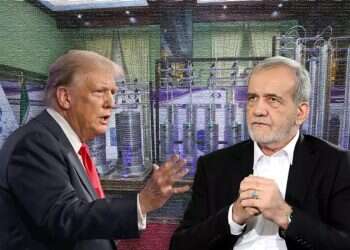
This marks the third time since Donald Trump returned to the White House that he has sought to reach an agreement with Iran. The two previous attempts ended in military action, but this time US officials insist that "the diplomatic effort is genuine and real." A US official told Axios: "The Israelis are the ones pushing for a strike."
Intensive diplomatic efforts by several US allies led to the opening of talks between Washington and Tehran. The negotiations were expected to take place on Friday in Turkey, but Iran is now seeking to change both the format and the timing of the talks, according to two sources cited by Axios.

The US is expected to arrive at the talks with significant leverage, including a massive military buildup in the Gulf that constitutes a credible threat, as well as an Iranian regime that is more fractured and isolated following widespread protests. Earlier this week, Lt. Gen. Eyal Zamir met with the chairman of the US Joint Chiefs of Staff, Gen. Dan Caine, and discussed with him and his team the full range of operational options and their implications.
Iranian officials have already threatened to withdraw from talks with US special envoy Steve Witkoff and with President Trump's son-in-law, Jared Kushner, according to a report in the Wall Street Journal.
The previous round of nuclear talks ended in war, after Trump approved Israeli strikes and later ordered direct US attacks on Iranian nuclear facilities in June. A second attempt came when the US sought to exploit Iran's interest in avoiding the reactivation of the snapback mechanism and to persuade the regime to relinquish its stockpile of enriched uranium.

US officials insist that Trump's decision to send his envoys, Witkoff and Kushner, to talks with Iranian Foreign Minister Abbas Araghchi is not a cover for another surprise attack. At the same time, the US has moved substantial firepower into the region in case Trump ultimately decides on military action.
Inside the White House, however, doubts have been raised about whether US bombs could truly bring about decisive political change in Iran, along with concern over the risk of a broad Iranian retaliation against US targets across the Middle East. Meanwhile, Turkey, Qatar, Egypt and other countries have undertaken an intensive diplomatic effort to ease tensions, culminating in the planned Friday meeting in Istanbul. Turkey's foreign minister has invited several Arab states to participate as observers.
As the US positioned an aircraft carrier and additional military assets in the region, the military plans under discussion became far more ambitious. Israel opposed the limited strikes Trump considered three weeks ago, arguing they would be merely symbolic and would not justify the risk of a massive response.