


Prime Minister Benjamin Netanyahu is set to meet US President Donald Trump, with Iran expected to top the agenda. According to two Israeli sources who spoke to CNN, the prime minister plans to discuss possible military options against the Islamic Republic during his visit, as Israel prepares contingency plans in case negotiations between Washington and Tehran collapse. Meanwhile, The Wall Street Journal reported that the US is considering seizing tankers carrying Iranian oil in order to increase pressure on Tehran.
One Israeli source said Jerusalem remains skeptical about the chances of the emerging US-Iran talks but is working to ensure its interests are safeguarded, including preserving Israel's freedom of military action under any future agreement. Netanyahu was expected to present Trump with updated intelligence on Iran's military capabilities, one source added.
"Israel is concerned about Iran's progress in restoring its ballistic missile stockpiles and capabilities to their pre-12-day war levels," one of the officials said. According to Israeli assessments, without intervention Iran could possess between 1,800 and 2,000 ballistic missiles within weeks to months.
Before departing for Washington on Monday, Netanyahu said he would discuss "Gaza, the region, but first and foremost Iran."
"I will present President Trump with principles for negotiations with Iran that are important for anyone who seeks peace and security in the Middle East," he said.

Military buildup across the region
At the same time, a comparison of satellite images from early February with those taken in January reveals a significant reinforcement of aircraft and military equipment across the Middle East, according to William Goodhind, a satellite imagery analyst with the Contested Ground organization.
Iran maintains underground missile complexes near Tehran as well as in Kermanshah and Semnan, and near the Gulf coast. In addition, an Iranian drone carrier, the Shahid Bagheri, was spotted in satellite images on January 27 about five kilometers (3 miles) from the port of Bandar Abbas, and again on February 10 in the same area.
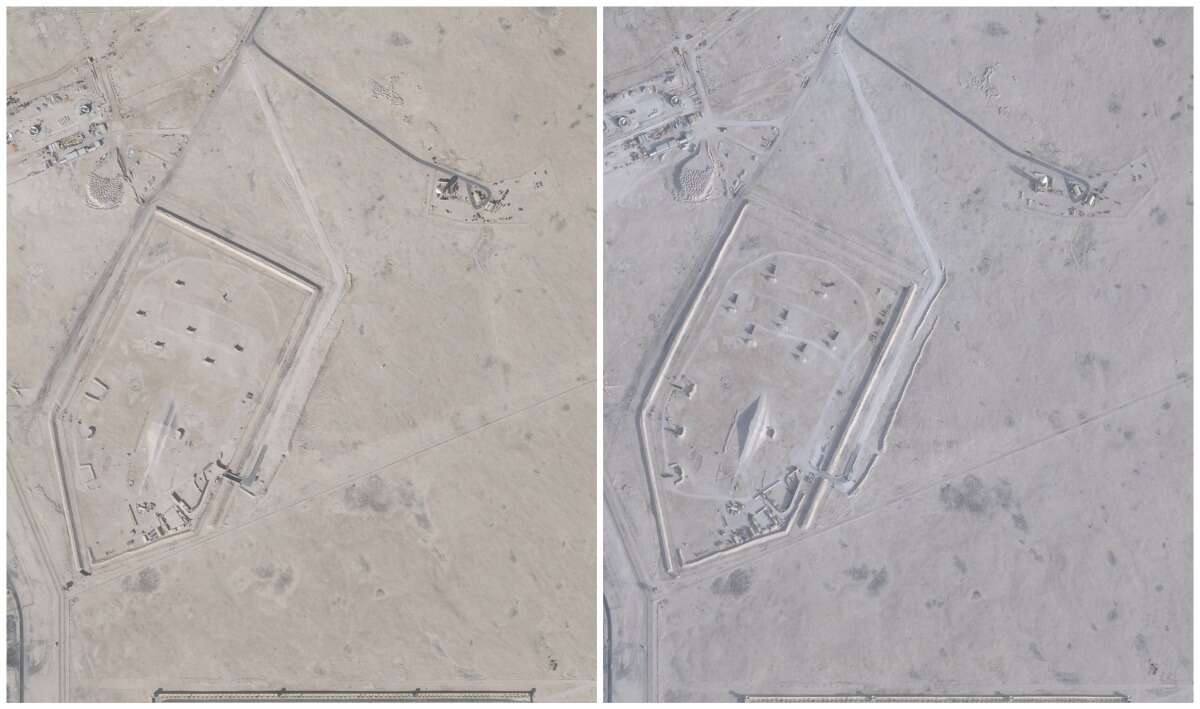
At Al Udeid Air Base in Qatar, Patriot missile systems were seen mounted on heavy M983 transport trucks in early February. Additional changes were observed at US bases across the region. At Al Udeid in Qatar, images from February 1 showed an RC-135 reconnaissance aircraft, three Hercules transport planes, 18 KC-135 refueling aircraft and seven C-17 transport aircraft. In images from January 17, there had been only 14 refueling aircraft and two C-17s.
At Muwaffaq Salti Air Base in Jordan, images from February 2 showed 17 F-15 fighter jets, eight A-10 aircraft, four Hercules transports and four unidentified helicopters. At a second site on the base, additional transport aircraft and four EA-18G Growler electronic warfare aircraft were observed, none of which appeared in images from January 25.
At Prince Sultan Air Base in Saudi Arabia, C-5 Galaxy and C-17 transport aircraft were seen on February 2. On Diego Garcia, seven additional aircraft were observed in images from February 6 compared with January 31. An increase in aircraft numbers was also recorded at a base in Oman between January 25 and February 10.


