


Insurance
Mansour Abbas told the truth in an interview with Dana Weiss when he recounted receiving a phone call in 2021 from Qatar trying to persuade him not to go with Bennett but with Netanyahu. But the full truth is even more fascinating: the call came from Qatar, but not from a Qatari. On the line was a senior Hamas official. He believed Netanyahu was headed toward continued calm and quiet understandings, whereas a new government would be dragged into an operation in Gaza.
Five years have passed; Hamas no longer acts to promote a fully right-wing government (mostly). But the underlying circumstances have not changed. Abbas still wants to enter a government at any cost, and his rivals want a joint list that would raise Arab voter turnout. Statistics do not lie: Arab unity yields no fewer than 13 seats and always ends in opposition; fragmentation yields up to ten seats but enables Abbas to influence from within.
Abbas's colleagues believe that this time they can reach 16 seats thanks to the "X factor": removing Ben Gvir from the government. They will tell their voters that even if a Jewish unity government is formed, Otzma Yehudit will remain outside. That, of course, does not satisfy Abbas. When he parted ways with his partners five years ago, he told them: "You want to topple every government and dissolve every Knesset." He well remembers how the other Arab parties—Hadash, Ta'al, and Balad—helped bring about the end of the change government. Therefore, he intends to place as many obstacles as possible in its path. Five secure seats in hand are preferable to fifteen in the bush in separatist fashion.
The surprise is that both Bennett and Netanyahu very much do not want the formation of a unified Arab list. Each trusts his own polls. In the change bloc they rely on most television polls, in which, without Arab unity, the opposition is within striking distance of 61 seats. Netanyahu relies on Likud polls, in which the right-wing bloc stands at 59 or 60 seats. A large Arab bloc is like buying an expensive insurance policy against disasters: it prevents your rival from obtaining a majority, at the price of shrinking your own bloc. But it's well known that both Netanyahu and Bennett wouldn't spend their last shekel on insurance, but on a lottery ticket.
What you don't see
Brigadier General Ofer Winter once boasted about a solution he developed as Givati Brigade commander during Operation Protective Edge to combat tunnels: place a large fan over a shaft, throw in a smoke grenade—and the smoke emerges from nearby shafts, exposing them. They named the system "Purple Fox," after the Givati Brigade's symbol. It was an excellent solution for 2014. But since then, the tunnels have advanced and Hamas has adapted.
The current war broke out, and at its outset Winter whispered the idea into the ear of one of the division commanders. The method of destruction developed since then is like democracy: the worst method—except for all the others.
But a dramatic and troubling revelation was tucked into the Prime Minister's speech this week. For months it was said that the IDF had destroyed almost all the tunnels in Gaza; later, during the ceasefire, the figure suddenly dropped to 60 percent. Then Netanyahu came and announced: there are 500 kilometers of tunnels in the Strip; we have eliminated 150 of them. Seventy percent still exist.
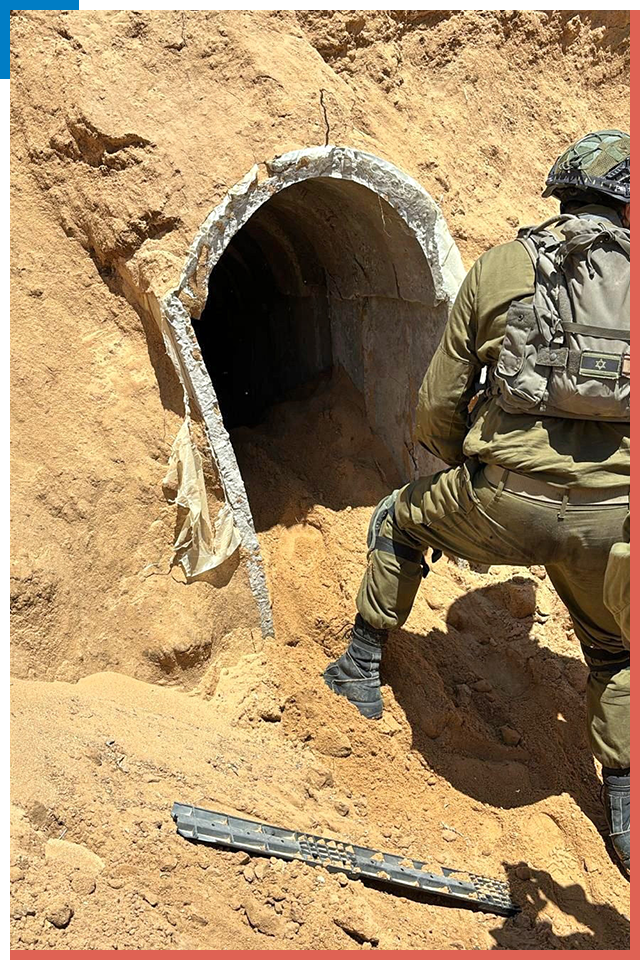
The tunnels are Hamas's Dimona. When speaking of strategic weapons—this is the weapon. If the vast majority survived, even after intense fighting, can the rest even be destroyed?
Add to that what soldiers in the field are saying. One claims Hamas has resumed digging, this time with shovels and children paid 20 shekels a day. There is no shortage of shovels, children, or money in the Strip.
Another officer speaks of more and more tunnels being found inside the "yellow line." The IDF conducted a massive statistical drilling effort—one borehole every 14 meters. Dozens of tunnels were discovered, yet even afterward additional shafts are being found.
Another officer likens the tunnels within Hamas-controlled territory to a tree, and their extensions into our territory to branches. We prune the branches, but Hamas's digging makes them grow back. Very troubling.
And yet Southern Command paints a different and far more optimistic picture. When the Prime Minister spoke of destruction, he referred only to tunnels completely demolished with tons of explosives every 100 meters. In addition, another 200 kilometers were neutralized by pumping in concrete—something that could theoretically be drilled through, but practically cannot. Moreover, the method involves blowing up the entrance and exit of a tunnel, leaving middle segments that are not counted as destroyed but are unusable. The IDF also completely rejects the claim of significant renewed digging or tunnel rehabilitation.
In territory under Israeli control, only about 40 kilometers remain untreated. Within two to three months, an announcement is expected that there are no more tunnels near Israel. How does that square with the militants who emerged this week from a tunnel in Beit Hanoun, a kilometer inside the yellow line? The army claims they survived for months on dates above ground and were eliminated when they emerged from a partially ruined section as soldiers pumped explosives into it.
So how does one decide, after October 7, whether to listen to senior command or to soldiers in the field? Perhaps by focusing on the shared message: the path to defeating Hamas runs through eliminating the tunnels even in territory not under our control. More than 100 kilometers remain.
They will not be destroyed remotely. If they are to be destroyed, it will only be from the ground.
Likud's right
"Democracy does not die in a single blow, but in a hundred small blows," said Supreme Court President Yitzhak Amit in one of the hearings. By the same logic, annexation does not have to come in a single declaration but in a hundred small steps. This week the government took a not-so-small step: it opened the possibility for Israeli companies to purchase land in Judea and Samaria and to register it, for the first time since 1967.
Aside from Yair Golan, who tossed out a comment about it in a radio interview, none of the opposition leaders said a word. Not Lapid, not Eisenkot, not Gantz, certainly not Lieberman or Bennett. When people speak about Israeli society shifting to the right, they do not mean that everyone will vote for Ben Gvir or Netanyahu. They mean exactly this: steps that were once at the heart of Israel's fiercest disputes are now consensus. Another example? If, after the elections, a miracle were to occur and Netanyahu formed a government together with Lieberman and Bennett, Smotrich and the ultra-Orthodox, it would be defined as a broad national unity government. A decade ago, when Lieberman joined that same kind of government, Haaretz was shaken by what it called an extreme right-wing government, and the late journalist Roni Daniel spoke about the possibility that his children would not remain in the country.
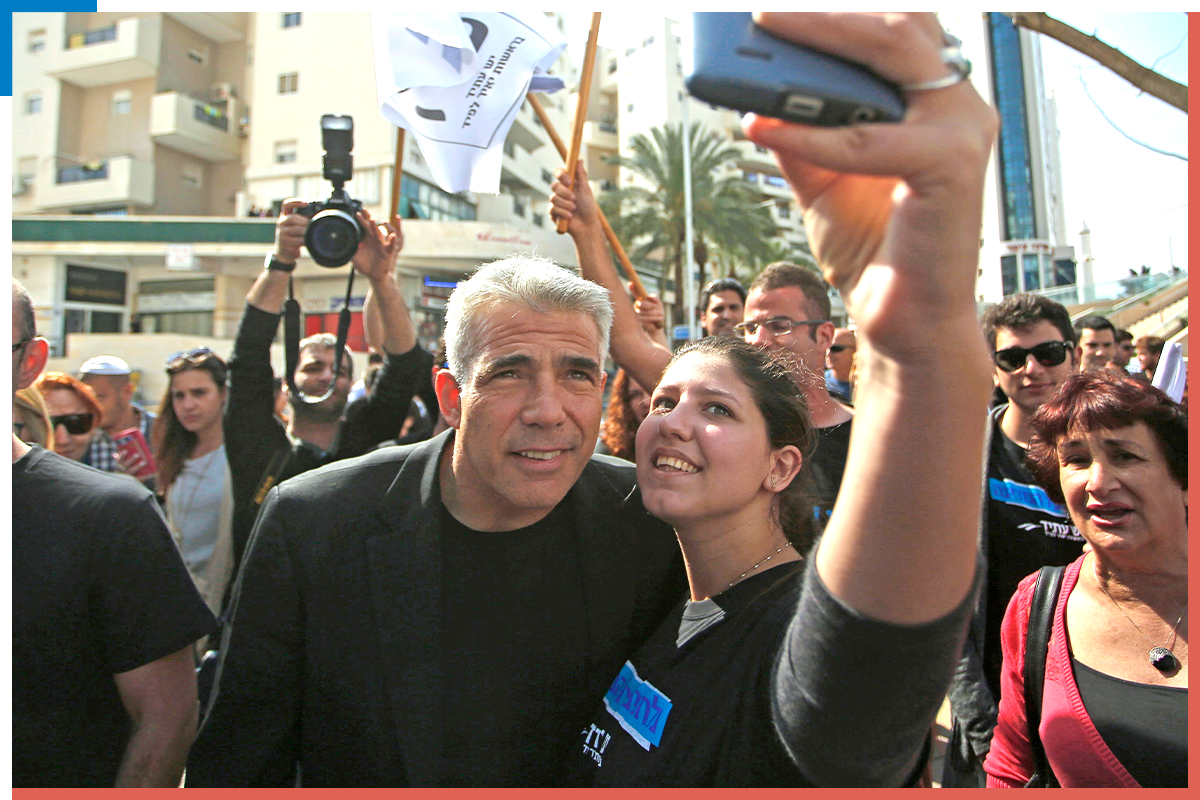
That is the background to Lapid's unusual warning this week: "I'm no longer sure we'll win." The "change bloc" faces a demographic challenge: since the last election, six hundred thousand new voters have been added—a record since the founding of the state. The overwhelming majority are ultra-Orthodox, religious-nationalist, residents of the periphery, and Arabs. In the same period, two hundred thousand people have died or left the country—also a record. That is a net difference of two to three seats.
The change bloc benefits from early and efficient organization that prevents wasted votes. Meanwhile, nine seats are currently being burned below the electoral threshold by parties that do not rule out Netanyahu (Bezalel Smotrich, Yoaz Hendel, Benny Gantz). The assumption, however, is that those votes will not ultimately be wasted. The public agenda has been almost entirely focused on ultra-Orthodox draft evasion, but slowly Odeh, Abbas, and Tibi—who nearly disappeared for years—are returning to public consciousness and voting considerations.
What Lapid said is that victory is not in the bag—he is right. In his view, Yesh Atid should lead the bloc, and that can of course be debated. But it is clear that there is no way to decide the contest without votes from right-wing Netanyahu-disappointed voters—those who want settlement in Judea and Samaria, a toned-down judicial reform, and a strengthened draft law.
There is a phrase in Israel: "The shell that kills you is the one whose whistle you do not hear." What threatens the change bloc is not internal squabbles nor fragile micro-parties like "The Reservists," but a new party of that kind: former Likudniks, a right wing not tainted by October 7.
Former Finance Minister Moshe Kahlon reached a plea deal this week that allows him to return; Yuli Edelstein is exploring options; Gilad Erdan, former ambassador to the UN, is appearing more frequently in studios.
Who made the bill fall?
The fall this week of the bill to limit prime ministerial terms was another reason for infighting among opposition leaders. Gantz claimed Bennett had scuttled it in the previous government; others blamed him as well. In this case, all answers are correct. What happened was this: Justice Minister Gideon Sa'ar's bill was pared down to a version everyone could live with—limiting terms only from the moment the law took effect. Bennett and Lapid apparently believed they could each serve more than two terms.
In the first week the bill was set to pass, Gantz announced a voting boycott over his demand to approve additional benefits for career officers. In the second week, once the crisis ended, it emerged that the German chancellor was visiting Yad Vashem at exactly the time of the vote, and Prime Minister Bennett asked to accompany him. The problem was the need for 61 MKs to pass a Basic Law; without that—no law. The vote approached; Yad Vashem did not approach the Knesset; and after Sa'ar stalled repeatedly, he had to request a one-week delay.
The decisive week arrived, the last day of the winter session. But these were the days of the Omicron wave, and opposition MK Avi Maoz was infected. An emergency meeting convened, where representatives of Yesh Atid and Labor proposed pairing off with him. "Pair off?" New Hope exploded. "Removing a coalition member means the law falls." It didn't help. "Rules must be respected," they replied, and the bill was postponed to the summer session. A few days later, the country awoke to Idit Silman's resignation, bringing the coalition majority to an end. Had the law passed then, Netanyahu would now be running for his final term. But it did not pass then, and it did not pass this week: 55 opposed, 44 supported. Avi Maoz voted against.


