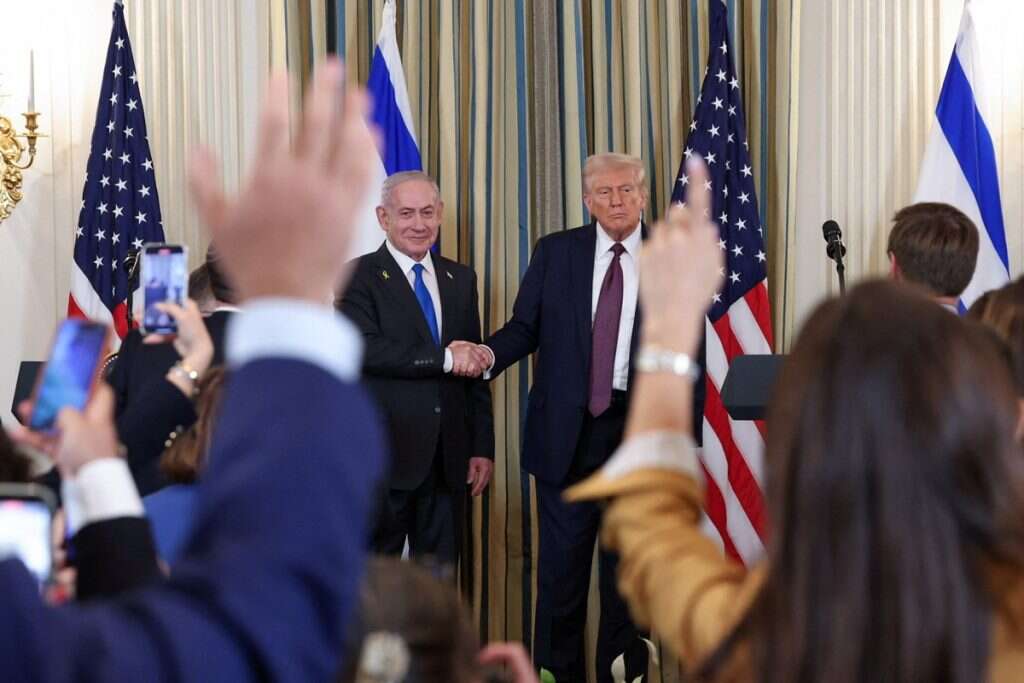
Prime Minister Benjamin Netanyahu said earlier this week, in a speech at the Conference of Presidents of Major American Jewish Organizations, that "we are giving Trump's plan a chance. The president said Hamas can be disarmed the easy way or the hard way. We need to achieve the full disarmament of Hamas – including the AK-47s [Kalashnikov] in their possession – and the destruction of the tunnels in the Gaza Strip."
However, a senior diplomatic source from the region who spoke with Israel Hayom said that Hamas fears having its weapons taken away, out of concern that Palestinians themselves will settle scores with the terror organization. For this reason, the source said, Israelis need to accept that disarming Hamas of its small arms will take years. "It's like disarming Beersheba of its weapons – can you do it in one day, or will it take years?" the source said.
The source explained that the reason is that on Thursday, Trump's Board of Peace will convene for the first time to approve the framework for managing and rebuilding the Gaza Strip. According to a document obtained by Israel Hayom detailing the plan for governing Gaza, it is explicitly stated that anyone who has ties to Hamas may not participate in governing the Gaza Strip. As the document states, "Only those who support and act in accordance with the Board of Peace's decisions will be eligible to participate in governance, rehabilitation, economic development, or humanitarian assistance activities in Gaza."
"For example, individuals or entities such as foreign terrorist organizations (as defined by the member states of the Board of Peace or the Board of Peace itself), and non-governmental organizations that have supported or have a proven history of cooperation, infiltration, or influence with or by Hamas or other terror groups, are barred from participation."
However, the same source said that the right approach is to also integrate those who were members of Hamas but were not involved in serious terrorist activity into the civilian mechanism that will govern Gaza. The source explained that approximately 12,000 Palestinian police officers – trained by Jordan and Egypt – are currently planned to arrive in the Strip. Of those 12,000, the EU will cover the salaries of 3,000, the source said.
Egypt's military buildup is no coincidence
The same source added that he was not surprised to hear that Prime Minister Netanyahu told the Knesset Foreign Affairs and Defense Committee two weeks ago that the Egyptian army is growing. According to the source, Egypt currently faces major challenges stretching from Sudan to Libya, and the army has grown in response. The source added that he sees no reason for a confrontation between Israel and Egypt, since Egypt views its peace agreement with Israel as a highly valued strategic asset.
Regarding the Rafah crossing, the same source confirmed that approximately 50 men and women pass through it each day. The Palestinian Authority and a European Union force supervise the crossing, while Israel approves the lists of those entering and exiting the Strip.
The Prime Minister's Office did not respond to Israel Hayom's inquiry.
Danny Zaken contributed to this report.