


Will Khamenei pull a Hitler?
Hitler called it the "Nero Decree." In March 1945, when the Allies were already on German soil advancing toward Berlin, he signed an order to burn all bridges, destroy all local industry and leave behind scorched earth.
A fierce debate is taking place in the upper floors of the Kirya and the lower levels of the "Bunker." It concerns the possible existence of a parallel Iranian directive, three words long: "The Doomsday Order." If such an order exists, it would not deal with destroying Iranian infrastructure but rather with issuing a "go" command to the entire Axis of Resistance—Hezbollah, the Houthis, Hamas and the militias—to fire everything they have.
If such an order exists, its meaning is no longer existential from Israel's perspective: Hamas has been dismantled as an army, Hezbollah has been cut down by 90%, and Syria no longer takes instructions from Tehran. But it would still be a major headache for the military, a serious challenge for Israel's defense systems and a prelude to a broad military operation in Lebanon.
Supporters of this view argue this is the way of fundamentalists—they do not know how to compromise and, from their perspective, will allow the entire region to go up in flames. Opponents believe there is no evidence for this and, in any case, question what exactly a button pressed in Tehran would even activate.
But Israel's actions over the past week seem to be driven—perhaps as a result of the lessons of October 7—by the assumption that it will happen. That is the reason for the escalating attacks on Hezbollah strongholds, with emphasis on its rocket array. It is also the reason for the growing concern and attention devoted to the Houthi threat.
How quickly we have forgotten the nightly rush of millions to shelters because of a single missile. The concern about the fanatics from Yemen goes far beyond that nuisance, whose main damage so far has been the prolonged destruction of the tourism industry. The Houthi army includes nearly 1 million fighters, and its plans include raids into Israeli territory. It is not an immediate threat, of course, and the distance is great, but we have already learned that seemingly far-fetched plans—in this case, an invasion via Jordan—cannot simply be dismissed.
A major question has accompanied party leaders in recent months: Why is Netanyahu insisting on passing a deeply unpopular draft law for a few months at most? The answer, always delivered in a mysterious tone, is "security matters." As far as is known, this concerns not only a possible war with Iran but another front as well. Another invasion of Gaza? A ground operation to renew the security zone in Lebanon? Perhaps an attack on the Houthis? There is no shortage of possibilities.
Amid the chaos reigning in the opposition, it is easy to miss the main struggle taking place these days. It is Bennett versus Eisenkot; everyone else is background noise and distraction.
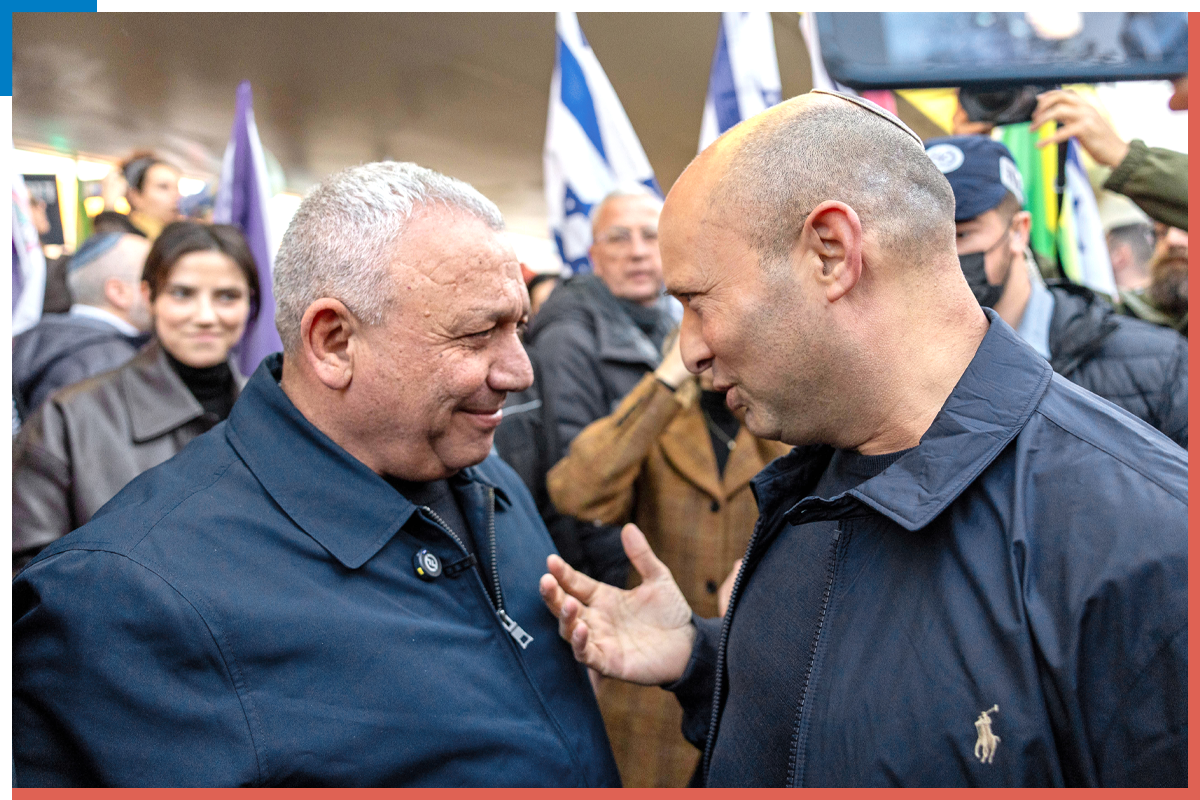
The math is simple: Yair Golan is boxed into the left; Liberman has a glass ceiling; Lapid is still deep in his rebranding campaign. The question of who leads the bloc lies between Bennett and Eisenkot. The gap between them has narrowed recently and stood in polls last week at 7-9 seats—still significant, but less so.
In Bennett's party they always ask in polls, "How much Gadi?" and in Yashar they immediately ask, "How much Naftali?" The reason is those 10 or so mandates—hundreds of thousands of voters—who for seven years have given their vote to the main challenger to Netanyahu. Today they are here, tomorrow elsewhere, without commitment or sentiment. Whoever leads, even by one seat, will receive them all. Right now they are with Bennett; a year ago they were with Benny Gantz. Where will they be on Election Day?
The important news in the bloc, therefore, is the one never officially announced: Gadi Eisenkot recently decided to run for prime minister. That is why he did not rush to unite with Bennett even though he was promised half the kingdom, literally. That is why Bennett pushed so hard for a joint run in recent months until he temporarily gave up. No negotiations have taken place between the sides for weeks, but they will certainly resume under pressure from bloc voters and strategic advisers, and the question is who will arrive there in the lead.
Eisenkot's strength lies in his exceptionally high favorability ratings, his relative newness and his organic connection to the camp. Bennett's strength lies in more than a year of leading in the polls, experience as prime minister and the ability to draw votes from the right. That is why he got tangled in Efrat with remarks about partnership with Smotrich and not ruling out Ben-Gvir. It was an unnecessary misstep that recalled the joke about the beggar who said that if he were Rothschild, he would be richer than Rothschild because he would continue begging. The attempt to gather a handful of votes from beyond the Green Line could cost Bennett valuable mandates on the other side.
Bitan's revenge
Knesset member No. 28 of Likud in the 1990s was one of the factors in Netanyahu's 1999 defeat to Ehud Barak. Could MK David Bitan in the 2020s do something similar?
The defeat on the VAT issue inflicted on Netanyahu and Smotrich was delivered by an eclectic coalition. It included socialist Knesset members (of which Likud has many); the hostility of ministers Barkat and Dichter toward the finance minister; Yuli Edelstein's revenge on his party (probably soon to be former), which removed him from chairing the Foreign Affairs and Defense Committee; and perhaps, though I may suspect unfairly, an ethnic component—Mizrahi Likud MKs versus the Ashkenazi faction of Religious Zionism.
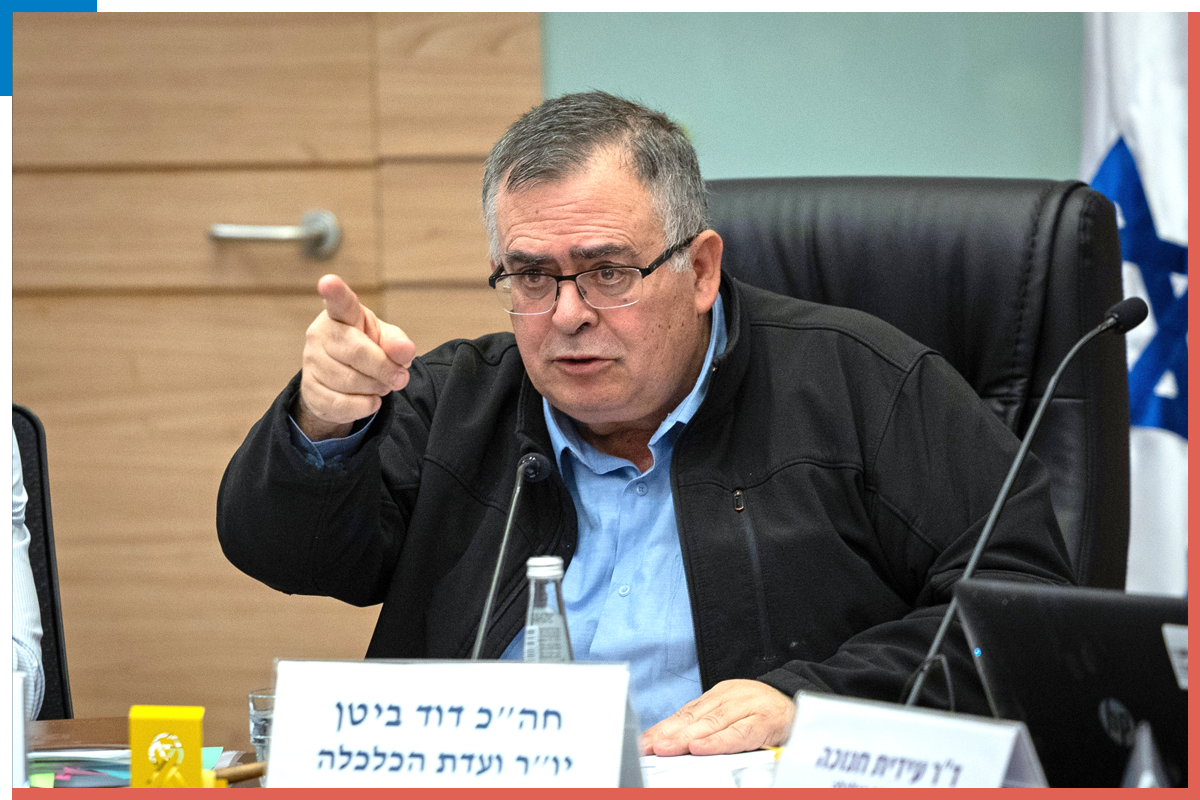
The group was led by a very sharp and vengeful political mind: David Bitan. A decade ago he was Netanyahu's all-powerful coalition chairman. Years passed; his contemporaries became senior ministers, even those younger than him. His indictment derailed his career, a black cat crossed between him and the prime minister, and in the last primaries the Prime Minister's Office nearly managed to push him off the list. Surprisingly, despite his complex legal situation and health condition, Bitan is strengthening. So much so that after the recent Likud convention elections, the chairman's office is trying to invalidate the results. Earlier he mobilized as chair of the Economics Committee against Shlomo Karhi's communications reform. Suddenly, the man who led the fight against opening the public broadcaster became the channels' main supporter. From his office this week he managed the campaign to topple Smotrich's initiative. Had he wished, he could already have brought down the draft law and triggered early elections. But he did not. It is therefore too early to eulogize Netanyahu's absolute control over his faction. His regime in Likud is not dictatorial but authoritarian: high control, but not absolute.
The ultra-Orthodox parties are watching developments in Likud with concern, wondering whether they will go all the way only to suffer defeat in the plenum. They are worried but have no choice. Their overarching goal is to reach elections from the government table, with the sword of sanctions removed, even temporarily, from the necks of yeshiva students. It is still unclear how much time they have; unusually, the Knesset has not yet set the date for the Passover recess.
A prisoner cannot free himself
Finally, a historic announcement by Agudat Yisrael in favor of military enlistment: "After all demands to preserve religion in functioning camps have been guaranteed—sanctity of the Sabbath, kosher food and the creation of a religious atmosphere through special units for ultra-Orthodox youth—the Central Committee of Agudat Yisrael calls upon every individual to report for service to the nation, in light of the increasingly grave dangers posed day by day by enemies who have said, 'Come, let us destroy them.'"
How unfortunate that it is indeed historic—that is, from long ago, during the War of Independence.
The quote appears in Shmuel Rosner's new book, "On the Haredim," which addresses the question of relations between Israel and ultra-Orthodox society. He does not place blame on the Haredim but on the state. "In the decision to exempt Torah scholars from service, the IDF effectively became the one recruiting young men to yeshivot, a military police ensuring that Haredim remain in the study hall," he observes.
He then wonders what would happen if the Amish community grew at breakneck speed, entered politics and tried to impose rules on other Americans—for example, removing all cars from the roads and transferring the entire population to horse-drawn carriages.
The Haredim are not asking to remove cars from the roads on Shabbat, but in practice that is happening more and more in growing ultra-Orthodox enclaves.
What will the state look like when one-third of its citizens are Haredi? And who will pay for the roads and public transportation? The average non-Haredi Jew, the book claims, currently pays about 3,500 shekels a month to enable a nonworking Haredi Jew to live with dignity. How much will that be in a few years?
The main argument against this statistic is that everywhere in the world the rich fund the poor. The difference, Rosner explains, is that only in Israel is poverty the result of choice—both of the Haredim and of the legislator: "The state supports the poor knowing they will remain in the cycle of poverty, not in order for them to exit it."
The past two years since the war have sharpened mainly the question of military service, as the public and the IDF bang their heads against the ultra-Orthodox wall trying to break it—so far without much success and with growing concern of a concussion. But the main story, evident between the lines, is the economy.
The Zionist hope is that after enlistment will come integration, and after that education and employment. That is a false hope because someone who arrives at age 25 with a wife and two children will struggle greatly to complete the necessary education and find a job that will raise them beyond check-to-check living.
The world is full of examples of countries that found themselves on the brink before abolishing outdated arrangements. Margaret Thatcher dismantled Britain's loss-making coal mines, creating a massive rupture whose cultural echoes are still felt today, and Lyndon Johnson dismantled racial segregation in America. By contrast, there has never been a sector like the Haredim, whose political and demographic power is growing rather than shrinking.
The polls granting the ultra-Orthodox parties 16 seats are a baseless illusion in a world where every day there are 1,000 new ultra-Orthodox voters for United Torah Judaism and another 500 for Shas.
There is a phrase in Israel: A prisoner cannot free himself from prison. It may be that only the ultra-Orthodox prisoner can open this cell, not the Zionist guard.


