


As the war against Iran;s regime dominates headlines and drives escalating tensions across the Middle East, it is easy to view events solely through a military lens: missile launches, airstrikes, assassinations, questions of capability and cost. But beneath that layer lies a far more human question that is central to the story: What happens to the Iranian people themselves when their government is under external pressure, when fear and hope collide in the streets, and when the future is uncertain but may also promise something better?
Iran is not only a strategic target or threat. It is a country of nearly 100 million people who have lived for almost half a century under a regime that defines obedience as loyalty and criticism as betrayal. For them, every development on the battlefield is measured by one question: Does it bring regime change closer, or does it strengthen the machinery of repression? Is the world finally seeing their story, or is it still talking about them instead of listening to them?
To understand what the Iranian people experience during wartime, one must listen to those who carry Iran in their memory and their body. Marjan Keypour Greenblatt, a human rights activist who was born and raised in Iran and became an exile as a teenager, describes the current moment not as just another round of fighting but as a historic test for Iranians, for the West and for the region as a whole.
Her story begins at a school in Tehran in the mid-1980s. The 1979 Islamic Revolution had already taken hold, the first supreme leader, Ayatollah Ruhollah Khomeini, ruled without challenge, and the ideology of the Islamic Republic had seeped into every institution, including classrooms. Greenblatt was only a teenager when her life suddenly changed course.

"I was 14 years old when my family decided to send me away," she recalled. "The reason why they rushed to get me out of the country was because one day in school, I got caught with an anti-regime poem and the dean of the school caught me with it."
On the surface it may not have seemed like a particularly subversive act. But in the Islamic Republic of Iran, even words on a page can become grounds for prosecution.
"There was not only a threat and a promise to suspend me from school, but there was also a possibility that I would be reported to the government agents, and I would be detained, like many other teenage girls who would be detained on charges of disrespecting the government or publishing anti-regime content."
Her parents quickly grasped the danger and arranged to smuggle their daughter out of the country. She was sent alone to Europe.
"I lived for three years under the guardianship of family in France, and then I came to the US when I was finally reunited with my family. It was a gradual process of leaving. My mother joined me after a year, and my father after two years. I didn't see them during that entire time."
Between persecution and racism
Exile was not only a geographical move; it became a formative experience. A girl persecuted in Tehran over a poem found herself confronting racism in France. She learned early that freedom cannot be taken for granted, even in Western democracies.
She recalls her experience in France with striking candor.
"The level of antisemitism and xenophobia that already existed in France terrified me on a daily basis, and it terrified my parents. They did not want to be in an environment where they would again have to hide their Jewish identity, and neither did I. I had no way to hide my Iranian identity. I had darker skin, I didn't speak French well, and I felt very threatened at school by xenophobic students influenced by the National Front movement that was gaining power in France in the late 1980s."
That dual experience, theocratic persecution on one hand and racist rejection on the other, crystallized into a worldview that shaped her career path.
"Precisely and directly because of that experience of persecution, I wanted to be a voice for marginalized populations. At that moment I thought this is not how things should be. We are all human beings, and we all deserve dignity and human respect. From a very young age I decided to make that my life's mission."
Greenblatt, 54, is married to Jonathan Greenblatt, chief executive officer of the Anti-Defamation League, one of the oldest Jewish organizations in the US dedicated to combating antisemitism and other forms of hatred and extremism. Since the age of 16 she has been involved in public activism and spent seven years working at the Anti-Defamation League. Eventually, however, she chose to shift her focus.

"For the past 12 years I have focused only on Iran, focusing on minorities and women there."
For her, this was not a career change but a continuation. A girl who fled repression became a woman fighting against it. Years after establishing herself in the US and dedicating her life to human rights, she felt compelled to focus once again on the country from which she had been smuggled out, not merely as a personal memory but as an urgent political arena. The turning point came around the rise of Iranian President Hassan Rouhani a decade ago, when the Obama administration attempted to pursue diplomatic engagement with Tehran.
While many in the West viewed Rouhani as a symbol of moderate reform in Iran, Greenblatt saw a power structure that had not changed.
"The moment the US started engaging in what appeared to be diplomatic engagement with Iran, shortly after Rouhani was elected, I knew that it didn't matter who held the position of president in Iran. That person has no real power. As long as the supreme leader is reigning, nothing changes. There is no real opportunity for reform, no tolerance toward the West or toward Israel."
Asked whether she had ever been optimistic about diplomatic agreements with Iran, she replied: "I was never optimistic. There is no diplomacy worth putting on paper with the Islamic Republic."
She acknowledges that this stance was not popular at the time, but her personal experience convinced her that the regime cannot be softened through diplomatic agreements. As long as the ideological structure remains intact, any change is an illusion.
Iran beneath the surface
Greenblatt herself no longer maintains frequent direct contact with people inside Iran, largely because of the risk it poses to them.
"I am always careful not to endanger anyone's safety, because I know the cost if they are caught with their cell phones and their communications with me would be revealed," she said.
Nevertheless, people inside Iran sometimes reach out to her on their own initiative. Over the past year, however, frequent internet shutdowns and regime threats to accuse anyone with foreign contacts of espionage have further reduced direct communication.
Instead, she follows Persian-language social media daily, monitors Iranian news outlets and maintains ties with various activist groups. Through this, she says, she manages to maintain a relatively current picture of public sentiment inside the country.
In recent years internal pressure on the regime has been simmering: the protests of 2019 and 2020, the "Women, Life, Freedom" movement and more recently demonstrations fueled by public frustration with the cost of living and with the regime itself. These protests were met with a massive wave of arrests and executions. Greenblatt describes them as a deep fracture in the national consciousness.

According to her, Iran is still bleeding from the trauma.
"The Iranian people are wounded and broken from the magnitude of the massacre in January, which probably left more than 40,000 innocent souls behind. But with the news of Khamenei's death, there has been a little bit of solace, a little bit of hope among the Iranian people."
The protest movement may have changed form or moved underground, she said, but it has not vanished. Iranian society, after years of repression, has undergone an irreversible process of awakening. The question is not whether there is a desire for change, but when and how it will materialize.
At the same time, many families are grappling with severe economic hardship that has become an inseparable part of daily life.
"Families are very aware that the poverty and hunger they are experiencing today are a direct result of the Iranian government's nuclear policy," she said. In the eyes of many citizens, the regime repeatedly prioritized its nuclear ambitions over the well-being of the public.
"Round after round of negotiations, and they never prioritized their own population," she said. As a result, sanctions remained in place and economic distress deepened.
"It is hard to overstate the depth of deprivation in the country today," she added. Yet there is also cautious hope. Many believe that if the regime is replaced and Iranians can control their country's resources and trade freely with the world, a genuine recovery will become possible.
The current round of fighting involving the US and Israel, under the respective operation names "Epic Fury" and "Roaring Lion," places the Iranian public in an almost impossible position: caught between a regime that represses them from within and bombs arriving from outside.
Greenblatt does not minimize the fear.
"There are people who are also afraid of the war. They are afraid of the bombings. They feel helpless. They have no shelters and no government they can trust to protect them."
Asked to describe the public mood today, she chooses a striking image.
"We are crying with one eye and smiling with the other."
But alongside fear, she detects another dynamic: pressure that is beginning to erode the regime's power structure. In her view, two conditions are necessary for such a regime to collapse: a significant weakening of the forces of repression and cracks from within.
She points to calls encouraging defections within the regime's security apparatus.
"There is an intense campaign aimed at encouraging defections from these forces and urging them to stand with the Iranian people rather than with the so-called leaders who are being eliminated one by one."
She noted that US President Donald Trump had sent a message to Iranian forces urging them to lay down their weapons and surrender, promising that if they did so their crimes would be forgiven.
"I think if they have any chance for themselves, for their survival and for the survival of the country, they should lay down their weapons and join the people, and defect today, not tomorrow."
"The West doesn't understand the threat"
While debate in the West often focuses on the legitimacy of the war, Greenblatt believes the discussion itself reflects a misunderstanding of the Iranian reality.
"They don't understand the real threat the Iranian regime poses to their lives and their values. They don't like war," she said of parts of the Western public and media, "and they downplay the importance of the threats posed by the Iranian regime."
According to her, this misunderstanding extends beyond threats toward Israel or the US.
"They also underestimate the threats and brutality the Iranian regime directs at its own people, and they don't understand how defenseless the Iranian people were on their own, unable to fight such overwhelming brutality and in need of some form of outside intervention to have a chance."
At the same time, she stresses a sensitive point: Iranians do not want a foreign government choosing their future leadership.
"The Iranian people do not want America to come and appoint a future government for them. They want the US administration not to interfere with their desire for democracy."

In her view there is a clear difference between weakening a repressive apparatus and shaping a country's political future from outside. The first may be necessary; the second is dangerous.
As the military confrontation unfolds, various scenarios for Iran's future circulate in Western discussions: a transitional government, new leadership, or even ideas about ethnic fragmentation or regional partition. Greenblatt rejects such ideas unequivocally.
"Despite the fact that Iran is a diverse country, they must recognize that Iran is one country, that all 92 million people are equally victims, and that the solution must be a vision that encompasses the entire country rather than dividing it."
"For real peace and stability in the region, we must support the territorial integrity of the country and promote a vision of unity within Iran rather than fragmentation."
According to her, "Iran will be much stronger and a much better ally for the West and even for Israel if its territorial integrity is respected and if the different ethnic communities all have a stake at being part of one Iran. Iran will be much stronger and a much better ally for the West and even for Israel if its territorial integrity is respected and if the different ethnic communities all have a stake at being part of one Iran."
Meanwhile, demonstrations in Western cities have shown support for the fighting among Iranian exiles who fled the regime's rule, alongside loud protests against the war carrying anti-American and anti-Israeli messages and claiming to speak for the "oppressed." For Greenblatt, these scenes evoke a powerful historical memory.
"These protests are terrifying. They strongly resemble the demonstrations that took place in the days leading up to the revolution in Iran in 1979."
She remembers those events not as a romantic story of a popular revolution but as a forceful takeover disguised with slogans of freedom.
"They came into the streets with primitive weapons to intimidate and force their way into taking over the government. They had beautiful slogans about liberty and freedom, but their behavior was very violent and threatening."
When she sees American and Israeli flags burned and anti-Western chants in the heart of New York, where she lives, she finds it difficult to see it as merely legitimate criticism.
"They are simply anti-America and anti-Israel and anti anything that embodies Western values. They reject our Western values under the label of opposing imperialism."
In her view, the pattern is familiar: using the language of social justice to undermine democratic institutions from within. For someone who witnessed a revolution turn into a dictatorship, the memory is not theoretical but a warning sign.
What would she say to those protesters?
"I would ask them to look at the images of innocent Iranians taken to the gallows and hanged, shot to death, tortured and raped. Are the humanity of those people worth less than your misleading ideologies?"
She added that even the concept of the "mustazafin" ("the oppressed"), used by Ayatollah Khomeini during the 1979 revolution, became a propaganda tool. Instead of supporting the oppressed, she said, "the regime created a nation that is oppressed by the regime, hungry, unemployed and under pressure from its rule."
Asked how societies can respond to such anti-national movements, she "thinks that patriotism has gotten a bad rap these days because it has become politicized."
But in her view, "patriotism is defending your home. Love for your country is not something that one should be ashamed of. It is something that should be part of everyone. It should be part of everyone's strong identity."
The day after the regime
As for the question of who should lead Iran if the regime falls, Greenblatt does not hesitate.
"I think the only leader who comes to mind, who has received the support of millions inside Iran and abroad at great risk to people inside Iran, is none other than Reza Pahlavi," she said, referring to the son of Iran's last ruler before the 1979 revolution, Shah Mohammad Reza Pahlavi, who like her has spent his adult life in the US.
"I cannot think of anyone else who could do it."
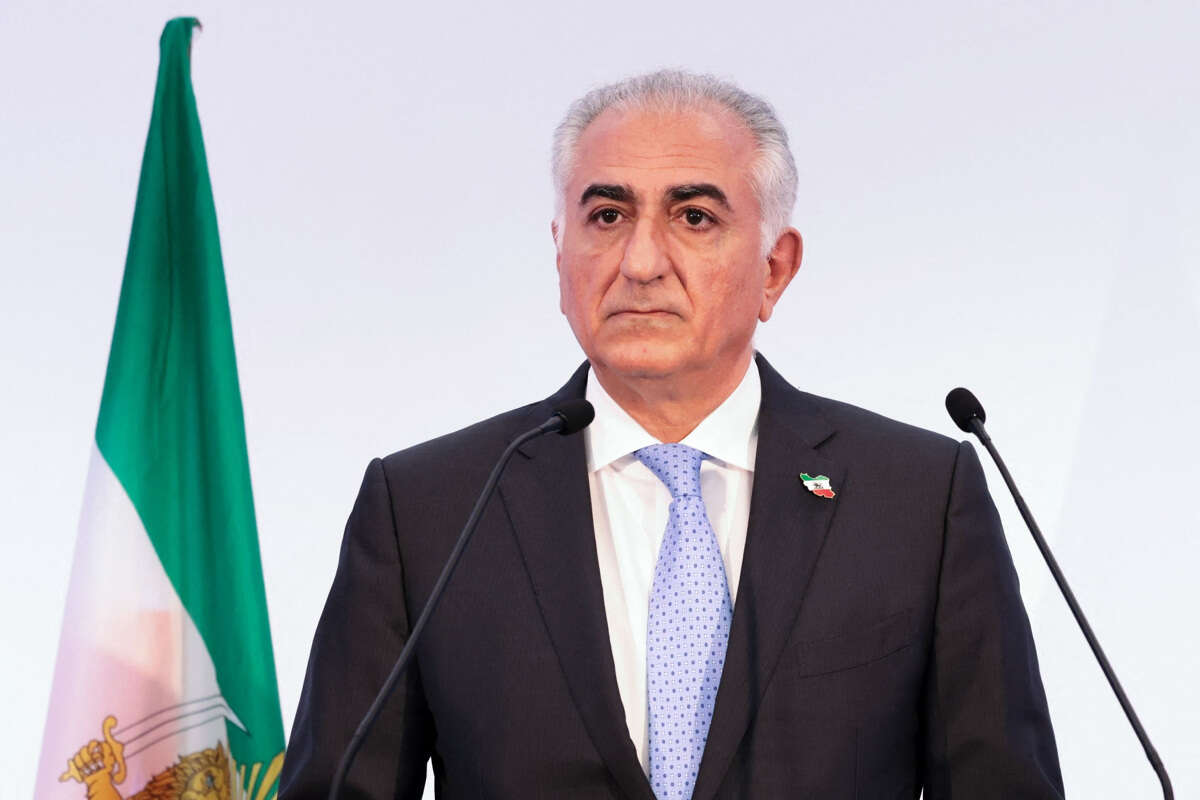
She emphasized that those worried Iran might simply move "from turban to crown" misunderstand his position.
"It needs to be clear to people who fear that Iran will go from turban to crown that Pahlavi does not claim to be Iran's Nelson Mandela. He wants to be the leader who helps Iran elect its future Nelson Mandela, without being prescriptive about it."
If the regime truly collapses and the Islamic Revolutionary Guard Corps loses its grip, Iran will not instantly transform into a thriving democracy. Greenblatt speaks about this without illusions.
The greatest immediate challenge, she says, can be summed up in two words: "the economy and the spirit."
Iran's economy, after years of sanctions, corruption, mismanagement and international isolation, will require deep reconstruction.
"The path to economic recovery will take time. There is a plan for it, but I think the Iranian people must have realistic expectations that change and reconstruction will not happen overnight."
That is where the question of spirit comes in.
"I think the Iranian spirit needs to be nurtured. While we may face hardships, suffer losses and see beautiful buildings destroyed, we will rebuild Iran and it will be ours, not ruled by the occupying regime of the Islamic Republic."
After a long conversation about repression, war and fear, she chooses to end on a note that is not obvious: not anger or revenge, but hope.
"I am very optimistic about the future. And I think we just have to be strong, both as Iranian people, as Americans and as Israelis, to endure the tough times that may be short-lived in order to be rewarded with a lasting peace in the future."
Greenblatt believes the day is not far off when she will finally be able to visit the homeland she was forced to flee as a teenager, and see it free and flourishing.


