


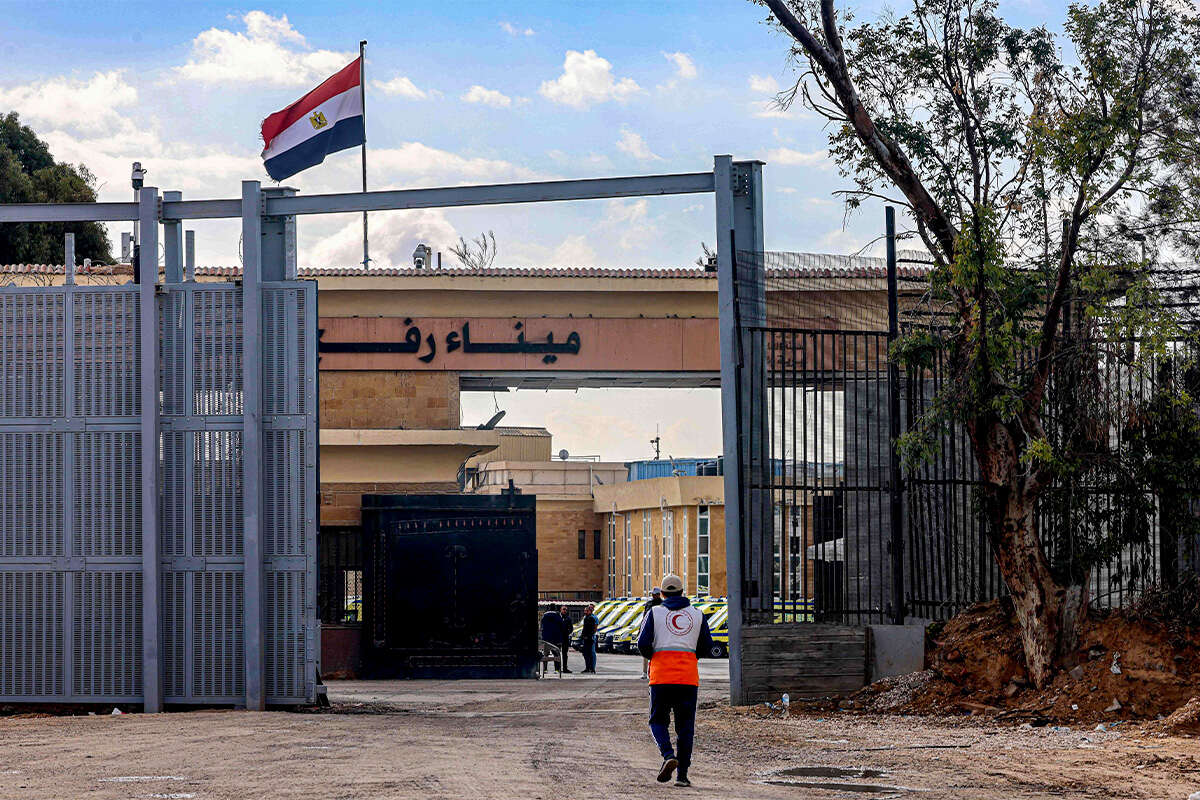
Even this week, Hamas delegations landed in Cairo. Two and a half years after the October 7 massacre, Egyptian intelligence is still holding meetings, conducting discussions and passing messages between the sides. This time, the focus was the second phase of the ceasefire agreement and the process of collecting Hamas' weapons. As expected, the terrorist organization is dragging its feet. Recently, its spokesmen attacked Nikolay Mladenov, head of Gaza's "Board of Peace." The Bulgarian diplomat had dared to make Gaza's reconstruction conditional on disarmament. In dealings with the Egyptians, Hamas and Palestinian Islamic Jihad generally remain restrained. They do not pick fights with the man who holds the key to the Rafah crossing.
From the outset of the war, Egypt maintained a minimalist approach. Hamas could be hit, but there had to be an alternative governing authority. That was one of the messages conveyed through various channels. After all, the Egyptian army had experience fighting the Islamic State terrorist organization in Sinai. There, the "Tribal Union" was set up and became a decisive factor in the struggle, alongside Israeli assistance. That was in the previous decade, but the lessons were filed away and preserved. In other words, Cairo advised Jerusalem to find a former criminal and current operator like Ibrahim al-Organi, who is close to Egyptian intelligence. The man identified for the role was former drug dealer Yasser Abu Shabab, a Bedouin.
The Gazan operative was murdered, but the militia model survived. Today those militias are led by former commanders in the Palestinian Authority security apparatus, who are causing Hamas no small headache. The Egyptians are proposing a broader model: training and deploying thousands of Palestinian Authority police officers. The technocratic committee affiliated with the PA has so far selected 1,000 Gazan volunteers for the new police force and is expected to choose another 3,000. Even so, Hamas does not appear ready to surrender power. On the contrary, during Ramadan, its policing mechanisms were deployed across the Strip. They collected taxes, monitored movement and continued taking revenge on those who dared criticize them during the war. The Egyptians claim Hamas has agreed to relinquish power, but they know very well who the client is.
"A war of psychopaths"
Only this week, another layer was revealed of the knife Hamas had sharpened and driven into Egypt's back. Members of Hasm, a terrorist organization affiliated with the Muslim Brotherhood, trained in Gaza before sneaking back into Egypt in recent years.
"The man in the picture is one of the senior terrorists in the Muslim Brotherhood's armed wing known as Hasm. Egyptian intelligence brought him back from one of the African countries. He admitted that he entered Gaza and trained there for four months on all kinds of weapons, including anti-tank missile fire. He intended to use that training to fire on an Egyptian presidential plane. That raises a major question. Despite the ties between Egypt and Hamas, which allow its members to enter and leave Gaza and stay there as part of the mediation process, has Hamas ever once informed the Egyptian authorities? It is impossible for someone to train for four months in Gaza without Hamas or its senior officials knowing about it," former Egyptian lawmaker Samir Ghattas said.
Ghattas said the senior Hasm operative had confessed to involvement in a series of terrorist attacks, including assassinations of Egyptian officers and plans to blow up car bombs inside the country. He noted that this was not an isolated case, and that the research institute where he works had published 28 names of members of Islamic State-like organizations who passed into Sinai through the tunnels in past years, with Hamas' knowledge. Cairo has also not held back from sharply criticizing Hamas' October 7 terrorist attack. "Hamas is a terrorist organization and a current of political Islam," Egyptian media figure Ibrahim Eissa, who is close to the regime, has said more than once. "It operates for Iran's benefit. These are fools, idiots and collaborators." On one occasion, he accused Hamas of trying to entangle Cairo in "a war of psychopaths."
The ultimate goal, he explained, was to bring chaos to Egypt, under whose cover the Muslim Brotherhood would return to power. "There is no reason to get worked up over the Israeli propaganda claiming 'the Egyptian army is preparing for confrontation.' All of this is an attempt by Israel, Hamas and Hamas' allies, the Brotherhood, to entangle Egypt."
From the Egyptian point of view, they fulfilled their role and received mainly a large helping of ingratitude. After all, they say they passed along warnings before the war. Not only through direct channels, and not only to the Israeli side. About a month before the October 7 massacre, Egypt was engaged in another mediation effort. The aim was to prevent "a comprehensive confrontation at the present time." Arab media reported on Sept. 3, 2023, that Israel and the US feared such a confrontation and possible Iranian involvement. An Egyptian source told the Qatari newspaper Al-Araby Al-Jadeed that Cairo had tried to block an Israeli plan to assassinate Salah al-Arouri, a senior Hamas figure in Beirut who directed terrorism in Judea and Samaria.
"Egyptian intelligence asked senior Israeli officials to stop making statements to the media and halt any plan related to moving the confrontation beyond the bounds of the West Bank, or harming senior Hamas and Palestinian Islamic Jihad figures outside it," the source said. "The Egyptian officials were in contact with the Hamas leadership and confirmed to them that there was a plan to strike Hamas leaders in Lebanon, foremost among them al-Arouri." A senior Hamas official confirmed that warnings had been passed regarding an attempt to assassinate al-Arouri, who was ultimately killed in a targeted strike in Beirut in January 2024.
On Sept. 26, it was the terrorist organizations in Gaza, "the factions," that sent a message to Egypt. "Patience is running out over the Israeli attacks and the continuing tightening of the siege on Gaza," it said. "The hour of confrontation is drawing closer," according to a report in Rai al-Youm. They added that "the continued closure of the Erez crossing in northern Gaza will not be a pressure card against the resistance, but will help accelerate the timing of the next round of escalation." It was not the only warning to emerge from Gaza, but in Israel all the signs were interpreted as false alarms. "Just another threat," one of many. Boys crying wolf.
Plagues of Egypt
From the standpoint of Egypt's cold interests, the war in Gaza was a catastrophe. Just two weeks ago, President Abdel Fattah el-Sissi said the total losses from ships that did not pass through the Suez Canal and pay transit fees had reached billions of dollars. "Egypt has lost about $10 billion in Suez Canal revenues in recent years as a result of global crises. That is a sum equal to nearly 500 billion Egyptian pounds. This has had a direct impact on the state's economic capacity," the Egyptian president said.
He was referring to attacks on vessels in the Red Sea by the Houthis in recent years. Indeed, at the start of 2023, about 12% of the world's oil shipments passed through the strait. By 2025, that figure had been cut in half to about 5%. It is no surprise that the renewed Houthi threat to close the Bab al-Mandab Strait did not pass in silence.
"The Houthis need to know that Egypt will not remain silent if its national security is threatened and the Bab al-Mandab Strait is closed," Egyptian lawmaker Mostafa Bakry said. "Egypt was silent for a long time despite the losses in the previous period. But I do not believe Egypt can remain silent in the face of threats to close the strait. The strait is Egypt's economic lifeline. Its closure would be a major disaster."
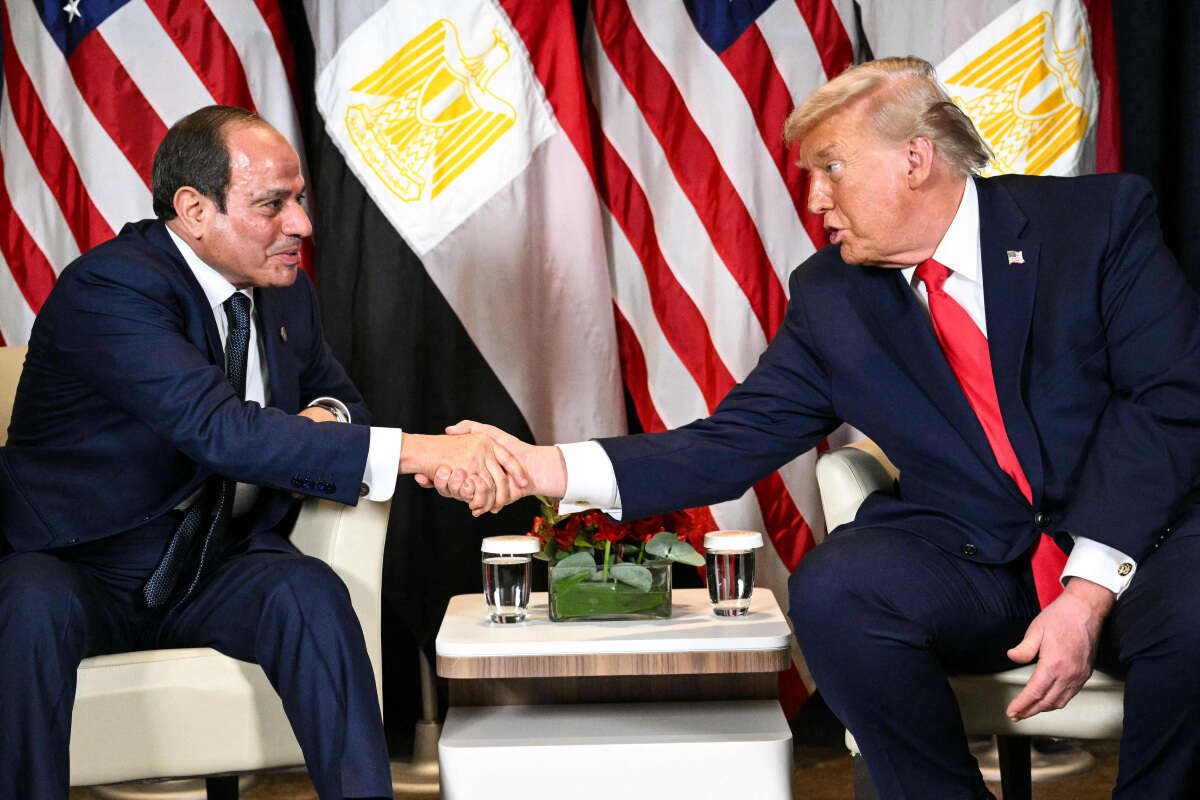
El-Sissi also made an unusual appeal to the man in the White House, one that was echoed by Egyptian politicians and media figures. "I say to President Trump, no one can stop the war in our region but you. I am speaking to you in the name of humanity and in the name of every peace-loving person," Egypt's ruler said at the International Energy Conference. "You, Mr. President, are a man of peace. I am sending you a direct message, in my name and in the name of the region and the world. There are dangerous consequences to the continuation of the war. Please, Mr. President, please help us stop it."
These days, the Egyptians are trying their luck mediating between the US and Iran together with Turkey and Pakistan. As in other Middle Eastern fronts, Cairo's diplomacy is trying to square the circle, encouraging the sides to close shady deals under the table. But this time the web of interests appears more tangled than ever. In the Islamic Republic, officials are leaking terms that amount to surrender: compensation, guarantees, evacuating bases in the region. For a moment, one might think the Iranians believe their own propaganda videos, in which Tel Aviv has been destroyed and only steel skeletons and concrete remnants remain from its towers. As if that were not enough, Gulf states were, to put it mildly, unimpressed by the neutral messages Cairo circulated at the start of the campaign. They expected Egypt to take a side, beyond issuing condemnations. But Cairo had interests of its own.
With every day that passed in the current war, the Egyptians lost money. The local currency fell to 54.59 pounds to the dollar, a drop of about 12% in a month. The chaos in the Persian Gulf drove up food and fuel prices. Red lights are flashing wildly. On the face of it, el-Sissi holds no real levers over the parties to the conflict. Israel and the Gulf states prefer to continue weakening the Iranian regime. The Islamic Revolutionary Guard Corps is betting that its regional war of attrition will eventually wear down the US and force Trump to pull back forces.
Red lines
After the Black Sabbath of October 7, the mediation mission looked impossible. Two hundred and fifty-one hostages in a single day, an unprecedented war in Gaza, the involvement of the Hezbollah terrorist organization and the Iranian axis. In a statement published in the opening phase of the campaign in the name of Yahya Sinwar, Hamas' leader in Gaza, there was a demand to "whitewash" the walls of Israel's prisons, in other words, to empty them completely of terrorists. Alongside that, Hamas demanded a guarantee that the war would end, a full withdrawal from the Gaza Strip, the lifting of restrictions and a reconstruction process. Israel demanded the dismantling of Hamas rule and military capability, and the return of all the hostages.
Beyond that tangle, Cairo expressed concern over a scenario in which masses of Gazan refugees would cross into Sinai. It was not an imaginary scenario. In the past, Hamas had already engineered a border incident when masses of Palestinians crossed into the Egyptian side of Rafah and caused chaos. This time the reference scenario was larger. Only about two weeks had passed since the war began, and the Egyptians watched anxiously as their nightmare began to take shape, with the movement of Gaza's population southward. Slowly, an enormous tent city began rising around Rafah.
"Egypt rejects any possibility of liquidating the Palestinian cause through military means and any attempt to forcibly uproot Palestinians from their land, or to do so at the expense of the states of the region," el-Sissi said at a joint press conference with German Chancellor Olaf Scholz on Oct. 18. Later in the speech, he warned that the movement of Palestinians into Sinai would create a terrorist base against Israel. It was not clear whether the Egyptian president was serious when he suggested settling Gazans in the Negev instead.
At the same time, inside Egypt itself, an unprecedented wave of hatred toward Israel erupted, inflamed by the state media. On Oct. 8, 2023, an Egyptian policeman carried out a shooting attack on a group of Israeli tourists in Alexandria. Amnon Bazalev, Alon Shmueli and Haggai Efrat were murdered in the attack, along with their local guide, Sayed Kamel al-Hawalka. On May 7, 2024, a Jewish Canadian businessman with Israeli citizenship, Ziv Kiper, was murdered. An unknown terrorist group named after Egyptian attacker Mohamed Salah, who carried out an attack on the Israeli border in May 2023, claimed responsibility and published surveillance footage of him.
The extent to which the Egyptian media stirred the cauldron of hostility toward Israel can be seen in one of the television series produced there during last Ramadan. In the series "Masters of the Land," an Egyptian doctor arrives in the Gaza Strip to help the war's wounded and falls in love with a Gazan man searching through the rubble for his missing nephew. Naturally, the episodes focus on Palestinian suffering and on alleged violations by the Israel Defense Forces. Hamas and the October 7 massacre it carried out are pushed to the margins. The thing is, this new series is considered a relatively toned-down version of the genre. In 2002, for example, the series "Horseman Without a Horse" dealt with "The Protocols of the Elders of Zion." In 2022, the series "The End" aired, tracing a futuristic world in which the State of Israel had already been destroyed in a nuclear war.
To Egyptian fears of a refugee wave and the anti-Israel hatred inside Egypt, another source of tension was added in 2024. After Israel took control of the Rafah crossing and the Philadelphi Corridor, Cairo initially demanded a full withdrawal. Egyptian officials even claimed this was a violation of the peace treaty. In May of that year, an Egyptian soldier was killed after opening fire on Israel Defense Forces troops. Despite the unusual incident, the standing coordination between the IDF and the Egyptian army continued. Another explosive issue at the time involved the cross-border tunnels between Gaza and Sinai. Publicly, the Egyptians claimed they had destroyed all the tunnels. In practice, a number of tunnels were destroyed by Israel with Egyptian knowledge.
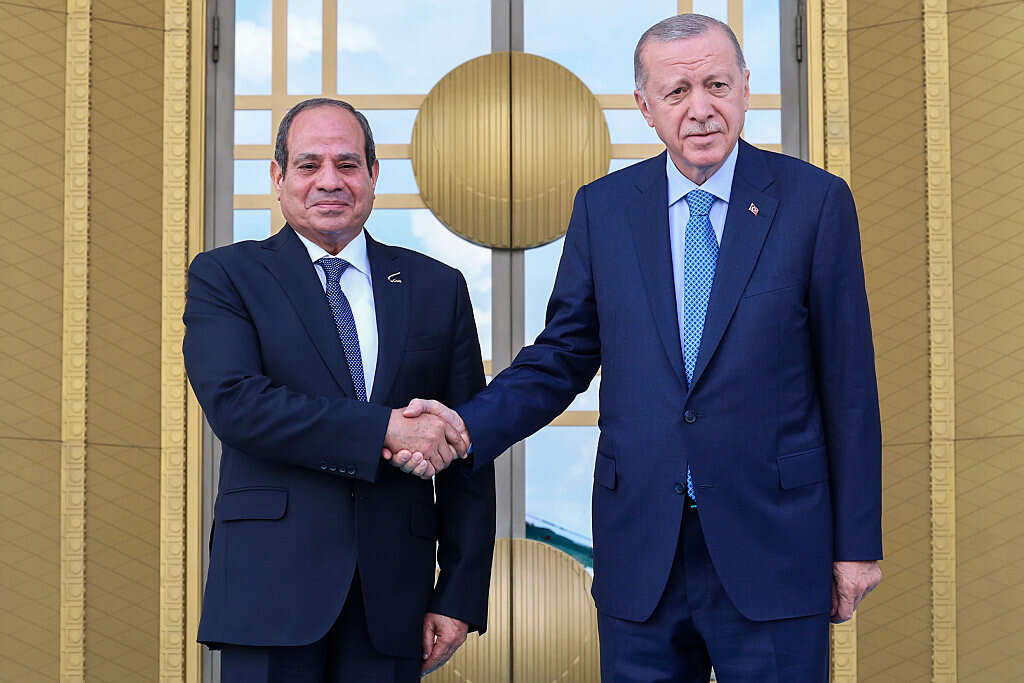
The campaign also led to a certain rapprochement between Cairo and Doha. In the past, Egypt saw Qatar as the sponsor of the Muslim Brotherhood, the state that operates Al Jazeera, which fueled protest during the Arab Spring. And yet the economic damage, the pressure for a ceasefire and fears of a security crisis on the Gaza border drove the Egyptians into the Qataris' arms. In the current round as well, el-Sissi and the emir of Qatar see eye to eye. Both rulers prefer a diplomatic solution that preserves a weak and isolated Iranian regime rather than steps that would bring about regime change. Neither wants anyone drawing inspiration for new revolutions.
In Israel, officials said the two states had learned to cooperate with one another. Even so, the Qatargate affair showed that some things do not change. When the affair exploded, it emerged that the Qataris had funded a 2024 campaign to improve their image. According to the suspicions, people in the Prime Minister's Office were involved in dripping out messages, some of them aimed at harming Egypt's image as a mediator. Here too, Egypt's cold interests tipped the scales. Instead of another confrontation, within a year and several months a Qatari real estate project was inaugurated on Egypt's Mediterranean coast. Cost of the investment: tens of billions of dollars.
Pass it on
Donald Trump's return to the White House in 2025 marked a new chapter. Above all, this was about the migration plan he presented in early February 2025, only a few weeks after entering office as US president. At the heart of that plan was the idea of transferring Gaza's population, among other places to Egypt, which Cairo viewed as a national security threat. Against that backdrop, old footage began circulating of Egyptian army training exercises alongside militant slogans such as "Migration is a red line," echoed countless times.
Surprisingly, checks at the time showed this was not a foreign campaign intended to cause diplomatic damage, but Egyptian accounts. It was part of a distinctive phenomenon known as "electronic committees," and in this specific case a committee of regime supporters known as Duwalgiya. Egyptian experts said at the time that this was a group affiliated with Egyptian intelligence that tends to transmit messages less comfortable for the official authorities. But Cairo did not stop at an online campaign. It moved to present an alternative for Gaza's reconstruction and applied diplomatic pressure. The cost of the plan it presented at the Arab League summit reached tens of billions of dollars.
In the end, the Egyptian campaign was a stunning success. The number of Gazans who left after Trump's migration plan was far lower than the number who had left before it, about 100,000. Toward the end of the war in Gaza in October 2025, Cairo had already been given the honor of hosting the negotiations on the agreement to end the war in Sharm el-Sheikh. Against all odds, Cairo's reconstruction plan reshaped the Trump administration's plans. Dreams of a Riviera on Gaza's coast were replaced by the "Board of Peace" and the technocratic committee. The big question is whether the Egyptians will be able to repeat that move in the current war between Israel and the US against Iran.


