

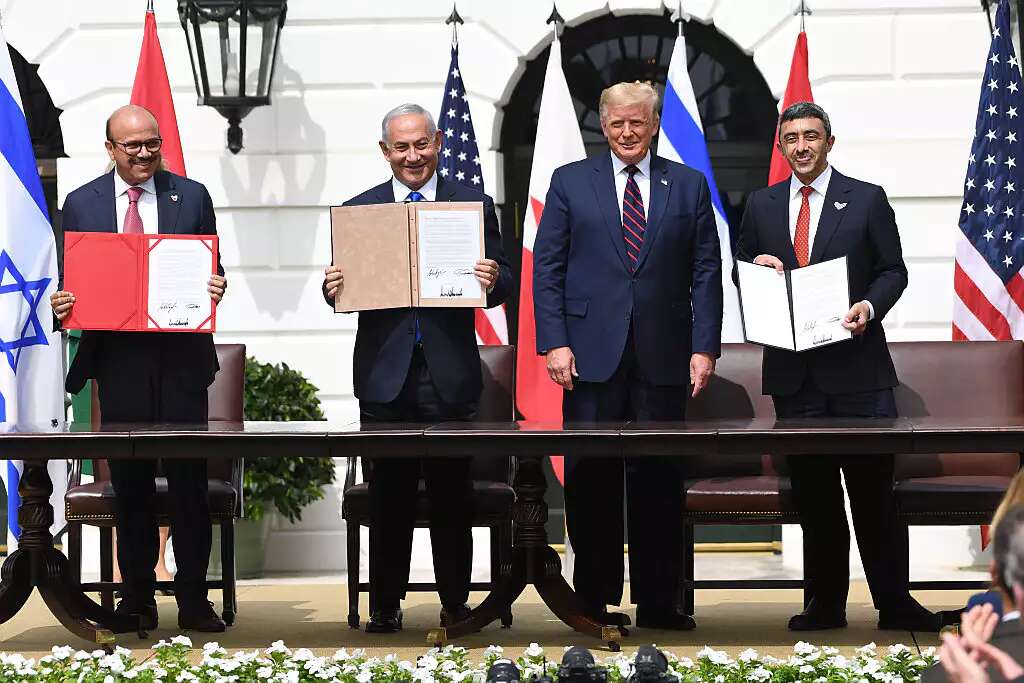
This month marks five years since the signing of the Abraham Accords, peace and normalization agreements between Israel and the United Arab Emirates and Bahrain, later joined by Sudan and Morocco.
Looking back, there is no doubt that the accords marked a historic turning point. They reflected a fundamental shift in the Arab world's approach toward Israel, to the point that many declared the dawn of a "new Middle East" unlike the one we had known before.
The idea of a "new Middle East" was championed by Prime Minister Benjamin Netanyahu, who signed the accords at the White House in September 2020. This was notable, since in the 1990s Netanyahu had strongly opposed the same vision when it was promoted by then-foreign minister Shimon Peres, following the 1993 Oslo Accords.
Peres argued that Oslo had created a "new Middle East" of peace and security. Netanyahu dismissed that at the time, saying: "What new Middle East is Peres talking about? It's the same old Middle East of terror and exploding buses."
Yet there is no denying that the Abraham Accords broke the glass ceiling in Arab-Israeli relations. Until then, the prevailing assumption was that no Arab country would dare strengthen ties with Israel without first resolving the Palestinian issue. One by one, however, Arab states not only agreed but eagerly sought to sign peace agreements with Israel, effectively sidelining the Palestinians, who had become a burden and an obstacle.
The accords also reflected a broader Arab recognition of Israel's strategic value: a regional power with economic and military strength that could help Arab countries develop their economies and defend themselves against Iran. This stood in stark contrast to earlier decades, when Arab states pursued peace with Israel primarily to recover territory or to gain favor with Washington.
By September 2020, the future of the region and of Arab-Israeli relations looked promising. Hopes were high that more countries would join, with Saudi Arabia, the most influential Arab state today, seen as the ultimate prize.
It may well have been Hamas leader Yahya Sinwar's fear of such a breakthrough with Saudi Arabia, one that could bury the Palestinian issue for good, that drove him to launch the October 7, 2023 terrorist attack. Sinwar hoped his assault would spark a regional earthquake and bring about Israel's collapse.
Instead, his attack, later joined by Hezbollah leader Hassan Nasrallah, ended with their deaths. More importantly, Israel inflicted devastating blows on Hamas and Hezbollah. Iran, too, suffered heavy setbacks, losing its foothold on the Mediterranean coast and revealing itself as a weak and vulnerable state unable to defend itself against Israel.
The further we move from October 7, the clearer it becomes that the Middle East remains much the same, perhaps not a "new Middle East," but certainly a different one. Today, most Arab states still seek stronger ties with Israel, viewing it as a crucial bulwark against the looming threats of Iran, Turkey and radical Islam. They are no longer willing to let Palestinian extremism dictate their future or drag them into an endless conflict with Israel.
The Abraham Accords showed that much depends not on Arab initiatives, but on what Israel does with US support. That remains the case today, in this old-new Middle East, fraught with risks but also rich in opportunities.
It is now up to Israel: whether it will once again take the initiative, expand Arab-Israeli relations, and together shape the future of the Middle East.


