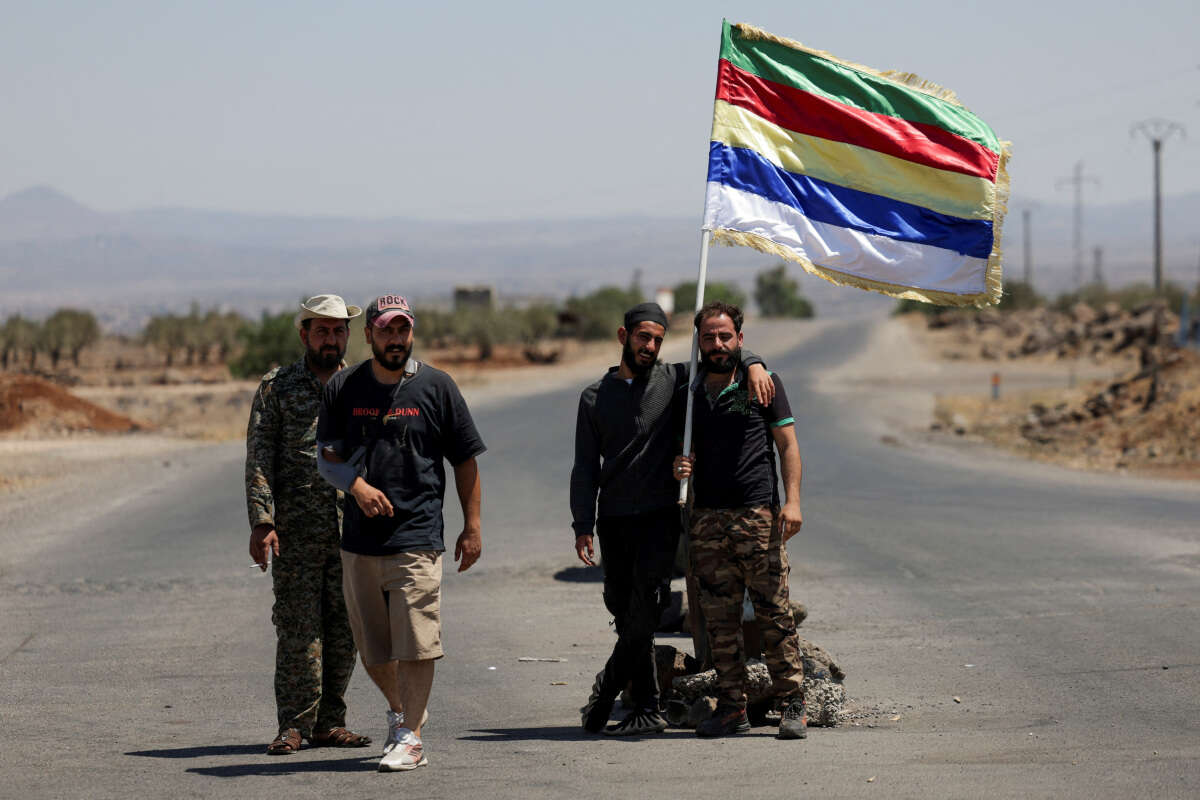
Last Saturday, hundreds of Druze in the southern Syrian city of Sweida demonstrated for their right to self-determination. Some of them carried Israeli flags, begging for Israeli intervention to keep them safe from the Islamist, terrorist regime that took power in Syria after toppling former dictator Bashar al-Assad. The plight of the Druze and other minorities in Syria represents an opportunity for Israel to cultivate new alliances that it cannot afford to miss.
Last month, the Druze of Syria experienced their own October 7th massacre—hundreds of them were brutally massacred by terrorists backed by Syria's Islamist President, Ahmed Al-Sharaa, also known as Al-Julani. Like Hamas, these terrorists took hostages, including more than one hundred women and girls. The province of Sweida, which has a Druze majority, is now under siege by Al-Sharaa's forces. Only Israel stands between Syria's Druze and the Islamist forces determined to annihilate them.
Israel responded to last month's massacre by launching airstrikes against Al-Sharaa's forces, even hitting targets in the Syrian capital, Damascus. But if Israel is to prevent the slaughter of more innocent Druze, it must go further in its military efforts. Israel needs to establish a permanent military presence in southern Syria, particularly in Sweida province. Doing so will create a safe buffer zone on Israel's northern border, preventing attacks from Islamists aligned with Al-Sharaa's regime or Iran. At the same time, it will protect the vulnerable Druze population of Sweida, as it is doubtful that Al-Sharaa's forces, or anyone else, will attack them knowing that they are protected by the IDF.
In addition, having IDF troops on the ground between Israel's northern border and Sweida will create a humanitarian corridor that can be used to bring vital aid to the Druze, as the siege of Sweida by Al-Sharaa's forces has created a humanitarian crisis. At present, very little humanitarian aid is getting through.
With IDF protection, the Druze of Sweida will be able to exercise their right to self-determination. They can choose to remain part of Syria or seek independence. Regardless of what they choose, Israel should continue to protect them, but also arm them so that they can eventually protect themselves. Israel should also afford them economic aid, especially if they choose independence, as natural resources in Sweida are scarce, and the Druze will need to develop economic self-sufficiency if their new Druze state is to succeed.
This model can also be applied to other parts of Syria with large concentrations of ethnic or religious minorities – particularly Rojava, the semi-autonomous Kurdish-led region of northeastern Syria, and Latakia, Syria's coastal region where Alawites form a majority. Both of these regions are under threat from Al-Sharaa's forces and their supporters.
Rojava is strategically located on the border with Turkey, Al-Sharaa's primary ally. Both Al-Sharaa and Turkey's Islamist President, Recep Tayyip Erdogan, would like nothing better than to slaughter the region's Kurdish population. Indeed, thousands of Kurds have already been murdered and forcibly displaced by Turkish forces and their Syrian proxies.
While the Kurds have their own military forces and are allied with the US, they stand little chance if Turkey throws its full military might into destroying them. After all, Turkey has the second-largest army in NATO, and possesses much of the advanced military hardware that other NATO countries have. However, they are unlikely to attack the Kurds if the Kurds have Israeli protection. Furthermore, having Rojava as an ally would mean having an ally on Turkey's border. Right now, Turkey has an ally on Israel's border in the form of Al-Sharaa's Syrian regime. But two can play at this game.
Israel might also be able to cultivate an alliance with the Alawites of Latakia, who also border Turkey, though this is probably unlikely since many of the Alawites supported the former Assad regime in Syria, and Assad was no friend of Israel. Then again, having no allies to protect them from the kind of massacres they have already suffered from may change their minds.
As you read this, you might be thinking that the Jewish state cannot seriously be expected to protect all of Syria's vulnerable minorities, especially now, when the IDF is busy fighting in Gaza, and Israel still faces threats from Hezbollah, the Houthis, and Iran. But truly, the recent war with Iran proved that there isn't anywhere in the Middle East that Israel can't reach. Besides, protecting Syria's minorities isn't just the moral thing to do. It's also very strategically beneficial, since it allows Israel to cultivate new allies in a region where it has very few. And in a time when Israel faces almost unparalleled ostracization for simply defending itself, the Jew amongst nations needs all the friends it can get.