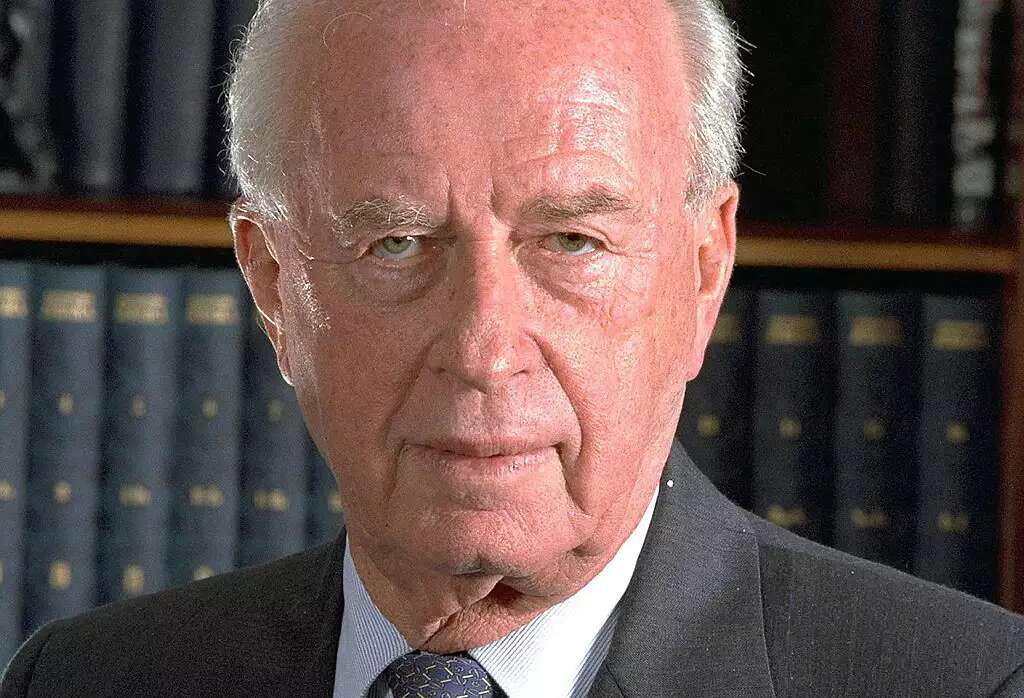
30 years after the terrible assassination of Yitzhak Rabin on November 4, 1995 in Kings of Israel Square in Tel Aviv, we note with sadness that Israeli society is still deeply divided.
One might have thought that Israel, an exemplary democratic country, would always be safe from a political attack. We were sorely mistaken. Verbal violence ultimately incited murder.
For the first time since the creation of the State of Israel, a Prime Minister has been assassinated by a Jew… Alas, even today, cruelty is omnipresent within Israeli society. It gnaws away, proliferates dangerously, destroys, like a cancer. The discord between Right and Left, between secularists and religious people, is undoubtedly the most serious of all our daily threats, near and far. It is high time to return to reason.
I had the great privilege of knowing Yitzhak Rabin. As 1965, while in charge of communications at the IDF General Staff, I followed his travels in the north of the country, in the company of General David Elazar, Dado.
Rabin was calm but worried. He chain-smoked and drank several cups of coffee. Immersed in military maps, he gave the impression of overseeing the military situation; he had answers for every eventuality. To relax, he played tennis with Dado. He was a good player, and his serve was very powerful. When he lost the ball, he grumbled, but immediately afterward, he smiled. He inspired confidence in us. His good character and sportsmanship were exemplary.
However, the belligerent declarations of the Arabs and the threats of war put Rabin under immense stress. This daily strain, coupled with sleep deprivation, plunged him into anxiety and insecurity. Rabin suffered a severe nervous breakdown. He smoked more than three packs of cigarettes a day and drank about twenty cups of coffee. Poisoned by nicotine and caffeine, he was given an injection by his personal physician, and for 36 hours, while the country was on a war footing, the Chief of Staff slept soundly. After this deep sleep, a distraught Rabin was forced to ask his deputy, Ezer Weitzman, to take command of the IDF. Weiztman flatly refused and encouraged his leader to overcome this difficult time. Rabin quickly recovered and led his country to the most resounding victory in modern history.
This war gave rise to a whole series of myths and accolades. Proud of his victory on the battlefield, Yitzhak Rabin nevertheless sought to put things into perspective. In a remarkable speech delivered on Mount Scopus at the Hebrew University of Jerusalem, Rabin spoke of the human and spiritual qualities of the IDF: "The paratroopers who captured the Western Wall leaned against its stones and wept. I doubt that one finds many such symbolic gestures in the entire history of humankind. We have earned the right to be aware of our superiority without having despised our adversaries. Our army is that of a nation that loves and ardently desires peace but is also capable of fighting bravely when its enemies force it to do so."
On that day, Rabin was awarded an honorary doctorate from the Hebrew University.
After more than eight years in the Palmach and twenty years in the IDF, Yitzhak Rabin ended his military career with distinction and in the euphoria of victory. The future lay before him. He was only 46 years old. For a long time, he had been racking his brains to determine the right path to take. He was a courageous fighter, but not a political wrestler. He lacked the cunning and shrewd nature of the politician, the one prone to intrigue and underhanded tactics. He was a man of integrity and loyalty. A truly shy man.
On February 1968, Rabin left for Washington to represent his country. He was received triumphantly as an American hero. However, his new career began with two serious incidents in an America still mired in the Vietnam War: the assassinations of Reverend Martin Luther King Jr. and Senator Robert Kennedy.
Rabin spent over five years in the American capital. He strengthened relations between the two countries and with Presidents Johnson and Nixon. During this period of diplomacy, he gave hundreds of interviews and lectures, and attended countless banquets and galas. His name was on everyone's lips, and the Israeli ambassador became a veritable star. Despite his official duties, at his wife's urging, he accepted substantial fees for his speaking engagements.
Having returned from Washington, Rabin plunges into the nightmare of the Yom Kippur War. The hero of the Six-Day War volunteers to advise his friend, Dado, the Chief of Staff, and share his knowledge and extensive experience in defense matters.
He also contributes to the implementation of the airlift which continuously transports American military equipment.
Two months after the war, in December 1973, Rabin joined Golda Meir's government as Minister of Labor. Six months later, the "grandmother of Israel" resigned, and Rabin became Prime Minister of the Jewish state. Never in the young nation's history had there been such a meteoric rise. Rabin, supported by the old guard of the Labor Party, was the first Sabra general to hold this position. He was only 52 years old. Clearly, destiny played a dominant role in this man's life. His career was full of twists and turns.
As soon as he decided to go into politics, Rabin was put on the spot by the press and Shimon Peres, his long-time adversary, whom he referred to as "the eternal schemer", fought him on all fronts and at every opportunity.
On June 3, 1974, Yitzhak Rabin presented his government to the Knesset. Private Shimon Peres was appointed Minister of Defense. General Ygal Allon was appointed Minister of Foreign Affairs.
Two weeks later, a US president made a historic visit to Israel.
By receiving Nixon with great fanfare in Jerusalem, Rabin sought to confirm that his policy was entirely dependent on the United States. After initialing the disengagement agreements with Syria and Egypt in Geneva, Rabin signed his first strategic agreement with Washington. The signing of an interim agreement with Egypt created a new balance of power in the region. It averted the prospect of renewed war on the southern front and paved the way for genuine negotiations aimed at reconciliation and peace.
The year 1975 saw the worst Arab attacks perpetrated in the country. Bombs exploded in shopping malls, airports and hotels; dozens of deaths and injuries plunged the country into mourning.
The Lebanese Civil War weakened Syria but frustrated the Palestinians, who decided to launch a series of spectacular attacks to attract international attention. The culmination of this wave of terrorism was undoubtedly the hijacking of the Air France Airbus in Entebbe. On July 2, 1976, Rabin decided to free the hostages in a daring operation. This spectacular raid was applauded worldwide and became legendary among the exploits of the Israel Defense Forces (IDF).
The year 1976 ended with a farcical incident: Phantom jets purchased in the United States and flown to Israel landed on a Friday, at the beginning of Shabbat. Sacrilege! The National Religious Party, a member of the coalition, passed a no-confidence vote along with the opposition. The Rabin government fell, remaining in place only as a transitional cabinet until the elections.
The following year began with a series of scandals unprecedented in the country's history. Rabin was clearly having a run of bad luck: shady dealings, corruption networks, fake invoices. An Israeli official managed to manipulate a Swiss bank, backed by the Rothschild… the governor of the Bank of Israel was arrested for embezzlement, and finally, the Minister of Housing shot himself in the head. A veritable soap opera of misfortunes culminated in a scandal involving an illegal bank account held by the Rabin in Washington. Without hesitation, Rabin announced his resignation from the government and the chairmanship of the Labor Party. Leah Rabin, in shock, attempted suicide… This affair dominated the news for a long time but ultimately reinforced Yitzhak Rabin's image of integrity and loyalty.
The political wilderness years lasted more than seven years. Rabin tried several times to return to party power, but each time Peres blocked his path.
In 1984, Rabin joined the national unity government and served as Minister of Defense for over six years. During his tenure, he successfully evacuated Israeli forces from the Beirut area and the Shouf Mountains. In October 1985, he launched a raid against the PLO headquarters in Tunis. Following the disastrous First Lebanon War led by Sharon, Rabin focused on boosting troop morale and improving the IDF's combat equipment. In this context, he opposed the construction of a new Israeli fighter jet, the Lavi.
Rabin was surprised by the outbreak of the First Intifada. He had thought this popular uprising would be temporary. He ignored its impact and disdainfully neglected the stone-throwing by Palestinian children. He tried to crush the revolt by force and repression. It was a failure.
In 1992, having regained his position as leader of the Labour Party, Rabin won parliamentary elections for the first time and became Prime Minister for the second time. Shimon Peres was Minister of Foreign Affairs.
Fundamental questions are being raised. What has been achieved by the Zionist dream? How many more soldiers must fall, how many more civilians be killed? How many more disabled people will there be? When will the bloodshed, the wars, the terrorism, the hostage-taking, and the blackmail of all kinds finally end? What will become of Israel?
Since taking the reins of power, these reflections have constantly haunted Yitzhak Rabin. With experience and years of experience, he approaches each subject with philosophy and sensitivity. He symbolizes the sabra, the true Israel, its lightning victories, its struggles for survival, its joys and its tears; war and peace. He is, in a way, its emblematic figure. Under the impetus of Shimon Peres, he hastily reshaped the map of the Middle East by recognizing Arafat's PLO and signing the Oslo Accords with him, despite strong pressure from the opposition.
The burning desire to achieve peace with the Palestinians blinded the leaders of the time. The romantic vision of a new, idyllic Middle East, as Shimon Peres so fervently desired, succeeded in swaying minds and altering the geopolitical landscape. Ambitious advisors, seeking quick fame and the complicity of the press. Rabin acknowledges that these accords are not perfect and that he hesitated for a long time before shaking Arafat's hand. He compares the Oslo Accords to a Swiss cheese: "There are too many holes, too many gaps that we should fill," he says, dissatisfied. Unfortunately, he trusted Yasser Arafat's "good intentions" and he was very wrong.
Rabin also signed a peace treaty with King Hussein of Jordan, the second Arab country after Egypt to establish diplomatic relations with the State of Israel.
On Saturday, November 4, 1995, Kings of Israel Square in the heart of Tel Aviv was filled with tens of thousands of citizens gathered for a massive peace demonstration. On the podium, Rabin, looking shy and wearing glasses, sang the famous peace song, "Shiru, Shir Lashalom," into the microphones. He was deeply moved. After thunderous applause, Rabin addressed the crowd:
"This gathering is clear proof that the vast majority of the people truly desire peace and are ready to take risks to achieve it," he declared emphatically. Then, redder than ever, his arm outstretched, he asserted:
"This people is against violence! Violence undermines the foundations of our democracy and therefore must be condemned and outlawed! Let's stop this vicious cycle! Let's all put an end to the violence of extremists!"
Thirty years later, the violence persists and extremists dictate the agenda. It is time to put an end to the divisions by wisely returning to reason and seriously considering the future of our children.
Thirty years ago, , pressured Yitzhak Rabin into signing the Oslo Accords despite his numerous reservations. Rabin knew perfectly well that the agreements hastily signed with the PLO would, sooner or later, be flouted by Yasser Arafat and his successors. The Chief of Staff of the Six-Day War lost his life, brutally and cowardly assassinated by a Jewish fanatic…
The gravity of the Oslo Accords lies in the naiveté of the leaders of the time, particularly Shimon Peres and Bill Clinton. Foolishly abandoning the serious process of the Madrid Peace Conference, they believed that with these new agreements, the page had been turned on the Palestinians and that the Middle East had finally changed. Yet, they knew that Arafat had come from Tunis with his troops and notorious terrorists. Welcomed in Gaza and Jericho like a triumphant hero, he established himself on our doorstep, contemplating the gradual conquest of all of Palestine.
Manipulative and cunning like a wily old fox, he launched his deadly Intifada and allowed Hamas to carry out suicide bombings. The justification for welcoming Yasser Arafat to the White House by an American president, and then daring to award a terrorist leader the Nobel Peace Prize, eclipsed the reality on the ground and plunged Israelis into insecurity, anxiety, and despair.