

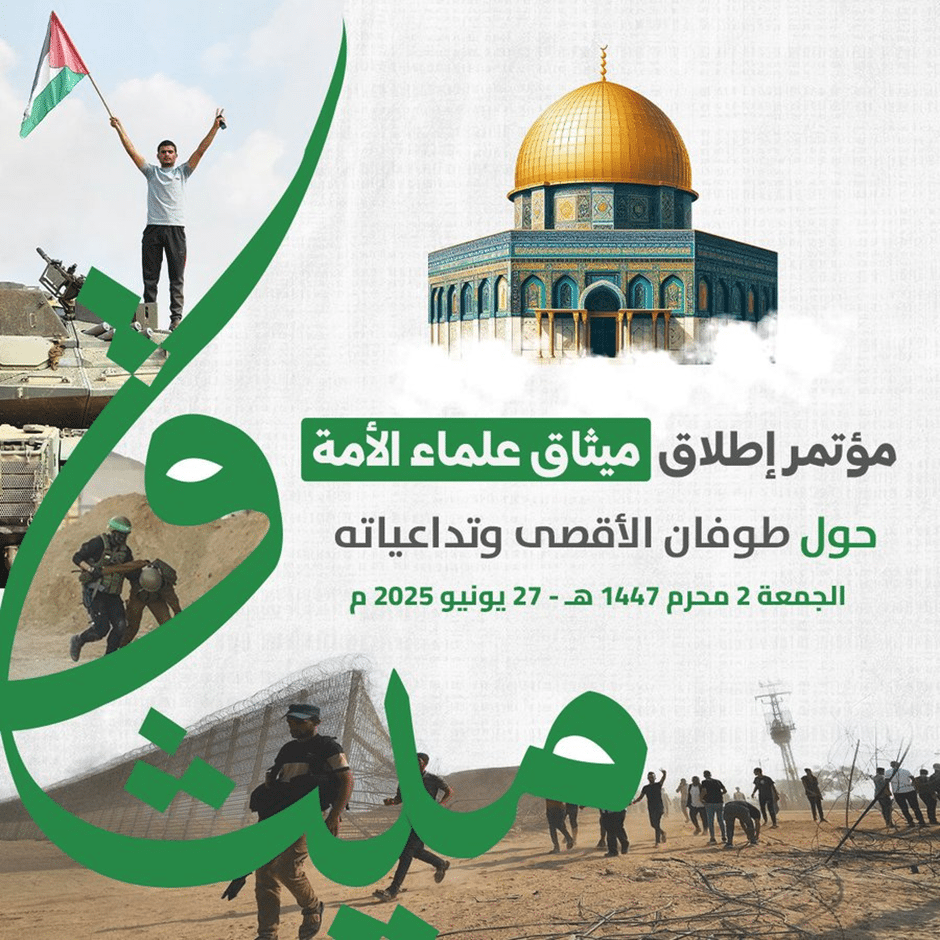
Roughly a month ago, the Global Union of Senior Muslim Clerics met in Turkey and released the "Charter of the Islamic Nation's Religious Scholars regarding the Al-Aqsa Flood and Its Implications". This was the religious Muslim world's first major statement on the October 7 massacre, following nearly two years without a definitive moral stance on the horrors perpetrated against innocents in the name of Islam. Far from condemning the acts, 350 clerics assembled to grant "religious legitimacy" to the massacre. They classified it as "defensive jihad," an integral part of the duty of jihad wars for Muslim organizations and individuals, and dismissed calls to disarm Hamas.
Turkey's role as host is expected – it is a bastion of the Muslim Brotherhood and a key player in the axis of resistance. More surprising is Turkey's recent participation in a UN conference in New York aimed at advancing a "two-state solution." Held on July 28-29, the conference stemmed from a UN General Assembly decision on December 3, 2024, which formed eight working groups, each co-led by a European and a non-European nation, often Arab.
Following an "extensive consultation round" with UN member states and civil society, the groups were charged with "outlining a practical framework to promote the two-state solution." In classic colonial fashion, European representatives sit and (presume to) determine the Jewish state's fate. The groups included: "A sovereign, unified Palestinian state coexisting with Israel," led by Spain and Jordan; "Security for Israelis and Palestinians," overseen by Indonesia and Italy; "A peace narrative," guided by Canada, Mexico, and Qatar; and "Safeguarding the two-state solution," led by Ireland and Turkey.
Israeli civil society groups took part in the conference preparations, their presence intended to give the illusion of Israeli involvement in shaping the path. In truth, these Israeli representatives adopted the Hamas and pro-Hamas European narrative as early as October 8, demanding an end to the war and fully endorsing the genocide and starvation campaign. Like the participating countries, they regard the current government as illegitimate, expecting its imminent collapse and replacement with a more pliable one.
Qatar took a prominent role in the conference, engaging in its typical double-dealing. Beyond long-term hosting of senior Hamas figures, Qatar spearheads the starvation campaign, which covertly aims to pressure Israel into stopping the war and leaving Hamas in charge of Gaza. Despite unwavering support for Hamas over the past two years, Qatar assumed the role of mediator between Israel and Hamas soon after the massacre. Thus, it opposes disarming or dissolving Hamas while simultaneously advocating for Palestinian Authority governance in Gaza. Europe eagerly embraces this duplicity.
In practice, the "day after" appears more distant than ever. The global pro-Palestinian narrative opposes the two-state solution, advocating for a single Muslim "Palestine" from the river to the sea. Hamas' rhetoric is echoed by human rights activists, disconnected from the historical narrative of the Land of Israel and the Oslo Accords' framework. In Western imagination, this poses no contradiction. This same imagination shaped the Sykes-Picot Agreement after World War I, when European powers drew Middle Eastern borders without regard for the region's complex ethnic realities.
From the ruins of Middle Eastern states, this imagination fueled the emergence of numerous terrorist organizations, dooming the region to relentless cycles of violent bloodshed. It also underpinned Oslo – another grandiose Western-backed initiative, imposed far above the Israeli and Palestinian publics. The current conference's innovation lies in the participation of countries like Saudi Arabia, Qatar, and Turkey, which seek to promote a vision of Muslim imperialism across many regions, including the Middle East.


