

At the core, before we talk about refugees, territory, or the debate over a Palestinian state, what we are in is a religious war. It's not a pleasant message, but at least it's clear and unmistakable. There is no ambiguity. It was the same in the days of the Hasmoneans, when we were forced to abandon the Torah for the king's law, when Shabbat and kosher laws were banned. It was the same this week, during the Hanukkah massacre in Sydney, following more than 3,700 antisemitic incidents targeting Jews in Australia over the past two years. It was also the same on October 7, in the face of Hamas, Hezbollah, and Iran.
Anyone who reads the manifestos of Iran and its affiliates, and studies their religious texts, will discover that they are willing to tolerate us, under one condition: that we Islamize. The Islamic religious justification for annihilating the Jewish people, should we refuse, is drawn from an established religious doctrine. Some even believe that Allah allowed the State of Israel to be established in order to gather the Jews in one place and make their extermination easier.
The Simchat Torah massacre was the result of a distorted, radical interpretation of Islam. One doesn't need to be a religious scholar to see it. Just listen to the words of these Muslim Nazis, captured by their own bodycams before they slaughtered, raped, and burned men, women, the elderly, and children. Their actions were soaked in perverse religious rationalizations. It's what Naomi Shemer and her husband Mordechai Horowitz once described as: "The Arabs prefer their murders hot, wet, and steamy, and if they ever get the freedom to fully realize themselves, we'll miss the Germans' good, clean gas chambers."
The hostages and released captives repeatedly report how their captors tried to convert them. Just like in the Hanukkah story—"when the evil Greek kingdom stood against Your people Israel to make them forget Your Torah"—so too now. When the Muslim Nazis tried to erase their Jewish identity and force them to convert, the Jewish spirit awoke. Keith Siegel began reciting the Shema twice daily and saying the blessing over bread. Yarden Bibas told his captors he was born a Jew and would die a Jew. Agam Berger refused their demands to cook on Shabbat and swore to herself and to her people: "I have chosen the path of faith." Her friend Liri Elbag, who was also targeted for conversion, recreated the Passover Haggadah in illustrations because she was forbidden to write. Tami Breslavsky said her son Rom was beaten and humiliated after refusing to convert. So it was with others. In the darkness of the tunnels, the Hasmonean spirit radiated from the Jewish soul, breaking through to the surface when the hostages came home.
Even the supposedly "moderate" Palestinian Authority, whom the US insists on bringing back into Gaza after a few rounds in the spin room, is part of this religious war. For years now, and still today, the PA refuses to recognize Israel as a Jewish state and has rejected every demand to do so. "The authority will never recognize Israel as a Jewish state," Mahmoud Abbas once declared. "We said this in the past, and we're saying it again—we will never agree."
The PA also wants to turn back the clock, to bring millions of descendants of refugees here (the original refugees themselves are mostly no longer living); to reestablish an Arab-Muslim majority; to designate the land as Islamic waqf. Bottom line: The PA is no different from Hamas. Its route to the same goal is simply more convoluted and deceptive. Its basis, too, is religious.
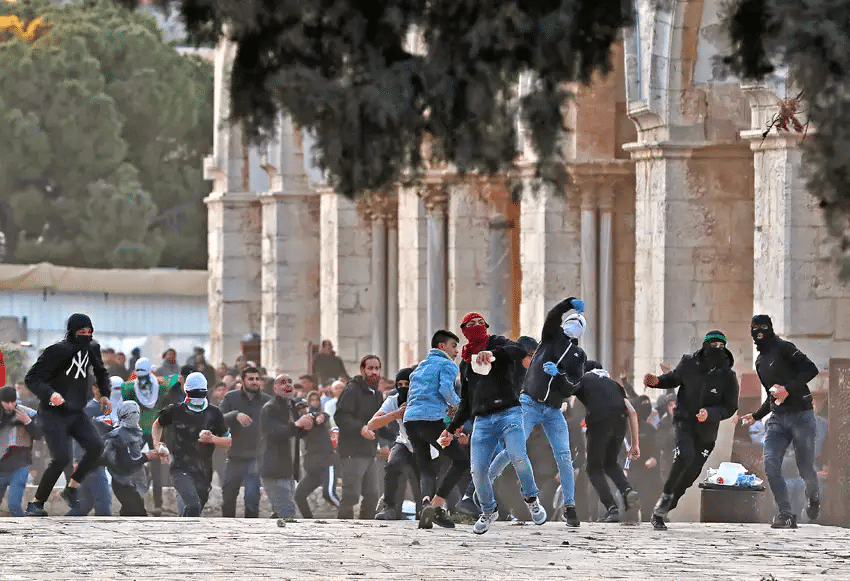
On October 7, Hamas sought to raise its flag over the Temple Mount, "to cleanse the Mount of the Jewish presence that defiles its Islamic character." That was the banner flown over the massacre. The operation's name—"Al-Aqsa Flood"—tells the story. For years, Israel tried to run from its past on the Temple Mount, pushing away Jews who wanted to pray there. It placed the menorah, symbol of the Hasmonean victory and the official emblem of the state, outside the Mount, facing the Knesset, not the mountain itself.
But those who flee from the mountain find the mountain pursuing them. Two years ago on Simchat Torah, Hamas marked its next target: the Temple Mount. And if Israel is serious about achieving a "total victory," then it must address this target too.
In Israel, even no, just as in Hasmonean times when the victory was realized on the Mount, the religious sentiment (as the late Uri Elitzur once explained) is a powerful political force. This is true for both Jews and Muslims. Anyone who denies this does not really understand modern politics.
The partial victory on the Temple Mount so far has come from the grassroots. It belongs entirely to the movement of Mount activists, who for decades have knocked on the locked gates of prayer and eventually opened them. Jews have been praying on the Mount for more than a decade now. Contrary to the predictions of security experts submitted to the courts, the sky did not fall. No world war broke out because of Jewish prayers. The Arab world, broadly speaking, has come to terms with it, even if it hasn't agreed.
Now it's time for the Israeli government to think about how it wants to see the Temple Mount, not just de facto but de jure. The claim that the status quo on the Mount hasn't changed is pure fiction. Muslims have turned the status quo on its head: They built three more mosques there, expanded prayer areas, restricted Jewish access and visitation times, destroyed archaeological remains from the Temple era, and turned the sacred compound into a hub of incitement, terror, and violence, a production line for attacks based on the false "Al-Aqsa is in danger" narrative. Hanukkah is a fitting time to lift more restrictions on Jews at the Mount, and, above all, to begin restoring Jewish prayer there through the front door, not by stealth or denial. This, too, is part of achieving a total victory.


