

The Jewish public in Israel overwhelmingly supports government policy to deport illegal Eritrean and Sudanese migrants, according to a poll published Wednesday by the Israel Democracy Institute, a non-profit dedicated to strengthening the foundations of Israeli democracy.
According to the organization's Peace Index, a monthly poll designed to gauge public trends, 66% of the Jewish public sides with the government decision in January to deport the illegal migrants.
Data from the poll rested on a sample of 600 Israelis questioned over two consecutive days in January.
The poll was conducted amid controversy surrounding the policy, which involves deporting illegal African migrants to third-party African countries, namely Rwanda. Many in the Israeli public have come out against the policy, with some even equating it to the Holocaust.
According to the poll, most of the Jewish public, specifically in the political Right, are unsympathetic to either the protests against the deportation or the comparison to Holocaust, adopting an anti-infiltrator attitude instead. Approximately half the Arab sector supported the plan and 37% opposed it.
Some 60% of those asked disagreed with the statement that "Israel as the state of the Jewish people, who suffered violence and persecution throughout history and sought refuge in various countries, must show greater generosity than other peoples and enable the asylum seekers to remain in Israel." Adhering to political divides, only a quarter of those who identify as right-wing agreed with the statement, compared to 78% who identified as left-wing.
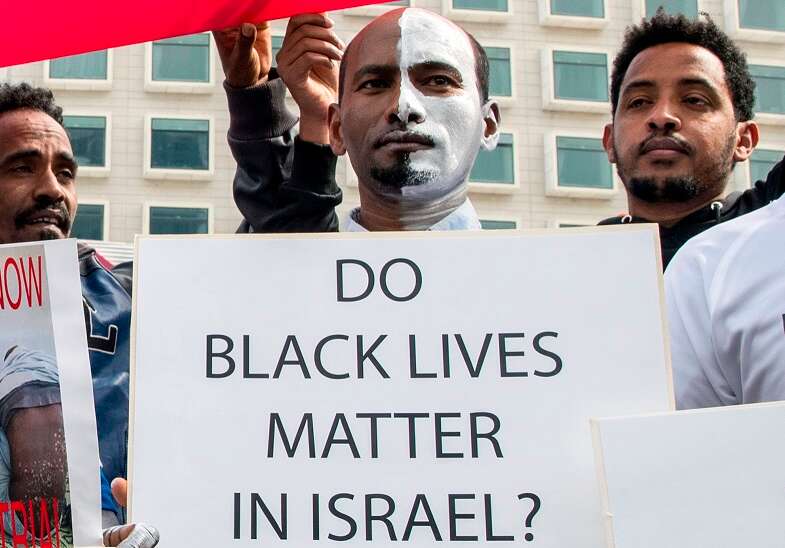
Meanwhile, thousands of African asylum seekers on Wednesday protested outside the Rwandan Embassy in Israel, calling on the African country not to cooperate with the Israeli plan to deport them.
Israel has given thousands of migrants in the country until April 1 to accept an offer to leave for an unnamed African destination – widely known to be Rwanda, based on testimonies of people who have already left – in exchange for $3,500 and a plane ticket. Those who choose not to leave face indefinite incarceration.
The protesters said the plan would put them in danger and said the deportations were racist. They urged Rwanda and its president, Paul Kagame, not to cooperate. Rwanda is one of Israel's closest African allies.
"Kagame – We are not for sale," said one banner. "Prison or Deportation? What would you choose?" said another. "Would you deport me if I was white?" said another, held by protesters with faces painted white.
Israel has 40,000 migrants, mostly from Eritrea and Sudan, who say they fled danger at home. Both countries have poor human rights records.
Israel contends that most of the migrants are job seekers and cites complaints that they have transformed working-class neighborhoods of south Tel Aviv into unrecognizable slums.
But the migrants and their supporters say those who have left have run into danger in Rwanda and Uganda, another destination country. They claim they have no rights in those countries, and quickly are forced to flee through war-torn countries like Sudan and Libya in hopes of making their way to Europe.
In a 2015 incident, a migrant who had left Israel was captured by Islamic State militants in Libya and decapitated.
The migrants say they do not want to settle in Israel, but want to remain as refugees until it is safe for them to return to their homelands.
"Deportation kills," the crowd chanted. "We are not criminals. We are refugees," they said.
Thousands of migrants entered Israel from neighboring Egypt until Israel completed a massive border fence to stop the flow. Since then, Israel has struggled to find a solution for those who had already entered the country.
The government says it has no obligation to take in migrants, and that it has taken steps to make sure they are not harmed. Women, children and families, for example, are exempt from the deportation order.


