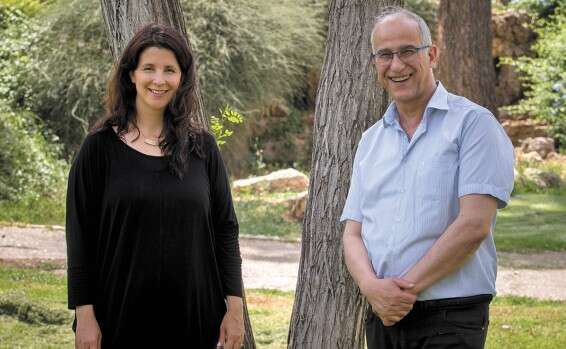
Throughout his 20s, Meir Buzaglo, then a doctoral candidate in philosophy who would later become a lecturer at the Hebrew University of Jerusalem, never observed Shabbat. When he was a little over 30, he embarked on postdoctoral studies at Harvard University. While there, he returned to the Shabbat observance of his childhood. Why there?
"The pressure and the intensity took over. I needed a break, a day when the world was 'dead,' there was no future, when I was in the present. Not necessarily in the sense of Jewish law. I decided that anything that contributed to my future was out of bounds. I didn't even allow myself to read philosophy, which is allowed on Shabbat," Buzaglo says in an interview to Israel Hayom.
Buzaglo is a social activist. He was one of the authors of the Kinneret Convention (a document from the Forum for National Responsibility that outlines what is needed to normalize the sometimes fractious relations between various Jewish sectors in Israel). He heads Tikkun, a movement for social renewal that is rooted in Jewish tradition. He is a founder of the Kedma nonprofit organization for social and educational equality. And he founded an institute to develop mathematics instruction. He does not wear a kippah. He follows tradition in a colorful, complex manner that is the total opposite of the dichotomous pattern Israelis are accustomed to – either 100% halachic observance or 100% secularism.
Dr. Ruth Kabbesa-Abramzon, chairwoman of the nonprofit group Shearim, which advocates for an Israeli form of Judaism, was influenced by Buzaglo's ideas and founded the Shabbat Unplugged initiative with support from the Avi Chai Foundation. Buzaglo brought the foundation on board. Abramzon was raised in a traditional Mizrahi Jewish home where the television was turned off for the weekly kiddush and then turned on again. Since her marriage, she has observed Shabbat according to the strictures of Jewish law (Halachah): "I follow Halachah, but stay traditional. It's an approach to life," she says.
Buzaglo: "Categorizing people as religious/secular [only] curtails the Jewish experience. Everyone has lost their minds. We're regular Jews. Shabbat, brit milah [circumcision]. You don't need flags, hats, cults, socks to identify as Jews. "
This coming weekend has been designated a "Nationwide Shabbat Unplugged," and will feature 80 "Shabbat" activities, although not all meet the criteria spelled out in the Shulchan Aruch (a 16th-century compendium of Jewish law). These include nature hikes, musical get-togethers – albeit without loudspeakers – and community meals. What they have in common is that they pull people away from screens.
Abramzon: "Screen addiction isn't a [uniquely] Jewish or Israeli problem and it's being researched all over the world, including as part of the field of new diseases. Heads of pediatric departments at psychiatric hospitals are testifying to the link between the full capacity and addition to screens. Shabbat is a solution found in Jewish culture."
Q: So a family will adopt Shabbat Unplugged to see each other once a week without their noses glued to their phones, but ultimately you expect them to observe Shabbat.
Abramzon: "Not at all. … Everyone should stick to their own Shabbat, just as long as they give it meaning. I wasn't looking for a solution to the problem of smartphones, but rather how to make Shabbat accessible in ways other than challah and candles. Challah and candles are wonderful symbols that don't speak to everyone. We asked ourselves how to talk about Shabbat and get around the issues of shops being open on Shabbat, public transportation, everything that is causing a tear in our people. We discovered that Shabbat isn't a problem, it's a solution.
An environmental 'tish' in Yeroham
"Our idea is … to put aside the screens and connect to what is important to you. What you dream of being all week long and don't manage, because the phone pulls you in. If there are people for whom Shabbat means working in the garden or painting, that's not my business. I don't care if someone gets to a hike by car or by foot, rather that they connect to the beauty of nature and leave their phones behind. We're talking about a quiet Shabbat at home, where the meals take place without phones. So there's a place for couples, kids, books, hiking, and looking at the world when it isn't filtered through Facebook or Instagram. Our website features Shabbat ceremonies of different kinds. The discourse about observing Shabbat or desecrating it is of no interest to us," Abramzon clarifies.
Buzaglo says that "screens have made us into lonely people."
"People go for a family visit to the Kinneret and stay glued to their phones. Detaching once a week takes us out of ourselves and connects us to our family, to the community. Creates a table where there is an intergeneration conversation with the kid who's back from nursery school or the kid who's home from the army or the grandkids," he says.
Q: Personally, [as an observant Jew] what helps me detach from the addiction to the little screen [of the smartphone] is the tough Halachah. It's forbidden. So I don't touch my phone for the 25 straight hours of Shabbat. A secular person needs a lot more self-discipline to do that.
Abramzon: "True, but we aren't talking about 25 hours of being cut off, but rather instilling [different] norms for less time. While the family is eating Shabbat dinner, they put their phones to the side. When you're on a hike, leave the phone in the car. We aren't a religious organization that waves the beauty of a religious Shabbat in the face of the secular. Secular people have and will have a secular Shabbat, and our goal is to help differentiate it from the rest of the week."
Buzaglo: "In Israel, we've managed to change norms on recycling and protecting wildflowers. Our time is valuable, as well. Shabbat isn't a day for finishing everything you didn't get done during the 24/7 race the rest of the week. It's about my ability as a person, as a family man, as a member of Israeli society, to accept responsibility for my time. To decide on whether to give into temptation. If you want to go to the mall, go, but do it consciously."
Shabbat Unplugged has declared a war on routine, on the constant availability expected of us, on the screens that eat away at our ability to detach, rest, and enjoy a break. Every year, Unplugged gives out grants to about 30 Israeli organizations that encourage people to tear themselves away from their screens and organize Shabbat activities – from an environmental tish (traditional festive meal) in Yeroham to Shabbat meals for students at Tel-Hai College, to Kabbalat Shabbat ceremonies with the LGBTQ community in Beersheba. Big, well-established organizations like the Society for the Protection of Nature in Israel, the Israel Association of Community Centers Ltd., BINA – the Jewish Movement for Social Change, as well as religious groups like "Or Torah Stone" also enjoy support from Shabbat Unplugged.
Not trying to change the majority
Abramzon cites a passage of midrash I hadn't known that describes Shabbat not as the end of a week or the beginning of a week – the Shabbat that preceded the Creation or the Shabbat at end of the six days of Creation – but as the middle of the week, preceded by three days and followed by three days. Shabbat represents a social and psychological center of gravity.
The staff at Shabbat Unplugged are representative of the project's goals. The content manager is a religious Jew who lives in a mixed religious/secular community; the educational director is a formerly observant woman who lives with a traditional partner; the marketing director is an atheist, secular Jews; the head of member organizations is an observant woman married to a secular man; and the office manager is traditional but still keeps Shabbat.
The initiative launched in June 2016, when social media was already the No. 1 time waster and cellphones were putting up invisible walls in homes – between children and their parents and between husbands and wives. One of the first people to talk about the idea of "unplugging" was Jewish American businesswoman Randi Zuckerberg, the sister of Facebook founder Mark Zuckerberg. Ms. Zuckerberg wrote a book in which she suggests that everyone adopt the Jewish Shabbat. It made waves.
Her book was followed by the emergence of Reboot, a Jewish American organization that urges people to emulate Jewish thinking and turn off their phones one day a week. Even Vogue ran an article urging readers from all backgrounds to "celebrate Shabbat." One of the founders of the online news outlet Huffington Post, a gentile, wrote about the wonders of Shabbat. U.S. Senator Joe Lieberman wrote a book titled "The Gift of Rest: Rediscovering the Beauty of the Sabbath" that was disseminated by ministers who liked the idea of Shabbat as a way of confronting the cellular curse.
Q: Have we become a 'light unto nations' before seeing the light ourselves?
Both Buzaglo and Abramzon smile bitterly.
"This is a global story about cultural change, and here [in Israel] we're fighting about buses [operating on Shabbat]," Buzaglo says.
"In Israel, it's hard to talk about Shabbat, because everything is colored by political significance and demographic fears. It isn't just another hobby. It's a question about what kind of country we want. It has to do with our grandparents, with their rebellion [against tradition]. But we founded a state and now it's time to take responsibility and update Judaism," Buzaglo adds.
Q: You both observe Shabbat, but people drive to your activities.
Abramzon: "We are faithful to the traditional Shabbat, but Halachah is not the language of most of the people in Israel, and we have no desire to change them. The content of our events isn't religious, it's Jewish. We don't talk to children over their parents' heads in an attempt to bring them back into the fold, and on the other hand, we don't do anything that keeps religious kids from coming."
At the end of the interview, they remind me of Rabbi Nahman of Breslov's story about a prince who was walking in a park where everyone is insane. The prince comes across a picture, and a man standing and looking at it calms down. The constant noise between our ears is the result of pressure created by a device the size of our palm, which is the park of the insane. The picture that calmed the man down, Buzaglo and Abramzon say, is Shabbat.